

The fastest way to raise your savings rate is to automate a transfer the day you get paid, then bank every raise and ended payment straight into that account instead of your checking account. Beyond that, switch to a high-yield savings account, kill your three biggest recurring expenses before touching small ones, pay off high-interest debt first, and add any side income directly to savings. Small, steady increases beat a dramatic one-month sprint that burns out by March.
TL;DR:
- Automating a transfer immediately after payday is the highest-impact habit, as it removes the need for willpower and ensures consistent savings.
- Prioritizing the reduction of housing, transportation, or food costs yields larger savings than micro-cuts, making structural adjustments more effective.
- Fully capturing employer 401(k) matches is crucial, as it provides an instant return and should be done before increasing other savings contributions.
- Paying off high-interest debt first generally produces a better overall financial return than keeping cash in low-yield savings accounts.
- Incrementally increasing automated transfer amounts by 1% with each raise, aligned with a savings escalator, significantly boosts savings over time.
Table of Contents
- How Do You Actually Increase Your Savings Rate?
- What Is Your Current Savings Rate, and Where Is It Leaking?
- How Do You Automate Savings Without Feeling the Pinch?
- Why the “Big Three” Matter More Than Skipping Coffee
- Should You Chase a Raise or a Side Gig First?
- Where Should You Actually Keep Your Savings?
- Should You Pay Off Debt or Save First?
- A 90-Day Plan to Raise Your Savings Rate Steadily
- What’s the Simplest Path to a Higher Savings Rate?
- Why Willpower Isn’t the Problem, Your Defaults Are
- Discretionary vs. Non-Discretionary: Where the Real Room Is
- How Do Tax-Advantaged Accounts Fit Into a Higher Savings Rate?
- The Overlooked Truth About Raising Your Savings Rate
- Sources
How Do You Actually Increase Your Savings Rate?
You don’t need ten strategies running at once. You need one or two that fit your paycheck schedule, executed without fail for 90 days. Here are the eight moves that move the needle the most, ranked by effort versus payoff.
- Automate the transfer first. Set a recurring transfer for the morning after payday, before you can spend the money. This is the single highest-leverage habit, according to Better Money Habits, because it removes the decision entirely.
- Move idle cash to a high-yield savings account (HYSA). If your money sits in a checking account paying near zero, you’re leaving free interest on the table every month.
- Cut one of the “Big Three” expenses. Housing, transportation, or food. One renegotiated bill beats 20 skipped lattes.
- Pay off high-interest debt before parking cash elsewhere. A credit card at 22% APR guarantees a better “return” than almost any savings vehicle.
- Redirect ended payments immediately. Car loan paid off? Daycare tuition ended? Move that exact dollar amount to savings in the same month.
- Capture your full employer 401(k) match. It’s compensation you’re otherwise declining to collect.
- Add a savings escalator. Increase your automated transfer by 1% every time you get a raise.
- Build a starter emergency fund before optimizing anything else. Even $500 to $1,000 stops a small setback from becoming new debt.
Pick two. Set them up this week. Everything below explains how.
What Is Your Current Savings Rate, and Where Is It Leaking?
Your savings rate is the percentage of your gross or net income you set aside each month, not what’s left over after spending. The formula: Savings Rate = (Total Saved ÷ Total Income) × 100. If you take home $4,500 a month and save $450, your savings rate is 10%. Most people who feel like they’re “trying hard” have never actually calculated this number, which is why tracking it visibly tends to change behavior almost immediately.
Here’s how to find your real number and spot the leaks in it:
- Pull three months of transactions from your bank or a budgeting app. A guide to tracking spending fast walks through the fastest setup if you’re starting from zero.
- Total everything you actually saved across savings accounts, retirement contributions, and extra debt payments beyond the minimum.
- Divide by gross income for the standard version, or net income if you want a more conservative, spendable-cash number. Use the same method every month.
- Scan subscriptions and recurring charges first. These are the easiest leaks to miss because they don’t feel like a decision each month.
- Run a two-week no-spend experiment on one category only (dining out, for example) to see how much slack actually exists before you assume you have none.
A spreadsheet works fine. So does any app that exports a CSV. The tool matters less than checking the number every single month.
How Do You Automate Savings Without Feeling the Pinch?
Automation works because it removes willpower from the equation entirely. Here’s the setup:
- Open a separate savings account the money can’t easily bleed back into your checking account. Out of sight genuinely means out of mind.
- Schedule the transfer for one to two days after payday, not on payday itself, to avoid bounced automatic bills.
- Start at whatever percentage doesn’t hurt. Even 5% is a real starting point.
- Increase employer 401(k) contributions the same way, most plans let you set automatic annual increases directly in the portal.
- Set a calendar reminder every six months to bump the transfer amount, in case your plan doesn’t support auto-escalation.
This scheduled bump is called a savings escalator, and it works because a 1% increase is nearly invisible in your paycheck but compounds into a meaningfully higher rate over a few years. A breakdown of automating your finances in one afternoon covers the exact account rules to set up in one sitting.
Pro Tip: Time your escalator to your raise, not the calendar. You’ll never miss money you never saw hit your checking account.
Why the “Big Three” Matter More Than Skipping Coffee
Housing, transportation, and food consume a large majority of most household budgets, which means a single win here dwarfs a dozen small ones. Cutting your daily coffee saves maybe $100 a month. Refinancing a car loan or negotiating rent can save that in a single transaction, then keep saving it every month after.
The math is blunt: trimming $5 a week from a subscription saves $260 a year. That’s why structural changes to housing, transport, and food consistently outperform micro-cuts.
Concrete levers worth checking, in order of typical payoff:
- Refinance or renegotiate your loan terms if rates have dropped since you signed, a call to a lender or a service like Lending Gurus can clarify whether refinancing makes sense before you commit.
- Review your insurance bundle annually. Auto and home insurance rates drift, and loyalty rarely gets rewarded with a lower bill.
- Meal plan around what’s already in your pantry one week a month, rather than overhauling your entire grocery routine at once.
- Weigh downsizing tradeoffs honestly. A smaller apartment or one fewer car sounds drastic, but run the actual numbers before dismissing it.
Pick whichever of the three (housing, transport, food) has the most obvious slack, and start there.
Should You Chase a Raise or a Side Gig First?
Both, but in a specific order. Employer retirement matching comes first because it’s the only “investment” that pays an instant, guaranteed return. If your employer matches 50% up to 6% of your salary and you’re contributing less than that, you’re turning down free money, a priority government financial guidance consistently reinforces ahead of nearly every other savings goal except high-interest debt.
After the match, handle raises and bonuses the same way every time:
- Redirect the entire raise to savings the same pay period it takes effect. Don’t let it touch your regular spending first.
- Send bonuses straight to your emergency fund or debt payoff, not toward a purchase you were already eyeing.
- Choose side income with a strong time-to-pay ratio (freelance skills you already have beat low-wage gig work that eats evenings for little return).
- Set an automatic rule that 100% of side income goes to savings, since it wasn’t part of your baseline budget anyway.
This is also where avoiding lifestyle creep matters most. A guide on avoiding lifestyle creep covers why raises tend to vanish into subtle spending bumps within a few months if you don’t redirect them immediately.
Where Should You Actually Keep Your Savings?
Not all savings accounts pull equal weight. A high-yield savings account (HYSA) typically pays several times more interest than a traditional bank savings account, with no lockup and no added risk for money you might need within a year or two. Short-term CDs can edge out HYSA rates slightly if you’re confident you won’t need the cash, and brokerage cash sweep accounts sometimes compete too, but liquidity matters more than an extra fraction of a percent for an emergency fund.
- Use a HYSA for anything you might need within 12 to 24 months.
- Verify your bank is FDIC insured or, for credit unions, confirm NCUA coverage directly before parking a large balance anywhere new.
- Reserve CDs for money you’re certain you won’t touch before the term ends, since early withdrawal penalties erase the benefit.
- Check current inflation data like the CPI series from the Federal Reserve when comparing a HYSA’s advertised yield to your real, after-inflation return.
A concrete example: $10,000 sitting at 0.4% in a standard checking account earns $40 a year. The same $10,000 in a competitive HYSA can earn several times that, with the same federal insurance protection. An emergency fund planning guide covers how much to hold and which account types make sense at different savings stages.
Should You Pay Off Debt or Save First?
If your debt’s interest rate is higher than what any savings account realistically pays, and that includes almost all credit cards, pay the debt first.
The one exception: keep a starter emergency fund of $500 to $1,000 even while attacking debt, so one flat tire doesn’t become new credit card debt.
- Use the avalanche method (highest interest rate first) if you want the mathematically optimal payoff and can stay motivated without quick wins.
- Use the snowball method (smallest balance first) if you need visible progress to stay consistent, most people do better with momentum than with pure math.
- Consider consolidating or refinancing high-interest balances into a lower fixed rate, but check the new rate, term length, and any origination fees before signing anything.
Once high-interest debt is gone, redirect that entire payment amount straight into savings. It’s the cleanest rate increase available.
A 90-Day Plan to Raise Your Savings Rate Steadily
You don’t need to fix everything at once. Pick three moves and track them weekly.
- Days 1 to 30: Calculate your current savings rate, automate one transfer, and open a HYSA if you haven’t already.
- Days 31 to 60: Tackle one Big Three expense (renegotiate, refinance, or meal plan) and redirect any ended payment to savings.
- Days 61 to 90: Recalculate your savings rate, increase your automated transfer by 1 to 2%, and confirm your emergency fund covers at least one month of essentials.
Check progress weekly with a two-minute balance glance, and check the actual rate monthly using the formula above. Only raise your automated amount once a change has felt painless for at least two full paychecks.
Pro Tip: *Don’t chase a dramatic one-month savings spike.
What’s the Simplest Path to a Higher Savings Rate?
Three things matter more than everything else combined: automate the transfer, fix one Big Three expense, and redirect every raise or ended payment the moment it happens. Start with whichever of the three you can set up in the next 15 minutes.
- This week: automate one transfer and calculate your actual savings rate.
- This month: tackle one housing, transport, or food expense.
- This quarter: add a 1 to 2% escalator and confirm your emergency fund is fully funded.
For deeper habit work, guides on boosting savings with 12 first moves and avoiding lifestyle creep build directly on this plan.
Why Willpower Isn’t the Problem, Your Defaults Are
People rarely fail to save because they lack discipline. They fail because their financial defaults work against them, and behavioral economics has a name for most of the culprits. Present bias makes a $50 dinner tonight feel more real than $50 compounding for retirement. Lifestyle creep quietly absorbs raises into slightly nicer everything until the raise disappears without a single deliberate purchase. Loss aversion makes canceling a subscription feel like a loss even when the alternative, that money sitting in a HYSA, is a bigger win you simply don’t feel as vividly.
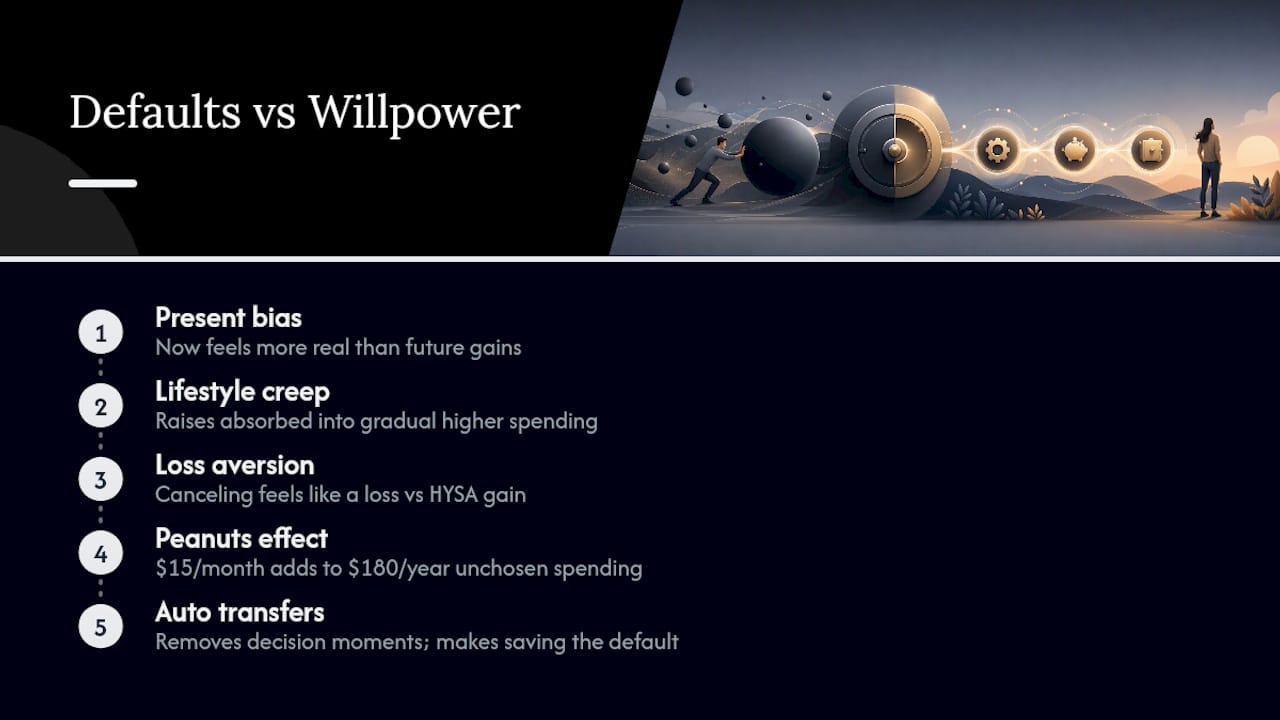
The fix isn’t more motivation. It’s redesigning the default so the easy choice is also the correct one. Automating a transfer works precisely because it removes the moment of decision where present bias usually wins. Even the act of calculating your savings rate monthly counters a bias called the “peanuts effect,” where small recurring costs feel too trivial to matter individually, even though $15 a month in forgotten subscriptions adds up to $180 a year you never chose to spend.
None of this requires more self-control. It requires fewer moments where self-control is even needed.
Discretionary vs. Non-Discretionary: Where the Real Room Is
Non-discretionary spending, rent, minimum debt payments, utilities, insurance, is fixed in the short term but often negotiable over a longer horizon. Discretionary spending, dining out, entertainment, impulse shopping, feels flexible day to day but rarely gets touched because it’s spread across dozens of small purchases instead of one visible bill.
The mistake most people make is attacking discretionary spending first because it feels like the obvious target, then giving up because the cuts are too small to notice. Flip the order. Review your non-discretionary spending once a year for renegotiation opportunities (insurance, loan refinancing, a cheaper phone plan), and treat discretionary spending as a monthly dial you adjust based on how the month is going, not a category you eliminate entirely.
A practical split: track discretionary spending weekly since it moves fast, and review non-discretionary spending quarterly since it moves slowly but has bigger single-line impact. That’s also more sustainable, since a budget with zero discretionary spending rarely survives contact with a birthday, a holiday, or a bad week.
How Do Tax-Advantaged Accounts Fit Into a Higher Savings Rate?
A dollar saved in a 401(k) or a traditional IRA effectively goes further than the same dollar saved in a regular account, because it reduces your taxable income now, in exchange for taxes owed on withdrawal later. A Roth IRA flips that: you pay taxes today, then withdraw tax free in retirement, which tends to favor people who expect to be in a higher tax bracket later in life.
For most people building their savings rate, the order looks like this:
- Contribute enough to your 401(k) to capture the full employer match. This is the highest guaranteed return available, a point government savings guidance treats as close to a universal recommendation.
- Fund an IRA (Roth or traditional, depending on your current versus expected future tax bracket) once the match is secured.
- Increase 401(k) contributions gradually, ideally using the same auto-escalation feature most plans offer.
- Keep short-term emergency savings separate from retirement accounts entirely, since early retirement withdrawals usually carry penalties.
Tax-advantaged accounts don’t just raise your net worth, they raise your effective savings rate by shrinking the tax bill you’d otherwise pay on that income. Once your retirement contributions are on autopilot, any extra savings capacity can go toward brokerage investing, where a tool like StockPilot can help you think through allocation for money you’ve already decided you don’t need short term.
The Overlooked Truth About Raising Your Savings Rate
Most advice on this topic obsesses over discipline, as if the people struggling to save simply need more resolve. That’s backwards. The people with the highest savings rates I’ve seen described in financial research aren’t more disciplined day to day, they’ve just removed more decisions from their own hands. Automation isn’t a workaround for weak willpower. It’s an acknowledgment that willpower is a finite, unreliable resource that shouldn’t be spent on a decision you can make once and never revisit.
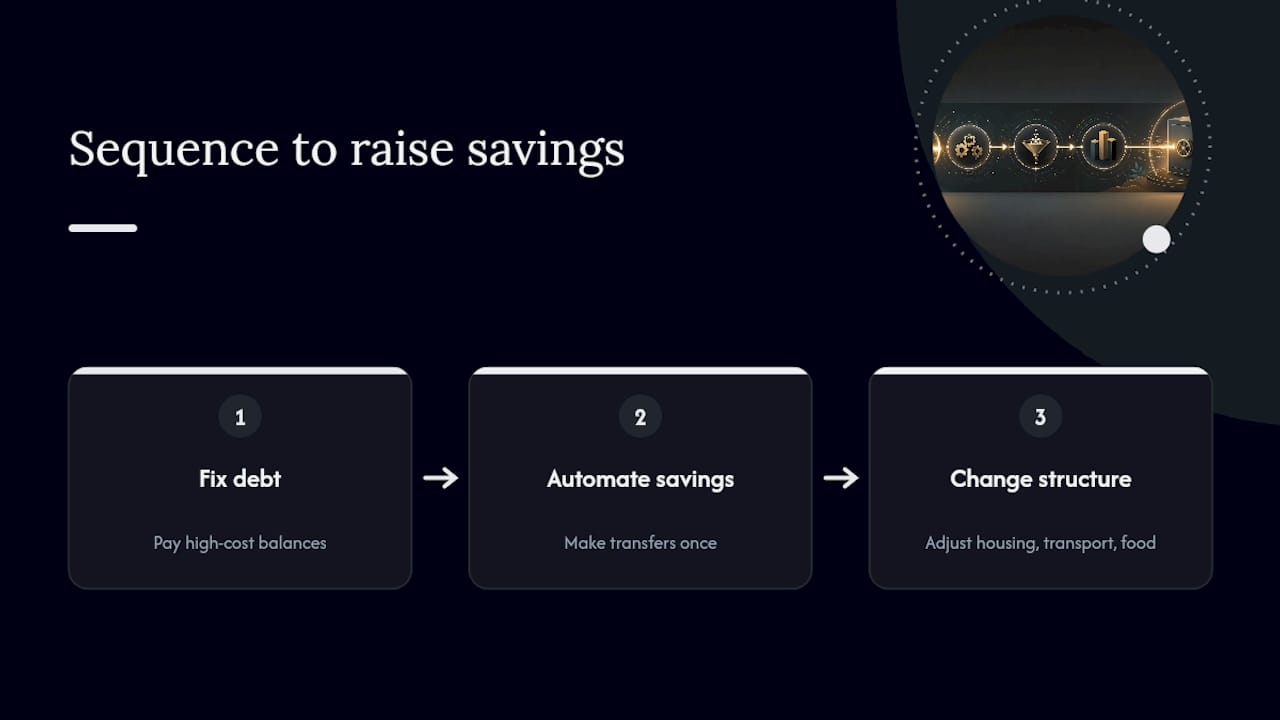
The other overlooked piece is sequencing. Fix the expensive debt first, automate second, then let structural expense changes (housing, transport, food) do the heavy lifting instead of a dozen tiny cuts that erode your motivation faster than they build your balance. Readers who want the habit layer underneath this plan should look at Finblog’s guide on increasing savings through first moves, which pairs well with the sequencing laid out here.
A sustainable savings rate isn’t built in a single heroic month. It’s built by making the boring choice automatic, so the hard choice never has to be made twice.
— Povilas
This article is general information, not a substitute for advice from a qualified financial advisor. Consult a qualified financial professional about your own circumstances before acting on anything here.