

The most reliable way to protect your assets is a layered plan built before any creditor comes knocking: adequate insurance, correct account titling and exemptions, the right business entities, and trusts where they fit. Timing decides whether that plan holds up in court. Coordinate it with an insurance agent, attorney, and tax advisor rather than assembling it piecemeal.
TL;DR:
- Insurance should be your first and most affordable layer, with umbrella policies matched to your net worth to fill coverage gaps.
- Properly maintained business entities like LLCs protect personal assets, but mixing personal and business finances can nullify this shield.
- Trusts, especially domestic asset protection trusts, provide long-term shielding but must be funded years before any claim; late funding risks reverseability.
- Regularly review beneficiary designations, insurance limits, and legal exemptions at least once annually, especially after major life or property changes.
- Offshore trusts offer stronger creditor protection but are costly and complex, making them suitable only for high-net-worth individuals with ongoing litigation risks.
Table of Contents
- How Do You Protect Your Assets With a Layered Strategy?
- What Insurance Do You Need Before Anything Else?
- Do Business Entities Really Protect Your Personal Assets?
- Are Trusts Worth the Complexity for Asset Protection?
- What Assets Are Already Protected Without Doing Anything?
- What Legal Risks Can Undo Your Asset Protection Plan?
- What Should You Do in the Next 90 Days?
- Finblog’s Take on Building a Protection Plan That Lasts
- How Do You Protect Cryptocurrency and Other Digital Assets?
- What Mistakes Undermine Even a Good Asset Protection Plan?
- How Much Should Asset Protection Cost You Each Year?
- How Often Should You Review and Update Your Protection Plan?
- Should You Consider Offshore Trusts and International Jurisdictions?
- Keep It Simple, and Keep It Current
- Get Practical Guidance From Finblog on Protecting What You’ve Built
- Sources
How Do You Protect Your Assets With a Layered Strategy?
Think of asset protection as concentric rings, not a single wall. Each layer catches what the one before it misses, and the order matters: insurance absorbs the first hit, titling and exemptions shelter what’s already protected by law, entities separate business risk from personal wealth, and trusts handle what’s left for long-term, high-net-worth exposure.
That structure exists because Investopedia’s guidance on shielding wealth from creditors makes clear that obstacles, not guarantees, are the realistic goal. No layer is bulletproof on its own. A landlord with one rental property might stop at insurance and an LLC. A surgeon with a high malpractice exposure and seven-figure savings needs insurance, entity separation, and probably a trust.
The layers, roughly in the order most planners build them:
- Insurance absorbs claims first, before any lawsuit touches your personal balance sheet.
- Titling and exemptions protect what state and federal law already shields, often at zero cost.
- Business entities separate operational risk from personal wealth, when maintained correctly.
- Trusts handle long-term or high-value exposure that insurance and entities can’t fully cover.
Every one of these varies by state and by asset type. A homestead exemption that protects a house in Florida might do almost nothing in a state with a low cap. Fidelity’s five-step asset protection framework starts with assessing your actual exposure before choosing tools, and that sequencing is the right instinct: match the layer to the real risk, not to whatever sounds impressive at a dinner party.
What Insurance Do You Need Before Anything Else?
Insurance is the cheapest, fastest layer you can add, and it’s the one most people underfund. A standard homeowners or auto policy typically caps liability around $300,000 to $500,000. One serious car accident or a slip-and-fall on your property can blow past that in a single settlement.
An umbrella policy sits on top of your existing home and auto coverage and picks up where they stop, usually in $1 million increments. If you own rental property, sit on a nonprofit board, or coach a kids’ sports team on weekends, you have exposure your base policies were never designed to cover.
Business owners need a second layer entirely:
- General liability covers third-party injury or property damage tied to normal operations.
- Professional liability (errors and omissions) covers claims that your advice or service caused financial harm, essential for consultants, agents, and anyone selling expertise.
- Directors and officers coverage protects board members and executives from personal liability tied to company decisions.
- Specialty riders cover high-value items like jewelry, art, or collectibles that standard policies undervalue or exclude.
Pro Tip: Match your umbrella limit to your net worth, not to what feels “enough.” If you’re worth $2 million on paper, a $1 million umbrella leaves half of it exposed.
The most common gap isn’t missing a policy. It’s a policy that hasn’t been updated since a home renovation, a new rental purchase, or a business expansion changed the real exposure underneath it.
Do Business Entities Really Protect Your Personal Assets?
An LLC or corporation separates business liabilities from personal ones, but only if you treat the entity as genuinely separate. A creditor suing your business generally can’t reach your personal home or savings, and in most states, a personal creditor suing you can’t seize your LLC outright. They’re often limited to a charging order, a lien on distributions rather than a forced sale of the business itself.
That protection collapses the moment courts find you’ve been treating the entity as an extension of yourself. This is called piercing the corporate veil, and a practical breakdown of how veil piercing actually happens shows the pattern is almost always the same: mixed personal and business funds, missing corporate records, or an owner who never bothered with formalities.
Here’s what keeps the shield intact:
- Open a dedicated business bank account and never pay personal expenses from it, even “just this once.”
- Hold annual meetings and keep minutes, even for a single-member LLC where it feels unnecessary.
- Sign contracts in the entity’s name, not your own, and make sure vendors and clients know who they’re dealing with.
- Keep the entity adequately capitalized rather than running it on fumes that invite a court to call it a sham.
- File separate tax returns and maintain separate books for every distinct entity you operate.
Real estate investors with multiple properties often use a Series LLC or separate LLCs for each property specifically so a lawsuit tied to one building can’t touch the others. If you’re running two or three ventures out of a single entity, that’s usually a sign you need to split them.
Are Trusts Worth the Complexity for Asset Protection?
A revocable living trust is excellent for avoiding probate, but it offers almost no asset protection because you retain full control over the assets, which means creditors can typically reach them too. Protection generally requires giving up some control, which is exactly why irrevocable trusts exist.
A Domestic Asset Protection Trust, available in states including Nevada, South Dakota, Wyoming, and Arizona, lets you remain a discretionary beneficiary of your own trust while shielding the assets inside it from most creditors. These states typically apply a two to four year statute of limitations after funding, meaning a creditor generally has to file a claim within that window or lose the ability to unwind the transfer. Fund the trust years before trouble, not months.
Other tools solve narrower problems:
- A Qualified Personal Residence Trust (QPRT) removes your home from your taxable estate while letting you live in it for a set term, useful for estate tax planning more than lawsuit defense.
- An Irrevocable Life Insurance Trust (ILIT) keeps life insurance proceeds outside your taxable estate and outside the reach of your creditors.
- Standard irrevocable trusts can hold business interests or investment accounts, trading your control for real creditor protection.
Brown Advisory’s layered planning framework treats trusts as one component among several, not the whole plan, and that’s the right mindset. Trusts carry legal fees, ongoing administration, and tax filings. They’re worth it for significant, exposed wealth. They’re overkill for a young family with a modest 401(k) and a mortgage.
What Assets Are Already Protected Without Doing Anything?
Before you build anything new, check what the law already shields. Federal law generally protects ERISA-qualified retirement accounts like 401(k)s from most creditors in bankruptcy. IRAs get similar protection under federal bankruptcy exemptions, though the exact dollar cap adjusts periodically and varies by account type. Life insurance cash value and death benefits are exempt from creditors in many states, sometimes fully.
Homestead exemptions protect a portion of home equity, but the amount swings wildly by state, from a few thousand dollars to unlimited protection in a handful of states. Bob Carlson’s advice on simple, effective protection points out that intentionally maintaining a mortgage on a home, rather than rushing to pay it off, can actually reduce the equity a creditor could reach.
Run these checks now, before you spend a dollar on anything more complex:
- Confirm every retirement account and life insurance policy has a named beneficiary, not just “estate” by default.
- Check how your home, cars, and investment accounts are titled, and whether joint ownership helps or hurts your situation.
- Verify your state’s homestead exemption cap and whether your equity exceeds it.
These fixes cost nothing but a phone call or a form. That’s exactly why they’re the first place to look.
What Legal Risks Can Undo Your Asset Protection Plan?
Timing is the single biggest failure point in asset protection, and it has nothing to do with which tools you pick. The Uniform Voidable Transactions Act, adopted in most states, lets a court reverse any transfer made to hinder, delay, or defraud a creditor, regardless of how legitimate the paperwork looks.
Courts look for “badges of fraud” rather than a signed confession of bad intent. A breakdown of how the UVTA threatens late planning lists the classic red flags:
- Transferring assets to family members or trusts shortly after being sued or threatened with a claim.
- Retaining hidden control or benefit over an asset you supposedly transferred away.
- Transferring for far less than fair value, or receiving nothing at all in return.
- Becoming insolvent immediately after the transfer.
Move assets into a trust or LLC after a demand letter arrives, and there is a real chance a court unwinds the transfer entirely, leaving you exposed anyway and having paid legal fees for nothing. Plan when things are calm, not when a process server is already looking for you. Beyond the reversal risk, expect real administrative weight: gift tax returns for irrevocable trust funding, annual entity filings, and trustee fees that continue whether or not you ever face a claim.
What Should You Do in the Next 90 Days?
Start with the cheapest, fastest fixes, then move to structural ones as your exposure and budget allow.
- Assess your actual exposure. List your net worth, your biggest liability risks (a rental property, a high-risk profession, a teenage driver), and which assets would hurt most to lose.
- Fix titling and beneficiaries this week. Confirm every account has a current beneficiary and check how your home and vehicles are titled.
- Call your insurance agent. Ask about umbrella coverage, professional liability if you’re self-employed, and whether your current limits still match your net worth.
- Document business formalities now if you already have an LLC: separate accounts, minutes, signed contracts in the entity’s name.
- Consult an attorney before forming anything new, especially a trust, since the wrong jurisdiction or timing can waste the effort entirely.
Pro Tip: When you talk to an attorney or tax advisor, ask specifically which layer addresses which risk, and what it costs annually to maintain, not just to set up. Advisors sometimes sell structure before establishing whether you need it.
Good questions for that first consultation: Which of my assets are already exempt under state law? Does my state recognize DAPTs, and would one actually help my situation? What’s the realistic annual cost of maintaining an entity or trust, including filings and advisor fees?
Finblog’s Take on Building a Protection Plan That Lasts
Asset protection succeeds or fails on sequencing, not sophistication. Forbes’s analysis of what asset protection actually accomplishes frames it correctly: the goal is raising the cost and uncertainty for a creditor, not achieving perfect immunity. Finblog’s own layered asset protection guide walks through how insurance, entities, and trusts interact in more detail than any single section here can cover.
Start with the cheap layers. Add complexity only when your exposure justifies it, and revisit the plan with your advisors at least once a year, since a new property, a new business line, or a move to a different state can quietly change what protects you.
How Do You Protect Cryptocurrency and Other Digital Assets?
Digital assets present a problem traditional asset protection tools weren’t built for: there’s no deed, no beneficiary form on file with a bank, and often no institution to subpoena. If you lose your private keys or a court doesn’t know an asset exists, standard legal remedies don’t apply cleanly.
Start with custody. Assets sitting on an exchange are technically controlled by that exchange, which means they’re vulnerable to the exchange’s own solvency problems, not just to your personal creditors. A hardware wallet or cold storage setup keeps private keys offline and under your direct control, separate from any single company’s balance sheet.

Titling matters here too, just differently than with a house or a bank account. Holding cryptocurrency through an LLC or trust can extend the same liability separation that applies to other business assets, provided you maintain the same operational discipline: separate wallets for business versus personal holdings, documented transfers, and no commingling.
Estate planning for digital assets needs its own layer as well. A will or trust that doesn’t specifically name and locate digital assets, along with instructions for accessing them, risks leaving a fortune permanently unreachable when you die. Several states have adopted versions of the Revised Uniform Fiduciary Access to Digital Assets Act, which lets you legally authorize a trustee or executor to access digital accounts, but only if your documents grant that permission explicitly.
For jewelry, art, or physical collectibles tied to a crypto-funded portfolio, dedicated storage and custody arrangements, such as those offered by specialty firms like StokdUp, can add a layer standard insurance riders don’t fully address.
What Mistakes Undermine Even a Good Asset Protection Plan?
The single most damaging mistake is waiting. People start planning after a demand letter arrives, when the UVTA and similar state statutes make nearly every transfer from that point forward vulnerable to reversal.
A close second is over-engineering. Bob Carlson’s guidance on defending an estate warns against reaching for complex, expensive structures when simple titling and exemption strategies would have done the job for far less money. An offshore trust costing $15,000 to set up and several thousand a year to maintain is wasted if a homestead exemption already covers the exposure.
Other recurring failures show up across nearly every plan that unravels in court:
- Treating an LLC as a formality instead of a discipline, then losing the shield entirely when a court pierces the veil over commingled funds.
- Forgetting to update beneficiary designations after a divorce, remarriage, or the birth of a child, which can send assets to an ex-spouse by default.
- Assuming one state’s exemptions travel with you after a move, when homestead caps and DAPT recognition vary sharply by state.
- Skipping insurance review after a major purchase, leaving a new rental property or expensive vehicle effectively uninsured against real exposure.
- Relying on verbal agreements in business dealings instead of signed contracts in the entity’s name.
Every one of these is fixable cheaply if caught early, and expensive or impossible to fix once a claim is already filed.
How Much Should Asset Protection Cost You Each Year?
Cost scales directly with complexity, and the jump between tiers is steep. Titling fixes and beneficiary updates cost nothing beyond your own time. An umbrella insurance policy typically runs a few hundred dollars a year for $1 million in coverage, making it the best return on investment in the entire plan.
Forming and maintaining an LLC involves state filing fees, which vary widely, plus annual report fees and registered agent costs if you use one. Budget for a modest annual accounting cost too, since separate entities usually mean separate bookkeeping and tax filings.
Trusts sit at the top of the cost curve. Setting up an irrevocable trust or DAPT typically involves attorney drafting fees, and ongoing costs include trustee fees if you use a professional trustee, plus tax preparation for the trust’s annual returns. None of this is optional maintenance you can skip once the paperwork is signed.
The mistake to avoid is comparing setup cost alone. A trust that’s cheap to create but expensive to administer for the next twenty years can cost more overall than a slightly pricier structure with lower ongoing fees. Ask any advisor for both numbers before committing: what does this cost to build, and what does it cost every year after that.
How Often Should You Review and Update Your Protection Plan?
An asset protection plan built in your thirties rarely still fits in your fifties. Review the whole structure at least once a year, and treat certain life events as automatic triggers for an off-schedule check.
A new property purchase, a business expansion, a marriage or divorce, a significant inheritance, or a move to a new state should each prompt an immediate review, not a wait-until-next-January approach. State exemptions, DAPT recognition, and even insurance requirements change the moment you cross a state line.
Build the review around a short checklist:
- Confirm beneficiary designations still match your current family situation.
- Verify insurance limits still reflect your current net worth, not last year’s.
- Check that business formalities (separate accounts, minutes, contracts) have been maintained consistently.
- Reconfirm your state’s exemption amounts, since legislatures adjust homestead and retirement account caps periodically.
Coordinate this review across your insurance agent, attorney, and tax advisor together rather than checking in with each separately, since a change that looks minor to one (a new rental property) can have ripple effects the others need to know about, like insurance gaps or entity restructuring needs.
Should You Consider Offshore Trusts and International Jurisdictions?
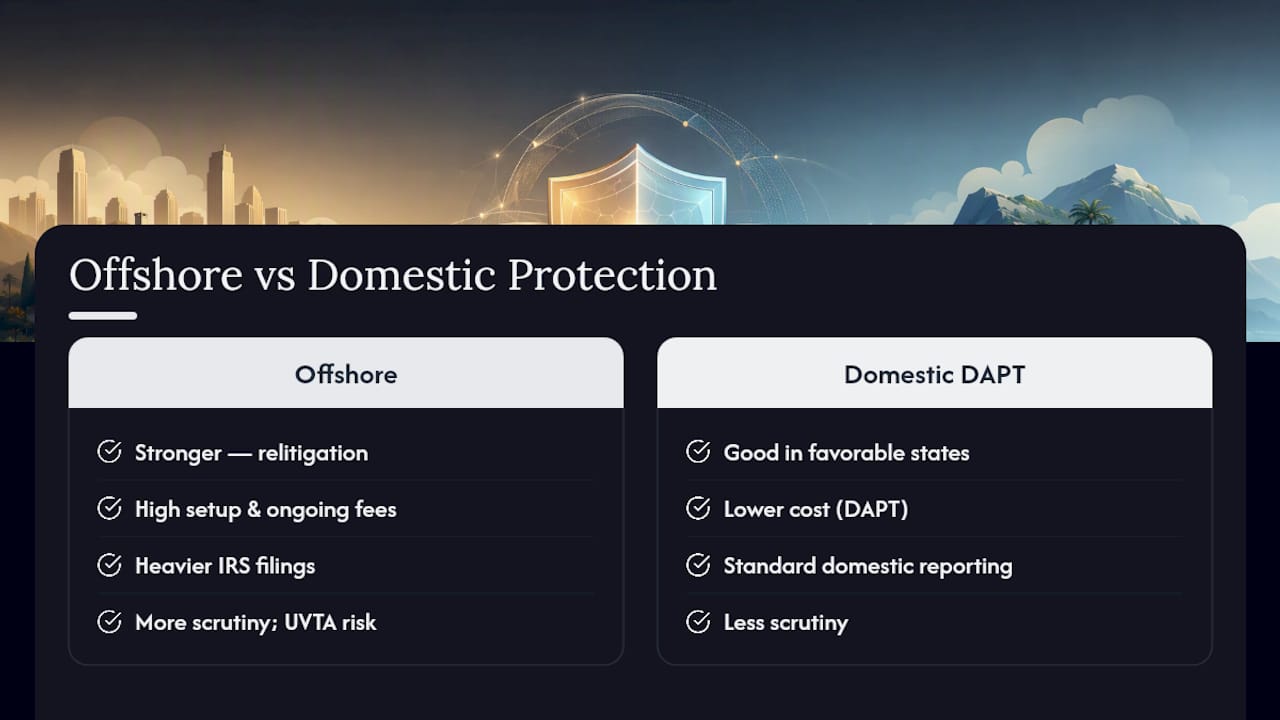
Offshore asset protection trusts, often established in jurisdictions like the Cook Islands or Nevis, offer stronger creditor protection than domestic trusts in some respects, mainly because foreign courts generally don’t have to honor a U.S. judgment automatically. A creditor often has to relitigate the entire case in the foreign jurisdiction, which is expensive and slow enough to discourage many claims.
That strength comes at a real cost. Offshore trusts typically run tens of thousands of dollars to establish and carry ongoing trustee and administration fees that dwarf a domestic DAPT. Reporting requirements are also significantly heavier: U.S. persons with interests in foreign trusts generally face additional IRS filing obligations, and failing to file them correctly can trigger substantial penalties regardless of whether the trust itself was properly funded.
Offshore planning also draws more scrutiny, not less. Courts and creditors’ attorneys are familiar with the structures, and the same UVTA timing rules apply with even more force. Funding an offshore trust after a lawsuit is filed is arguably worse than doing so domestically, since it can look like an attempt to place assets beyond the court’s reach entirely.
For most individuals and business owners, domestic tools, a DAPT in a favorable state, proper insurance, and disciplined entity use, solve the problem at a fraction of the cost. Offshore planning tends to make sense only for genuinely high net worth situations with significant, ongoing litigation exposure, and it should never be a first step. If you’re considering it, that consultation belongs with an attorney who specializes specifically in international asset protection, not a general estate planner.
Keep It Simple, and Keep It Current
Overcomplicating a plan is nearly as risky as ignoring one. Every extra trust or entity adds a filing deadline, a fee, and one more thing that can go wrong if you or your advisor forgets about it. The people I’ve seen get burned weren’t usually undersheltered. They’d built something elaborate years earlier, then stopped paying attention to it.
Build only the layers your actual exposure justifies, then put a recurring date on your calendar to revisit the plan with your advisors. A protection strategy that fit your life five years ago rarely fits it today.
— Povilas
Get Practical Guidance From Finblog on Protecting What You’ve Built
This resource focuses on the layer most people skip: the ongoing coordination between insurance, titling, entities, and trusts that keeps a protection plan actually working year after year, not just on the day it’s signed. That fits readers who don’t want a one-time fix but a plan that holds up as their income, property, and family situation change.
If this article left you wanting a deeper walk-through of how the pieces fit together for your specific situation, a wealth protection strategies guide breaks down the next-level detail, and a financial estate planning guide covers the trust and tax side in more depth. Consider signing up for a newsletter or submitting a consultation request to start mapping out which layers your situation actually needs.
This article is general information, not a substitute for advice from a qualified financial advisor. Consult a qualified financial professional about your own circumstances before acting on anything here.
Sources
- Simple Asset Protection Strategies That Defend Your Estate – Forbes
- How to Protect Your Assets From a Lawsuit or Creditors – Investopedia
- Asset protection: 5 strategies to protect wealth – Fidelity Investments