
China is rapidly deploying AI across its economy, bringing productivity gains but also growing fears that millions of workers could eventually find their jobs automated.
Unlike the US, where much of the AI race has focused on building the most powerful models, China has aggressively pushed companies to actually use the technology. The share of Chinese industrial companies using AI models and agents jumped from 9.6% in 2024 to 47.5% last year, according to IDC.
The impact is already visible. AI is being used across programming, translation, media production and logistics, while robots are increasingly appearing in parcel delivery, food delivery and other physical jobs. China’s live-action short-video production reportedly fell about 75% year over year in the first quarter, as generative AI became more widely used in content creation.
For workers, that efficiency comes with a cost. One Beijing programmer interviewed by AP was laid off alongside around 160 colleagues, while a translator said industry pay has fallen by more than half compared with previous years. Chinese technology companies have also cut or restructured tens of thousands of positions, partly as AI changes how work is done.
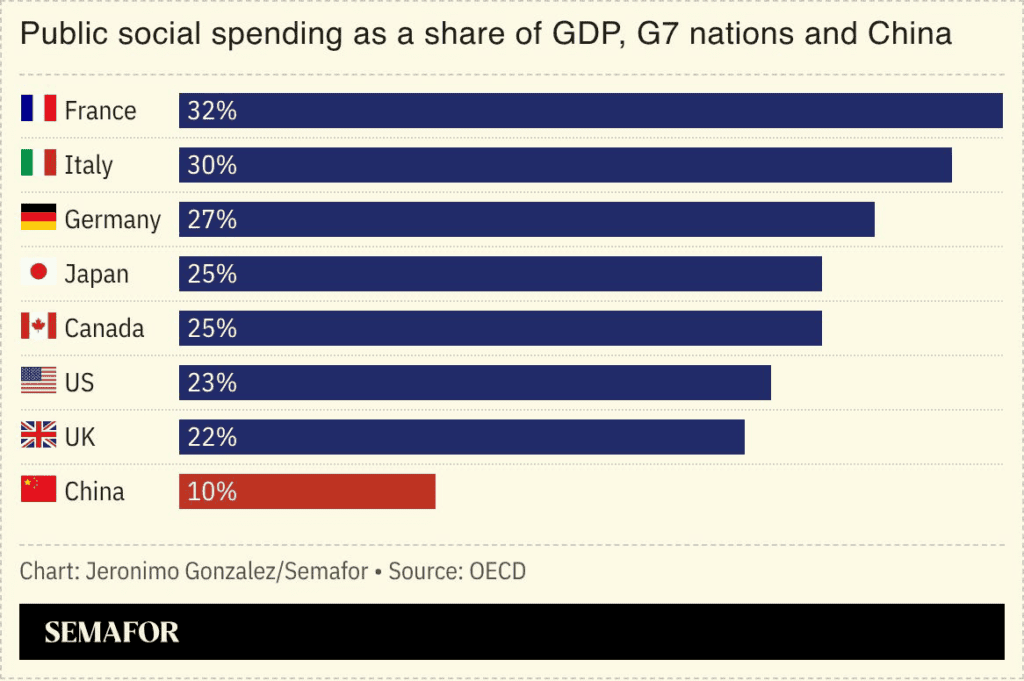
China Has a Smaller Safety Net
The risk is particularly important because China’s public social spending is relatively low compared with major developed economies. China spends around 10% of GDP on public social programs, compared with 23% in the US, 27% in Germany and 32% in France, according to OECD data highlighted by Semafor.
China is already struggling with youth employment. Overall urban unemployment is around 5%, but unemployment among 16-to-24-year-olds who are not students is roughly three times higher. Economists warn that rapid AI adoption could worsen those pressures and potentially weigh on consumer spending and social stability.
There is a longer-term upside. China’s population is aging and shrinking, and by 2050 there are projected to be fewer than two working-age adults for every retiree. Automation could eventually help the country compensate for that shrinking workforce.