
Start with these six steps to open an account and make your first investment today. Open a brokerage account, fund it with an amount you won’t need for at least three years, buy a broad index ETF or a fractional share, set up automatic monthly contributions, and check your risk exposure once a quarter.
- Open an account. Pick a brokerage that offers fractional shares and no account minimums.
- Fund it. Transfer money from your bank, starting with whatever you can afford.
- Choose your first investment. A broad market ETF is the simplest starting point for most beginners.
- Place your first order. Use a market order for a straightforward buy.
- Automate contributions. Set a recurring monthly transfer so you invest without thinking about it.
- Check your safety net. Confirm you have an emergency fund before adding more money to your portfolio.
This is general education, not personalized financial advice. For account safety and broker verification, Investor, FINRA, and SIPC are the places to check before you fund anything.
Key Takeaways
Starting in the stock market successfully depends on opening the right account, funding it consistently, and choosing broad diversification over individual stock bets.
| Point | Details |
|---|---|
| Match account to goal | Use a taxable brokerage for near-term access and an IRA for retirement tax benefits. |
| Favor funds over stocks | Broad ETFs give instant diversification; individual stocks require research and carry higher risk. |
| Automate your contributions | Dollar-cost averaging with a fixed monthly amount smooths out market volatility over time. |
| Rebalance sparingly | Review allocation quarterly and adjust only when it drifts more than 5 percentage points. |
| Verify before you fund | Check SIPC coverage and FINRA registration, then explore Finblog’s beginner guides for your next step. |
Where to Verify What You’ve Learned
- Investor: core investing basics and risk education.
- FINRA BrokerCheck: verify a broker’s registration and disciplinary history.
- SEC EDGAR: read a company’s official filings before buying its stock.
- SIPC: confirm your brokerage carries account protection.
- For personalized plans, consult a licensed financial advisor.
Table of Contents
- Stock Market How to Start: Picking the Right Account
- Individual Stocks or Funds: What Should You Buy First?
- How Much Money Do You Need to Start?
- How to Place Your First Stock Trade
- Building a Long-Term Investment Plan
- Managing Your Portfolio Without Overdoing It
- When Should You Get Professional Help?
- Your 30 and 90 Day Starter Plan
- Get Started With Finblog’s Investing Resources
- Frequently Asked Questions
- Sources
Stock Market How to Start: Picking the Right Account
The account you open determines how your money is taxed and when you can touch it. A taxable brokerage account gives you full access to your money anytime, but you pay capital gains tax on profits. An IRA or Roth IRA locks your money away for retirement in exchange for tax advantages, either now (traditional IRA) or later (Roth IRA), and both come with early-withdrawal penalties before age 59½. Choose based on the goal: near-term goals belong in a taxable account, retirement money belongs in an IRA.
Opening either type usually takes ten minutes online. You’ll need a Social Security number, a government ID, and your bank routing and account numbers to fund it. Most brokers accept an electronic transfer as your first deposit, and it typically clears in one to three business days.
Before you commit, run through a quick checklist:
- Are trading commissions $0 for stocks and ETFs?
- Does the broker support fractional shares and automatic recurring deposits?
- Is there an account minimum, and can you avoid it?
- Is the broker a FINRA-registered member with SIPC coverage?
- Does the mobile app include basic research tools, not just a trading screen?
Pro Tip: Paperless identity verification is now standard at most major brokers. If a platform asks you to mail documents or wait days for approval, that’s a sign to look elsewhere.
Individual Stocks or Funds: What Should You Buy First?
Most beginners are better off starting with a broad index ETF or mutual fund, not individual stocks. Funds spread your money across hundreds of companies in a single purchase, which removes the risk of one bad pick wiping out your account. Individual stocks make sense once you enjoy researching companies and can stomach the swings that come with betting on one business.
Here’s how the main options stack up:
- Individual stocks: highest potential reward, highest risk, requires ongoing research, no built-in diversification.
- ETFs: trade like stocks during market hours, low fees, instant diversification, easy to buy in small amounts.
- Mutual funds: similar diversification to ETFs, but priced once daily and sometimes carrying higher minimums or fees.
- Target-date funds: fully hands-off, automatically shifts from growth to conservative holdings as your target date approaches.
A practical split: use ETFs or a target-date fund for the bulk of your portfolio, and if you want to pick individual stocks, cap that to a small slice of money you can afford to lose without derailing your plan.
Pro Tip: Fractional shares solve the biggest early obstacle for beginners: expensive stock prices. Instead of needing hundreds of dollars for a single share, you can buy $25 worth of a stock priced at any level and still build a diversified position over time.

How Much Money Do You Need to Start?
You don’t need thousands of dollars to start investing. Fractional shares let you begin with $25 or $50 and build from there, but that money should come after you’ve covered your basics.
Before investing a dollar, confirm you have:
- Three to six months of essential expenses in a savings account.
- No high-interest debt (credit cards above 15% to 20% APR) sitting unpaid.
- Enough monthly cash flow to invest without touching money you’ll need in the next three to five years.
Once those boxes are checked, dollar-cost averaging (DCA) is the simplest way to invest consistently. Instead of trying to time the market, you invest a fixed amount on a set schedule. Say you invest $200 every month for a year: some months you’ll buy shares at a high price, some months at a low price, and the average smooths out the ride. Investor education from the SEC points to time in the market, not timing the market, as the core driver of long-term growth.
How to Place Your First Stock Trade
Placing your first trade takes about five steps on any standard brokerage platform. Search for the ticker symbol, decide how much to invest (in dollars or shares), select an order type, review the details, and confirm.
- Type the ticker symbol or fund name into the search bar.
- Enter either a number of shares or a dollar amount if fractional shares are supported.
- Choose your order type.
- Review the order summary, including any fees.
- Confirm and save the trade confirmation for your records.
Order types matter more than most beginners expect:
- Market order: buys or sells immediately at the current price. Good default for long-term buy-and-hold investing.
- Limit order: only executes at a price you set or better. Useful if you want price control and don’t mind waiting.
- Stop order: triggers a sale once a stock hits a certain price, often used to limit losses.
Before you fund anything, confirm the platform is SIPC-protected, check the commission structure, and turn on recurring purchases so future contributions happen automatically.
Building a Long-Term Investment Plan
Set your goal and time horizon first, then let those two things decide your asset allocation. Money you need in two years should sit differently than money you won’t touch for twenty.
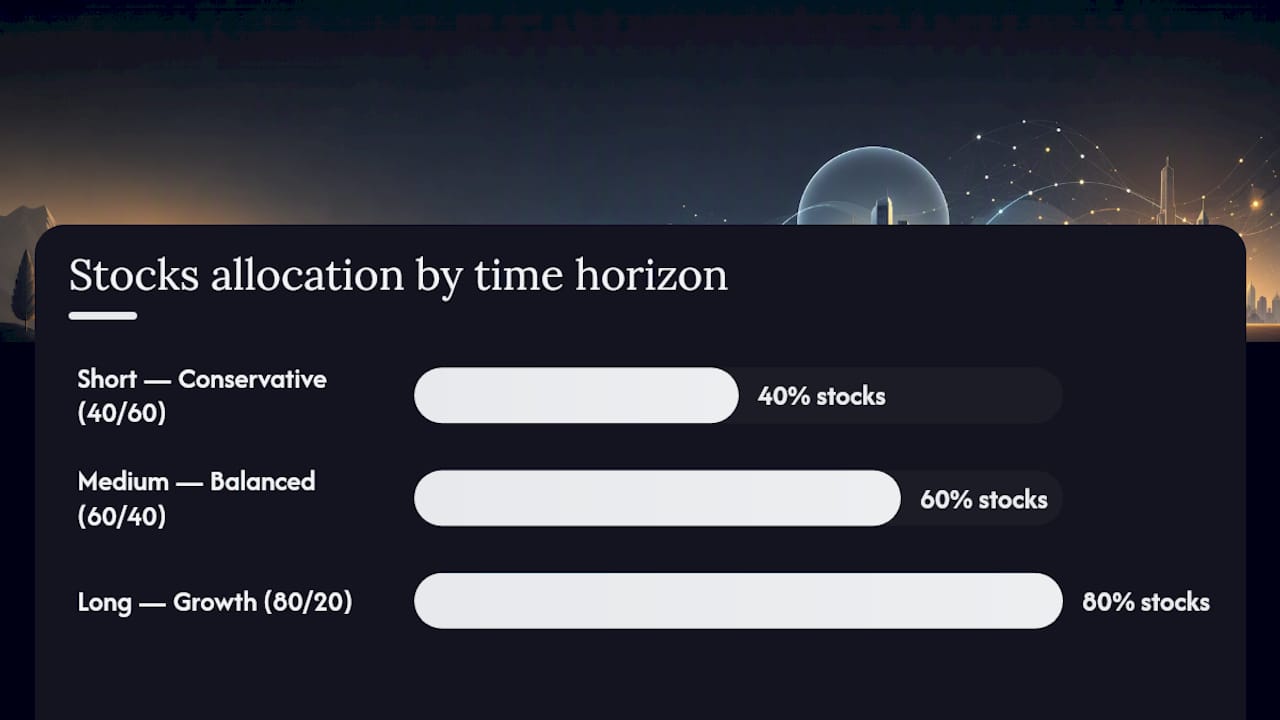
Asset allocation is simply how you split your portfolio between stocks, bonds, and cash. Diversification is spreading money across many holdings within each category so no single company or sector can sink your results. Both work together to manage risk without requiring you to predict the market.
A few illustrative starting points by goal:
- Conservative (short time horizon, low risk tolerance): roughly 40% stocks, 60% bonds and cash.
- Balanced (medium time horizon): roughly 60% stocks, 40% bonds.
- Growth (long time horizon, higher risk tolerance): roughly 80% stocks, 20% bonds.
These are starting frameworks, not formulas, and your own comfort with volatility should adjust them. If you’d rather not manage the split yourself, a target-date or target-risk fund handles the allocation and adjusts it automatically as you get closer to your goal.
Pro Tip: Rebalance once a year, or whenever an allocation drifts more than five percentage points from your target. Rebalancing more often than that usually just adds transaction costs and tax friction without improving your results.
Managing Your Portfolio Without Overdoing It
A quarterly check-in is enough for most beginner portfolios. Look at your allocation, confirm your contributions are still on track, and rebalance only if something has drifted meaningfully from your target.
Fees deserve attention every time you review your account. Watch for expense ratios on funds (aim under 0.20% for broad index funds), any per-trade commissions, and the tax treatment of your account type, since a taxable brokerage account triggers capital gains tax on profits while an IRA defers or eliminates it.
Common mistakes worth avoiding:
- Checking your portfolio daily and reacting to short-term swings.
- Chasing a stock tip from social media without doing any research.
- Selling everything the first time the market drops.
- Skipping your emergency fund to invest more aggressively.
- Ignoring fees because they seem small on any single trade.
A simple rebalancing routine: review allocation quarterly, act only past the 5% drift threshold, and prefer tax-advantaged accounts for assets you’ll trade more often, since taxable accounts create a bill every time you sell for a gain.
When Should You Get Professional Help?
Use a robo-advisor if you want low-cost, hands-off portfolio management. See a human financial advisor if your situation involves complex tax questions, estate planning, or a major life change like inheritance or a business sale.

Before hiring anyone, ask directly about fees, whether they’re a fiduciary (legally required to act in your interest), what a typical client looks like, and what services are actually included. Request their Form CRS, which spells out fees and conflicts of interest in plain language.
Watch for red flags: guaranteed returns, pressure to act immediately, unclear credentials, or fees that aren’t disclosed upfront. FINRA’s BrokerCheck lets you verify registration and disciplinary history before you hand anyone your money.
Your 30 and 90 Day Starter Plan
Momentum beats perfection. Open your account this week, fund it, and place one trade. Then build from there.
In your first 30 days:
- Open a brokerage account and complete verification.
- Confirm your emergency fund covers three to six months of expenses.
- Set up a recurring monthly deposit, even if it’s small.
- Buy your first broad index ETF using a market order.
Over the next 90 days:
- Add a second fund for broader diversification, or set an automatic rebalancing rule if your broker offers one.
- Review your fees and increase your contribution amount if your budget allows.
- Turn on two-factor authentication and save every trade confirmation.
A simple example shows why consistency matters more than timing: investing $200 monthly at an average 7% annual return grows to roughly $34,000 after ten years, with most of that growth coming from compounding in the later years, not the early contributions. Once your first trade clears, Finblog’s beginner resources are a good next stop for deepening what you’ve just started.
A Note From Povilas
Feeling unsure the first time you fund an account is normal. Every experienced investor started with the same hesitation over the same buttons on the same confusing screen. The plan above works because it removes decisions, not because it removes risk. If you want the fuller version of any step here, Finblog’s investing guides walk through each one in more depth, and our newsletter covers what’s changing in the market as you keep learning.
Get Started With Finblog’s Investing Resources
Finblog gives beginners a faster path to real financial guidance than piecing advice together from scattered blog posts and forum threads. Rather than guessing which broker checklist or allocation model applies to your situation, you get educational content built specifically for new investors, plus a direct route to consultation resources if you want a second opinion on your plan. That matters most right after you’ve placed your first trade, when questions about account types, fees, or allocation tend to pile up fastest.
If you’ve just finished the 30-day checklist above, the next move is simple: browse Finblog’s stock market basics guide to reinforce the terminology you’ve now used in practice, and sign up for the newsletter to keep building on the plan you just started.
Frequently Asked Questions
What’s the fastest way to start investing with very little money?
Open a brokerage account that supports fractional shares, then buy a small dollar amount of a broad index ETF. You can start with as little as $25 to $50.
Is it better to start with stocks or ETFs as a beginner?
ETFs are the more forgiving starting point because one purchase spreads your money across many companies. Individual stocks work better once you’re comfortable researching businesses and accepting more risk.
How much should I invest each month when I’m just starting out?
Whatever fits your budget after covering essentials and your emergency fund. Even $50 to $200 a month invested consistently through dollar-cost averaging builds meaningful savings over years, thanks to compounding.
Do I need a financial advisor to start investing?
No. A robo-advisor or a simple DIY portfolio of broad ETFs is enough for most beginners. Consider a human advisor only when your finances get complex, such as with major tax decisions or estate planning.
How do I know if my broker is safe?
Check that the firm is FINRA-registered and SIPC-insured. Both details are usually listed on the broker’s website footer or disclosure page.
This article is general information, not a substitute for advice from a qualified financial advisor. Consult a qualified financial professional about your own circumstances before acting on anything here.