

Open one account that reports to the three major credit bureaus, make every payment on time, and keep your balance low. That’s the whole game. Everything else is detail.
Here’s what to do this week:
- Apply for a secured credit card or credit-builder loan. These are the two fastest, most reliable ways to create a reporting relationship with the bureaus.
- Ask a trusted family member or friend to add you as an authorized user on their credit card, ideally one with a long, clean payment history.
- Enroll eligible bills (rent, utilities, phone) in a reporting program so payments you’re already making start counting.
On timing: VantageScore can generate a score relatively quickly once an account is reported, while FICO generally requires about six months of on-file activity before producing a score. Being “credit invisible” — having no file at all — isn’t the same as having bad credit. It just means you haven’t yet created any reporting relationships, and that’s fixable.
Key Takeaways
Building credit from scratch requires one reporting account, consistent on-time payments, and utilization kept between 10%–30%, with a realistic timeline of six months before a FICO score appears.
| Point | Details |
|---|---|
| Start with one account | Open a secured card or credit-builder loan that reports to all three bureaus. |
| Payment history is paramount | On-time payments drive approximately 35% of your FICO score, more than any other factor. |
| Keep utilization at 10%–30% | Keep your reported balance below 30% of your limit to stay in the safe range. |
| Expect six months for a FICO score | VantageScore appears sooner; FICO needs roughly six months of consistent reporting. |
| Finblog offers personalized guidance | A Finblog advisor can match you to the right starter product and build a 6–12 month credit plan. |
Table of Contents
- 1. How to build credit from scratch using credit cards
- 2. Ways to build credit without a traditional credit card
- 3. How to choose the right starter product for your situation
- 4. Core habits that drive most of your score improvement
- 5. Realistic timeline: when your score appears and what to expect
- 6. How to get your credit reports, read them, and fix errors
- 7. Common mistakes that stall new credit profiles
- 8. What regulators and research say about establishing credit
- Finblog can help you build a personalized credit plan
- Sources
1. How to build credit from scratch using credit cards
Cards are the most common entry point for building credit, and for good reason: they’re widely available, they report monthly to the bureaus, and they give you a revolving line that demonstrates responsible use over time. The CFPB confirms that secured credit cards can build credit when payments are reported, and recommends verifying reporting before applying.
Secured credit cards
A secured card works by requiring a cash deposit, typically $200–$500, which becomes your credit limit. You use the card like any other credit card, pay the bill, and the issuer reports your payment history to the bureaus. After a period of responsible use, many issuers will graduate you to an unsecured card and return your deposit.
The critical detail: not every secured card reports to all three bureaus. Before applying, call the issuer and ask directly: “Do you report to Equifax, Experian, and TransUnion?” If the answer is anything less than all three, keep looking.
Student and entry-level unsecured cards
If you’re enrolled in college, student cards are worth considering. They typically don’t require a deposit, carry modest credit limits, and are designed for thin credit files. The tradeoff is that approval isn’t guaranteed without any credit history, and limits tend to be low. Some issuers will approve applicants with no history at all; others want at least a few months of banking activity.
Retail and store cards
Store cards often have looser approval standards than general-purpose cards, which makes them tempting for beginners. The catch is that interest rates tend to run high, sometimes above 25% APR. Use one only if you plan to pay the full balance every month. Carrying a balance on a high-rate store card will cost you money and can push your utilization up fast.
Becoming an authorized user
This is one of the fastest ways to get a positive account on your credit file without opening your own account. When someone adds you as an authorized user on their card, that account’s history can appear on your report. Experian notes that this strategy works best when the issuer reports authorized-user accounts and the primary account has a clean payment history. If the primary cardholder misses payments or maxes out the card, that negative activity can show up on your file too.
Before agreeing to the arrangement, verify two things: that the issuer reports authorized users to the bureaus, and that the primary account is in good standing.
Practical usage rules for any starter card:
- Charge only what you can pay in full each month.
- Pay before the statement closing date when possible, not just the due date, to keep your reported balance low.
- Keep utilization between 10%–30% of your limit. This range supports a healthier credit utilization rate and gradual score improvement.
- Never use a prepaid debit card expecting it to build credit. Prepaid cards don’t report to bureaus and won’t help your file.
Pro Tip: When comparing secured cards, prioritize three features in this order: bureau reporting (all three), annual fee (lower is better), and whether the card has a graduation path to an unsecured product. A card that checks all three is worth a slightly higher deposit.
2. Ways to build credit without a traditional credit card
Cards aren’t the only path. If you’d rather not open a revolving account, or if you’ve been denied, there are solid alternatives that create the same kind of reporting relationship.
Credit-builder loans
A credit-builder loan works differently from a regular loan. The lender holds the loan amount in a locked savings account while you make monthly payments. Those payments are reported to the bureaus. At the end of the term, you receive the funds. The CFPB’s credit-invisible checklist describes this structure and highlights the importance of confirming that the lender reports to the nationwide credit reporting companies.

Loan amounts typically run $300–$1,000, with terms of 6–24 months. The practical benefit beyond credit-building: you end the term with a lump sum in savings, which makes this a good fit for people who want to build both a credit file and an emergency fund simultaneously.
Community banks, credit unions, and some online lenders offer these products. As Regions Bank notes, credit unions in particular often provide credit-builder loans with lower fees than online alternatives.
Rent and utility reporting
Most landlords don’t automatically report rent payments to the bureaus. But third-party rent-reporting services can bridge that gap. Services like Rental Kharma and LevelCredit work by verifying your lease and payment history, then reporting that data to one or more bureaus. Some services charge a monthly fee; others charge a one-time setup cost.
Experian Boost takes a different approach: you connect your bank account, and the tool scans for on-time utility, phone, and streaming payments, then adds qualifying payments to your Experian file. The effect is immediate for your Experian score, though it only affects Experian, not Equifax or TransUnion.
Before enrolling in any rent-reporting service, confirm which bureaus receive the data. A service that reports only to one bureau is better than nothing, but a service reporting to all three is more useful.
Comparing your non-card options
3. How to choose the right starter product for your situation
The best product is the one you’ll actually use correctly. Here’s a short checklist to narrow it down.
Decision checklist:
- Do you have $200–$500 available for a deposit? If yes, a secured card is worth considering.
- Is your monthly cash flow tight? A credit-builder loan with a fixed monthly payment may be easier to manage than a revolving card.
- Do you need revolving credit history specifically (for a future credit card application)? Choose a secured card.
- Do you need installment history (for a future auto loan or mortgage)? A credit-builder loan builds that.
- Do you have a family member with excellent credit who trusts you? Authorized user status can get you started fastest.
- Are you already paying rent consistently? A rent-reporting service adds value at low cost.
- How soon do you need a credit score? If you need one within 3–4 months, authorized user status or Experian Boost can generate results faster than a new account alone.
When each option fits best:
- Secured card: You have a deposit, want revolving credit, and plan to use the card regularly for small purchases.
- Credit-builder loan: You prefer a fixed payment, want to build savings simultaneously, and don’t need a revolving line.
- Authorized user: You have a trusted contact with good credit and want the fastest possible entry into the credit system.
- Rent reporting: You’re already renting and want to convert existing payments into credit data with minimal effort.
Always confirm before committing: Does this product report to all three bureaus? What are the fees? Is there a minimum reporting period before a score is generated?
Pro Tip: Some secured cards require 12 months of on-time payments before they’ll consider a credit-limit increase or graduation to an unsecured product. Ask about that timeline before applying, not after.
4. Core habits that drive most of your score improvement
Two habits account for the majority of your score: paying on time and keeping balances low. Everything else is secondary, especially in the first year.
Payment history: the biggest lever
Payment history is the largest single factor in a FICO score, constituting about a third of the total., making it the largest single factor. One missed payment can set back months of progress. A 30-day late payment stays on your report for seven years. For new credit builders, this isn’t just a tip. It’s the whole strategy.
Set up autopay for at least the minimum payment on every account. Then manually pay the full balance before the statement closes. Autopay is your safety net; manual payment is how you avoid interest.
Credit utilization: keep it in the right range
Utilization measures how much of your available credit you’re using. The recommended target is 10%–30% of your total available credit. On a moderate credit limit, that means keeping your reported balance well below the limit, ideally around 10% or less.
The timing matters more than most beginners realize. Bureaus receive your balance as of the statement closing date, not the payment due date. If you charge $400 on a $500 card and pay it off before the due date, the bureau may still see a $400 balance if it was reported at statement close. Making a mid-cycle payment before the closing date keeps your reported utilization low. For a deeper look at how utilization math works, Finblog’s credit utilization guide walks through the mechanics in detail.
Application discipline: don’t apply for everything at once
Each credit application triggers a hard inquiry, which can temporarily lower your score by a few points. Multiple applications in a short window signal financial stress to lenders. Apply for one product, use it for 6–12 months, then consider whether you need another. The Finblog primer on what affects your credit score covers how inquiries interact with other score factors.
Pro Tip: If you’re rate-shopping for a mortgage or auto loan, multiple inquiries within a 14–45 day window are typically treated as a single inquiry by FICO. For credit cards, no such grouping applies, so space those applications out.
5. Realistic timeline: when your score appears and what to expect
Credit-building is slow by design. Here’s what actually happens month by month.
Milestone table:
| Timeframe | What happens |
|---|---|
| Month 1 | New account appears on your credit report |
| Month 3 | First payments reported; file starts to take shape |
| Month 6 | FICO may issue a score if account has been open and reporting consistently |
| Month 12+ | Credit file deepens; more favorable offers become available |
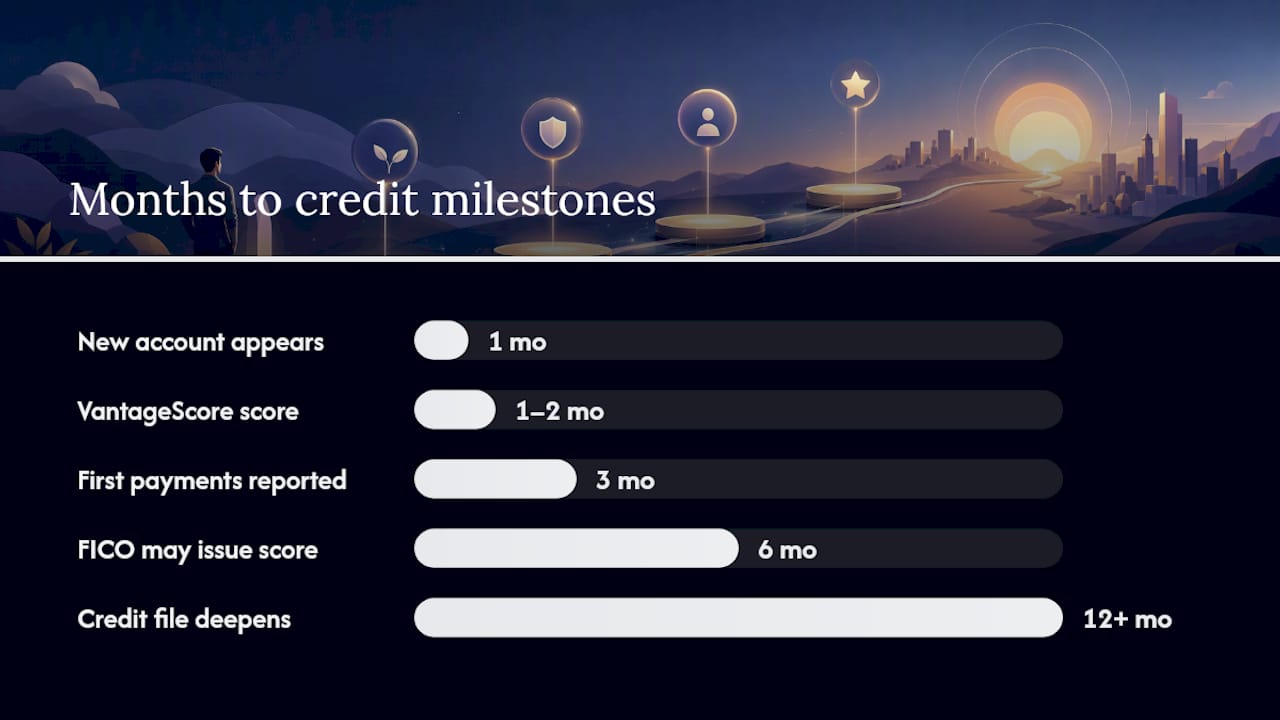
VantageScore can generate a score sooner, sometimes within the first month or two of a reported account. FICO, which most lenders use for major decisions, typically needs about six months of on-file activity. Plan accordingly: if you need credit for an apartment lease or a car loan, start the process at least 6–12 months before that decision.
What score movement looks like in practice:
- Early months: slow, sometimes no visible movement even when you’re doing everything right.
- Around month 6: a FICO score appears, often in the 600s for someone with a clean but thin file.
- Month 12+: consistent on-time payments and low utilization push the score steadily upward.
- Sudden jumps are rare. Steady, boring improvement is the normal pattern.
Track progress using free tools like the credit monitoring features built into many bank apps, or through services like Credit Karma (VantageScore) and Experian’s free tier. Check your actual credit reports separately at AnnualCreditReport.gov to catch errors.
6. How to get your credit reports, read them, and fix errors
Your credit report is the raw data your score is calculated from. Errors on it can block a score from generating or drag it down before you’ve even started.
Step-by-step: accessing and reviewing your reports
- Go to AnnualCreditReport.gov, the official, free source authorized under federal law. Pull reports from all three bureaus: Equifax, Experian, and TransUnion.
- Review the accounts section: confirm every account listed is yours, the payment history is accurate, and the credit limits are correct.
- Check the inquiries section: verify you authorized every hard inquiry shown.
- Review personal information: name, address, Social Security number. Errors here can cause mismatched files.
- Look at public records: judgments or collections that don’t belong to you are worth disputing immediately.
Disputing an error:
- Gather documentation: account statements, correspondence, or any record that contradicts the error.
- File a dispute directly with the bureau reporting the error. All three bureaus accept disputes online, by mail, and by phone.
- The bureau has 30 days to investigate and respond.
- If the dispute is resolved in your favor, the error is corrected or removed. If not, you can escalate to the CFPB or add a statement of dispute to your file.
- Dispute with the original creditor as well, not just the bureau, for faster resolution on billing errors.
Pro Tip: Dispute errors in writing, even when the online portal is faster. A written record protects you if the error reappears, which happens more often than it should.
7. Common mistakes that stall new credit profiles
Most early credit mistakes come from misunderstanding how the system works, not from bad intentions. Here are the ones that cause the most damage.
Mistakes to avoid:
- Using a prepaid card expecting it to build credit. Prepaid cards don’t report to bureaus. They’re useful for budgeting but do nothing for your credit file.
- Missing even one payment. A single 30-day late payment can drop a thin file significantly and stays on your report for seven years.
- Maxing out a small limit. A $300 card charged to $280 puts your utilization at 93%. That single number can suppress your score even if every payment is on time.
- Opening multiple accounts in a short window. Several hard inquiries in quick succession signal risk to lenders and can slow score growth.
- Cosigning without understanding the liability. If the primary borrower misses payments, those negatives appear on your report. You are equally responsible for the debt.
- Assuming all bills automatically build credit. Most utility, rent, and phone payments are not reported unless you actively enroll them in a reporting program.
Red flags to watch for on your report:
- More than two hard inquiries in a six-month period when you’ve only applied for one product.
- Collections or charge-offs you don’t recognize (possible identity theft or reporting error).
- Accounts listed as open that you’ve closed, or vice versa.
If something goes wrong: a single missed payment isn’t fatal. Pay it immediately, bring the account current, and keep every subsequent payment on time. The impact fades as your positive history grows. For more structured recovery steps, Finblog’s guide to improving your credit score covers tactical options for accelerating progress after a setback.
8. What regulators and research say about establishing credit
The core guidance here comes from primary sources, not opinion.
Experian identifies authorized user status, secured cards, credit-builder loans, rent reporting, and Experian Boost as the main routes for people with no credit history. These aren’t fringe strategies. They’re the standard toolkit.
MyFICO confirms that payment history accounts for approximately 35% of a FICO score, the largest single factor. No other habit comes close in the first year of building credit.
Key figure: Aim to use 10%–30% of your available credit. Staying in that range signals responsible use without appearing over-leveraged.
The CFPB’s guidance on credit-invisible consumers makes a point worth repeating: lacking a credit file is not the same as having bad credit. It simply means no reporting relationships exist yet. The fix is active, not passive. You have to create those relationships deliberately, because most everyday bill payments don’t flow to the bureaus on their own.
Authoritative rules of thumb backed by these sources:
- Expect roughly six months before a FICO score appears.
- Always verify that a product reports to all three bureaus before applying.
- Prepaid cards don’t build credit. Full stop.
- Avoid buy-here-pay-here dealers and payday-style lenders when building credit; many report only negative information, not positive payment history.
| Source | What it covers |
|---|---|
| MyFICO | Score factor weights, including the 35% payment history figure |
| CFPB credit-invisible checklist | Credit-builder loan mechanics and reporting verification steps |
| Experian starter guide | Practical options for people with no credit history |
| Equifax on scoring models | VantageScore vs. FICO timing differences |
| AnnualCreditReport.gov | Free access to all three bureau reports |
A note on monitoring tools
Free credit monitoring tools are worth using, but understand what they show. Credit Karma and similar apps display VantageScore, which can differ meaningfully from the FICO score a lender pulls. Use monitoring tools to track trends and catch errors. Use AnnualCreditReport.gov to verify the underlying data.
What Finblog recommends
The research points to one consistent conclusion: the product matters less than the habit. A secured card used carelessly will hurt you. A credit-builder loan with consistent payments will help you. Pick one route, commit to it, and let time do the work.
Building credit takes patience, but the path is clear. Start with one account, pay on time, keep balances low, and check your reports regularly. The score will follow.
Finblog can help you build a personalized credit plan
Knowing the steps is one thing. Knowing which step fits your specific situation, income, and timeline is where most beginners get stuck. Finblog’s financial coaching service matches you with an advisor who reviews your current financial picture, recommends the right starter product for your goals, and builds a 6–12 month credit plan around your actual cash flow.
Advisors can also help you read your credit reports, identify errors worth disputing, and set realistic milestones so you’re not guessing whether you’re on track. There’s no one-size-fits-all answer when it comes to establishing credit history, and a personalized plan cuts months off the trial-and-error phase.
If you’re ready to stop guessing and start with a clear roadmap, connect with a Finblog advisor today and get a plan built around your situation.
Sources
- What’s in your credit score
- What are some ways to start or rebuild a good credit history? | Consumer Financial Protection Bureau
- Building credit from scratch
- Are scores from FICO and VantageScore different? | Equifax
This article is general information, not a substitute for advice from a qualified financial advisor. Consult a qualified financial professional about your own circumstances before acting on anything here.