
TL;DR:
- A hedge fund portfolio actively uses multiple strategies and diverse assets to generate returns independently of market trends. Its risk management relies on automated controls, strict concentration limits, and real-time AI monitoring to protect capital. Investors should analyze liquidity terms, historical resilience, and operational risks for better decision-making.
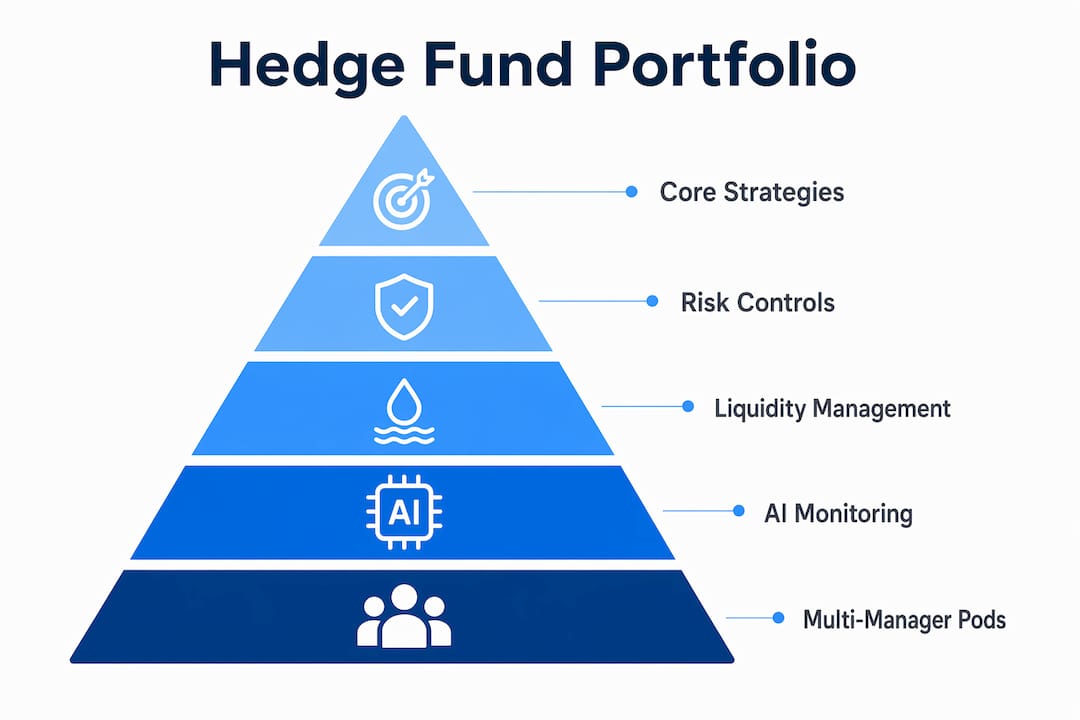
A hedge fund portfolio is defined as an actively managed collection of assets that uses multiple investment strategies, across both liquid and illiquid markets, to generate returns independent of broader market direction. Unlike a standard mutual fund, a hedge fund portfolio combines long and short positions, derivatives, private equity, and real assets under one structure. The goal is alpha generation, not just market participation. Regulatory frameworks like SEC Form 13F and AIFMD shape what funds must disclose, while internal risk management frameworks govern how capital gets deployed. Understanding this architecture helps investors and analysts evaluate funds with far more precision than return figures alone allow.
What are the key strategies and asset allocations in a hedge fund portfolio?
The most common hedge fund investment strategies fall into four categories: long/short equity, event-driven, global macro, and multi-manager pod structures. Each carries a distinct risk profile and asset allocation pattern. Long/short equity funds hold concentrated stock positions on both sides of the market. Event-driven funds target corporate actions like mergers, spinoffs, and bankruptcies. Global macro funds trade currencies, rates, and commodities based on economic themes.

Multi-manager pod platforms represent the most institutionalized form of hedge fund asset allocation. Each pod operates as a semi-independent unit with its own risk budget, position limits, and performance targets. Millennium Management illustrates this at scale: the firm held $34.15B in four broad-market ETFs, representing 17.6% of its disclosed portfolio. That allocation functions as a liquid beta hedge, offsetting directional stock exposure across pods.
Baupost Group takes a different approach to asset allocation. The firm holds 30–50% of assets in cash or non-public equities at any given time. That level of cash is not idle capital. It represents dry powder for distressed opportunities and a structural hedge against forced selling during market dislocations.
Common hedge fund strategy types and their typical asset focus:
- Long/short equity: Stocks, sector ETFs, single-name options
- Event-driven: Merger arbitrage, distressed debt, special situations
- Global macro: Currencies, sovereign bonds, commodity futures
- Multi-manager pods: Diversified across all of the above with strict risk budgets
- Quantitative: Systematic signals across equities, futures, and fixed income
Pro Tip: When evaluating a fund’s asset allocation, ask what percentage sits in instruments that can be liquidated within five trading days. That number tells you more about real liquidity than any marketing document.
Portfolio concentration limits are tighter than most investors expect. Single-name positions are typically capped at 1–3% of gross book value, with industry exposure limited to 5–15%. These are not guidelines. They are hard limits enforced at the risk management level.
How do hedge funds manage risk and liquidity within their portfolios?
Hedge fund risk management operates on a different plane than retail investing. The structural risks are distinct: leverage amplifies losses, liquidity mismatches can trigger redemption spirals, and operational failures like NAV manipulation or style drift can destroy a fund before market losses do. A sound risk framework addresses all three categories simultaneously.
Pod-based platforms use automated mechanical controls that remove manager discretion at critical thresholds. Drawdown triggers at 5%, 7.5%, and 10% force position cuts or full pod wind-downs regardless of the portfolio manager’s conviction. This design prioritizes capital preservation over any single manager’s judgment. Citadel and Millennium both operate this way, and it explains why multi-manager funds tend to show lower peak-to-trough drawdowns than single-manager funds with similar gross exposure.
Liquidity management tools add another layer of protection. Gates restrict the percentage of fund assets that can be redeemed in any given period. Side pockets isolate illiquid positions from the main fund, preventing a run on liquid assets when investors exit. Redemption terms, typically quarterly with 30–90 day notice periods, create a buffer between investor behavior and portfolio action.
Primary risk categories and how funds address them:
- Market risk: Managed through concentration limits, factor hedging, and gross/net exposure caps
- Leverage risk: Controlled via margin limits, stress testing, and daily P&L monitoring
- Liquidity risk: Addressed through gates, side pockets, and position sizing tied to average daily volume
- Operational risk: Mitigated by independent fund administrators, third-party valuation, and compliance oversight
- Style drift: Detected through factor decomposition and regular strategy audits
Factor decomposition is one of the most underappreciated tools in hedge fund risk management. By breaking down returns into systematic factors (market beta, sector exposure, size, momentum) and isolating the residual, risk teams can confirm that a portfolio manager is generating genuine alpha rather than just riding a factor that happens to be working. This process runs continuously on pod platforms, not quarterly.
Pro Tip: Before allocating to any hedge fund, request the fund’s liquidity terms alongside its historical drawdown data. A fund with a 45-day redemption notice and illiquid underlying positions is structurally mismatched, and that mismatch becomes a problem exactly when you need liquidity most.
What role does AI play in modern hedge fund portfolio monitoring?
Traditional risk reporting runs on a T+1 cycle. A portfolio manager sees yesterday’s risk numbers this morning. AI-driven systems change that entirely by providing continuous exposure tracking across positions, correlations, and market conditions in real time. The difference is not incremental. It is structural.
AI risk monitoring detects risk concentrations 40–60% earlier than traditional systems. That speed advantage translates to a 2–3 week lead time for portfolio managers to adjust exposures before volatility peaks. In a market where correlations spike suddenly during stress events, that lead time is the difference between a controlled reduction and a forced liquidation.
Regime-adaptive correlation models represent one of the most practical AI applications in portfolio oversight. Standard correlation matrices assume relatively stable relationships between assets. AI systems update these relationships continuously, flagging when correlations between previously uncorrelated positions begin to converge. That convergence is often the first signal of a crowded trade unwinding.
Key AI risk monitoring capabilities in hedge fund portfolios:
- Continuous gross and net exposure tracking across all positions
- Real-time correlation updates that adapt to changing market regimes
- Early warning signals combining portfolio data, market microstructure, and behavioral patterns
- Liquidity deterioration alerts triggered by widening bid-ask spreads and falling volume
- Automated stress testing against historical and hypothetical shock scenarios
- Factor exposure monitoring to detect unintended systematic risk accumulation
The behavioral data dimension is newer and worth noting. AI systems now incorporate order flow patterns and position-building velocity to flag when a portfolio manager’s behavior diverges from their stated strategy. That signal feeds directly into the style drift detection process that compliance teams previously ran manually on a monthly basis.
How can investors interpret hedge fund portfolios for better decisions?
13F filings are the primary public window into hedge fund holdings, but they show only a fraction of the picture. Baupost’s 13F reveals public equity positions while hiding the cash reserves and private investments that define the fund’s actual strategy. Analysts who build a thesis solely on 13F data are analyzing a shadow of the real portfolio.
Performance metrics beyond raw returns matter significantly. Operational risks like stale asset valuations, style drift, and NAV manipulation have higher predictive value for fund failure than most financial metrics. A fund posting strong returns while quietly drifting from its stated strategy is a fund accumulating hidden risk.
Steps for evaluating a hedge fund portfolio:
- Review the fund’s stated strategy and compare it against disclosed positions for consistency.
- Analyze liquidity terms relative to the underlying asset mix. Flag any mismatch between redemption windows and position liquidity.
- Request drawdown history and examine the speed of recovery, not just the depth of the drawdown.
- Assess portfolio resilience by asking how the fund performed during specific stress events (March 2020, Q4 2022, August 2024).
- Look for concentration red flags: single positions above 5% of disclosed holdings or sector tilts above 20% warrant explanation.
- Examine the fund’s use of leverage. Gross exposure above 400% in a long/short fund signals meaningful amplification of both gains and losses.
Hedge fund performance in stress periods reveals more about portfolio construction quality than any bull market track record. A fund that held up in october 2023 or during the regional banking crisis of 2023 has demonstrated something real about its risk controls.
Key Takeaways
A well-constructed hedge fund portfolio combines multi-strategy diversification, hard risk limits, and real-time monitoring to generate alpha while containing drawdowns across market cycles.
| Point | Details |
|---|---|
| Multi-strategy allocation | Funds combine long/short equity, macro, and event-driven positions to reduce single-strategy concentration risk. |
| Hard risk limits | Single-name caps of 1–3% and industry caps of 5–15% are enforced mechanically, not left to manager discretion. |
| AI monitoring advantage | AI systems detect risk concentrations 40–60% earlier than traditional T+1 reporting, giving managers a 2–3 week adjustment window. |
| 13F filing limitations | Public filings show only equity holdings. Cash, private investments, and derivatives remain hidden, distorting the full picture. |
| Operational risk priority | Style drift and NAV manipulation predict fund failure more reliably than short-term return volatility. |
What most investors miss about hedge fund portfolio architecture
The mechanical nature of risk controls in pod-based platforms surprises most investors who come from a traditional active management background. In retail or mutual fund investing, a manager can hold a losing position through conviction. In a pod structure, a 10% drawdown triggers automatic position cuts regardless of the manager’s view. That is not a flaw. It is the design.
What I find consistently underappreciated is how much of a hedge fund’s edge comes from the infrastructure around the portfolio manager, not from the manager’s stock picks alone. The risk systems, the factor decomposition tools, the liquidity monitoring, the automated de-risking protocols. These are the actual competitive advantages of large multi-manager platforms. A talented pod manager at a firm with weak risk infrastructure will underperform the same manager at a firm with strong systems, all else equal.
The AI monitoring shift is real and accelerating. Funds that still run T+1 risk reporting are operating with a structural disadvantage in fast-moving markets. The hedging strategies that worked in lower-volatility regimes need continuous recalibration now, and manual processes cannot keep pace.
For individual investors evaluating hedge fund allocations, the most useful question is not “what did this fund return last year?” It is “what happened to this fund during the worst three months of the last five years, and how quickly did it recover?” That question cuts through marketing and gets to the quality of the underlying risk management.
— Povilas
Finblog covers hedge fund investing in depth
Finblog publishes detailed analysis on hedge fund strategies, risk management frameworks, and portfolio construction for investors who want more than surface-level commentary. Whether you are evaluating a fund allocation for the first time or stress-testing an existing position, the guides on Finblog cover the mechanics that matter. From ETF-based hedging approaches to drawdown analysis and stock trading risk management, the content is built for analysts and serious investors who need precision, not generalities. New articles publish regularly, tracking how major funds are adjusting their portfolios as market conditions shift.
FAQ
What is a hedge fund portfolio?
A hedge fund portfolio is an actively managed collection of assets using multiple strategies, including long/short equity, derivatives, and private investments, to generate returns independent of market direction. It differs from traditional portfolios through its use of leverage, short selling, and complex risk controls.
How does hedge fund asset allocation differ from mutual funds?
Hedge funds allocate across a wider range of assets, including illiquid private equity, distressed debt, and derivatives, with concentration limits enforced mechanically. Mutual funds are restricted to public securities and cannot short sell or use significant leverage.
What do 13F filings actually show about a hedge fund’s holdings?
13F filings disclose only U.S. public equity holdings above $100 million in assets under management. They exclude cash, private investments, short positions, and derivatives, which means they often represent a minority of a fund’s actual exposure.
How do pod-based hedge funds control risk automatically?
Pod platforms set hard drawdown thresholds, typically at 5%, 7.5%, and 10%, that trigger automatic position cuts or full pod wind-downs without requiring manager approval. This removes discretion at the moments when emotional decision-making is most likely to cause damage.
What are the biggest red flags when analyzing a hedge fund portfolio?
The three most significant red flags are redemption terms that do not match the liquidity of underlying assets, style drift away from the fund’s stated strategy, and leverage levels that amplify losses beyond what the return history would suggest.