

TL;DR:
- The stock market is an accessible way for Americans to build wealth through buying and holding shares.
- Beginners should focus on long-term investing with diversified index funds, avoiding frequent trading and market timing.
The stock market is defined as a marketplace where investors buy and sell shares of publicly traded companies, and it is the most accessible wealth-building tool available to ordinary Americans. Stock market 101 for dummies covers the core concepts every beginner needs: what stocks are, how prices move, why long-term investing beats trading, and how to place your first order. About 58% of U.S. adults own stock, yet ownership is concentrated sharply at the top. The top 1% of households hold 50% of all stock value, while the bottom 50% own just 1%. That gap exists largely because most people never learn the basics.
What is stock market 101 for dummies, and how does it work?
A stock represents a fractional ownership stake in a company. When a company like Apple or Ford wants to raise money, it sells shares to the public through a stock exchange. You buy those shares, and you become a part owner of that business.
Stock exchanges are organized marketplaces where buyers and sellers meet. The New York Stock Exchange (NYSE) and Nasdaq are the two largest in the United States. Every trade that happens on these exchanges follows a simple principle: price is set by supply and demand. When more people want to buy a stock than sell it, the price rises. When sellers outnumber buyers, the price falls.
Two main types of stocks exist for beginners to know:
- Common stock gives you voting rights at shareholder meetings and a share of profits through dividends. Most individual investors buy common stock.
- Preferred stock pays a fixed dividend and gets priority over common stock if a company goes bankrupt, but it usually carries no voting rights.
- Growth stocks reinvest profits back into the business instead of paying dividends. They tend to rise faster but also fall harder.
- Dividend stocks pay regular cash distributions to shareholders, making them popular with income-focused investors.
Understanding these categories is the first step in any beginner stock market guide. You do not need to master every type before you start. Common stock in diversified funds is where most beginners belong.
What is the difference between long-term investing and trading stocks?
Long-term investing means buying stocks or funds and holding them for years or decades. Trading means buying and selling frequently, sometimes within the same day. For beginners, the distinction matters enormously.

The stock market has delivered positive returns in about 73% of years historically, with an average annual return near 10%. That number assumes you stayed invested through the bad years. Traders who jump in and out of the market regularly miss those recovery periods and often lock in losses.
Here is why long-term investing wins for most beginners:
- Compound growth accelerates over time. A $5,000 investment earning 10% annually becomes roughly $13,000 in 10 years without adding a single dollar.
- You avoid emotional trading mistakes. Panic selling during a downturn is the most common way beginners destroy their returns.
- Tax treatment favors patience. Investments held longer than one year qualify for lower long-term capital gains tax rates.
- Transaction costs add up fast. Every trade carries a cost. Frequent trading multiplies those costs and eats into returns.
- Timing the market is nearly impossible. Professional fund managers with full-time research teams fail to beat the market consistently. Beginners rarely do better.
Pro Tip: Set a rule for yourself before you invest: you will not sell during a market drop unless your financial situation has fundamentally changed. Write it down. That rule will save you money.
Market volatility is normal and expected. The market experiences significant declines about one out of every three years, including occasional drops of 20% or more. Beginners who understand this stay calm when prices fall. Those who do not often sell at the worst possible moment.
Why does diversification matter for beginner investors?
Diversification is the practice of spreading your money across multiple investments so that one bad stock does not ruin your entire portfolio. Diversified portfolios reduce the risk of permanent capital loss compared to holding individual stocks. A single company can go bankrupt. An entire market index almost never does.
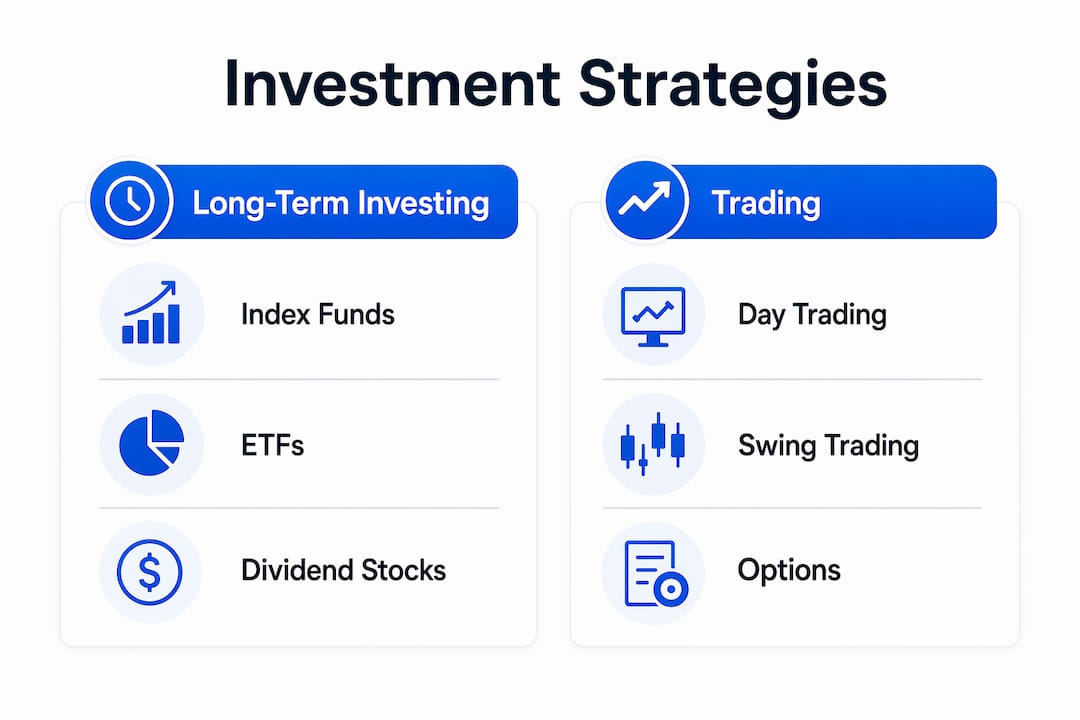
Beginners have two main paths to diversification:
| Approach | How it works | Best for |
|---|---|---|
| Index funds | Track a market index like the S&P 500; low cost, automatic diversification | Passive investors who want broad exposure |
| ETFs (Exchange-Traded Funds) | Trade like stocks but hold many assets; flexible and low cost | Beginners who want diversification with trading flexibility |
| Mutual funds | Actively managed pools of stocks; higher fees but professional selection | Investors who prefer a hands-off approach with guidance |
| Individual stocks | You pick specific companies; higher risk, higher potential reward | Experienced investors with time to research |
Most financial educators recommend that beginners start with index funds or ETFs as their foundation. These instruments give you exposure to hundreds of companies through a single purchase. The S&P 500 index, for example, holds 500 of the largest U.S. companies. One ETF tracking that index gives you a stake in all of them.
Pro Tip: Owning 20 to 30 individual stocks across different sectors achieves meaningful diversification. Owning 200 individual stocks creates a management problem without much added protection. Start with a broad index fund and add individual stocks only after you understand what you own.
You can read more about building a diversified portfolio on Finblog, where the concept is broken down with practical examples for individual investors at every stage.
How do beginners start buying stocks?
Opening a brokerage account is the first practical step. The process takes 10 to 15 minutes online, and beginners can start with as little as $25 to $50 using fractional shares. Fractional shares let you buy a portion of a single share, which means you can invest in high-priced stocks without needing hundreds of dollars upfront.
Once your account is funded, you need to understand order types before placing your first trade:
- Market orders execute immediately at the current market price. They guarantee you get the trade done, but not the exact price you saw on screen. During volatile periods, the price can shift between when you click and when the order fills.
- Limit orders let you set the maximum price you are willing to pay. The order only fills if the stock reaches your target price. Limit orders provide price control but may not execute if the market moves away from your target.
- Stop-loss orders automatically sell a stock if it drops to a set price, protecting you from larger losses.
Costs are another area beginners often overlook. Most major U.S. brokers charge zero commission on stock and ETF trades. That sounds free, but costs remain. Bid-ask spreads act as hidden costs and vary by how actively a stock is traded. Less-traded stocks carry wider spreads, meaning you pay more than the listed price when you buy and receive less when you sell.
One regulatory rule beginners often misunderstand: federal regulations require $25,000 minimum equity for pattern day trading accounts. That rule applies only to accounts that execute four or more day trades within five business days. Standard investing accounts have no such requirement. You can open an account with $50 and invest at your own pace without triggering any day trading rules.
Only invest money you can afford to leave untouched for at least three to five years. The market will drop during that period. That is not a problem if you do not need the money immediately. It becomes a serious problem if you are forced to sell at a loss to cover living expenses. Dollar-cost averaging is a proven method for managing this risk: invest a fixed dollar amount on a regular schedule regardless of market conditions. You buy more shares when prices are low and fewer when prices are high, which smooths out your average cost over time.
Key Takeaways
Long-term investing in diversified, low-cost index funds is the most reliable path for beginners to build wealth in the stock market without taking on unnecessary risk.
| Point | Details |
|---|---|
| Start with the basics | Stocks represent ownership in companies; prices move based on supply and demand. |
| Favor long-term investing | The market returns roughly 10% annually on average; staying invested beats timing the market. |
| Diversify from day one | Index funds and ETFs give beginners broad exposure with low cost and low complexity. |
| Understand order types | Use limit orders for price control; market orders for speed; know the difference before you trade. |
| Watch for hidden costs | Commission-free trades still carry bid-ask spreads; factor these into your cost calculations. |
Why beginners get the stock market wrong
Most beginners I have seen make the same mistake: they treat the stock market like a casino. They watch a stock climb for three days and buy at the top. They see it drop and sell in a panic. Then they wonder why they lost money.
The uncomfortable truth is that patience is the actual skill in investing. It is not stock picking. It is not reading charts. It is sitting still when every instinct tells you to do something. I have watched people with average incomes build real wealth over 20 years by doing almost nothing except buying index funds consistently and ignoring the noise.
Day trading is where most beginners go wrong fastest. The regulatory minimum of $25,000 for pattern day trading exists for a reason. The SEC and FINRA set that rule because day trading is genuinely dangerous for undercapitalized accounts. The market volatility risks that feel exciting in the short term are the same forces that wipe out accounts within months.
Dollar-cost averaging is the strategy I recommend to every beginner without exception. Invest $100 or $200 every month into a broad index fund. Do not check the price every day. Do not sell when the market drops 15%. The discipline of consistent investing over years is worth more than any hot stock tip you will ever receive.
The stock market rewards the boring and punishes the impatient. Build the habit first. Refine the strategy later.
— Povilas
What Finblog offers beginner investors
Finblog publishes practical, no-nonsense guides for investors at every level, with a focus on the concepts that actually move the needle for beginners. Whether you are ready to open your first brokerage account or want to understand how dollar-cost averaging works in practice, Finblog covers it without the jargon. The beginner investing resources on Finblog walk you through account setup, portfolio building, and the mindset shifts that separate investors who succeed from those who quit after the first market dip. Start with the guides, build your foundation, and invest with confidence.
FAQ
What is a stock in simple terms?
A stock is a small ownership stake in a company. When you buy a share, you own a fraction of that business and benefit when its value grows.
How much money do I need to start investing in stocks?
You can open a brokerage account and start investing with as little as $25 to $50 using fractional shares. No large upfront sum is required.
Is day trading the same as investing?
No. Day trading means buying and selling stocks within the same day, which requires a $25,000 minimum account balance by federal regulation. Standard investing has no such requirement.
How does diversification protect my portfolio?
Diversification spreads your money across multiple stocks, sectors, or funds. If one investment loses value, others can offset the loss, reducing the risk of permanent capital loss.
What is dollar-cost averaging?
Dollar-cost averaging means investing a fixed dollar amount on a regular schedule regardless of market conditions. It reduces the impact of short-term volatility by averaging your purchase price over time.