

TL;DR:
- Income investing involves building a portfolio to generate dependable cash flow through dividends and interest. Diversifying across dividend stocks, bonds, and real estate reduces risk and creates a resilient income stream. Regularly reviewing assets and focusing on quality ensures sustained payouts through market fluctuations.
Income investing is the practice of building a portfolio to generate reliable, ongoing cash flow through dividends, interest, and other distributions. Unlike growth investing, which bets on price appreciation, this approach treats your portfolio as an income engine. The industry term for this discipline is “income-oriented investing,” though income investing is the phrase most individual investors use and recognize. The core assets include dividend-paying stocks, fixed income securities, and real estate investment trusts (REITs). Done well, it produces passive income strategies that pay you through every market cycle.
What types of investments generate income?
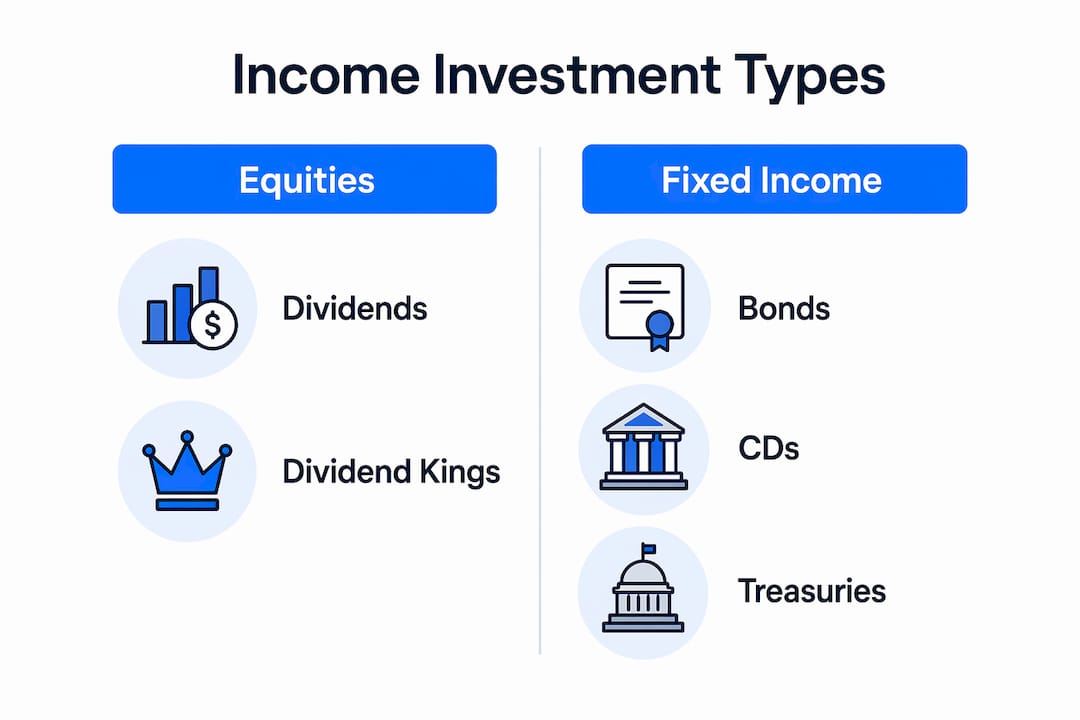
Income-generating assets fall into three broad categories: equities that pay dividends, fixed income instruments, and real estate vehicles. Each works differently, carries different risk, and responds differently to economic conditions.
Dividend-paying stocks
Dividend stocks pay shareholders a portion of company earnings, typically every quarter. The most reliable payers belong to a group called Dividend Kings, companies that have raised their dividend for at least 50 consecutive years. Johnson & Johnson and Colgate-Palmolive both qualify, with 64 consecutive years of dividend increases. That kind of streak does not happen by accident. It requires durable pricing power, consistent free cash flow, and management that treats the dividend as a commitment rather than a bonus.

Not every dividend stock is a slow-and-steady Dividend King. AbbVie, for example, reported $15 billion in total revenue in Q1 2026, with its drug Skyrizi up 31% and Rinvoq up 23%. AbbVie combines a high current yield with real revenue growth. That profile suits investors who want income today and the potential for dividend increases tomorrow.
Fixed income investments
Fixed income is the category most investors associate with bonds, certificates of deposit (CDs), and Treasury securities. The term “fixed” can mislead. Fixed income denotes scheduled payment obligations, not necessarily fixed dollar amounts. Floating-rate notes, for instance, adjust their coupon payments as benchmark interest rates move. That distinction matters when you are building a portfolio to last through multiple rate cycles.
Bonds pay interest (the coupon) at set intervals and return principal at maturity. Credit quality, duration, and yield all interact. A long-duration bond is more sensitive to rate changes than a short-duration one. A high-yield bond pays more but carries more default risk. Matching these characteristics to your income timeline is the core skill in fixed income portfolio management.
Real estate income
REITs give individual investors access to real estate income without buying property directly. A REIT must distribute at least 90% of its taxable income to shareholders, which makes them structurally high-yield vehicles. Rental properties offer a different profile: more control, more concentration risk, and income that depends heavily on local market conditions.
Dividend-paying stocks, bonds, and REITs differ significantly in yield, risk, liquidity, and sensitivity to economic conditions. Combining all three forces you to think about how each piece behaves when the others are under stress. That is the foundation of a resilient income portfolio.
How do you build a diversified income portfolio?
A well-built income portfolio does not rely on a single asset class. Investors layer strategies to generate income across market cycles rather than depending solely on bonds. The goal is to spread risk across issuers, maturities, sectors, and asset types so that no single event can cut your income stream in half.
Here is a practical framework for building that kind of portfolio:
- Start with your income target. Calculate the monthly or annual income you need. Work backward to determine how much capital you must deploy and at what average yield. This prevents you from chasing yield just to hit a number.
- Anchor with investment-grade bonds. Use Treasury bonds or high-grade corporate bonds as the stable core. These protect capital and provide predictable cash flow even when equity markets fall.
- Build a bond ladder. Rolling maturities provide diversification across interest rate environments and support cash flow stability. A ladder with bonds maturing in one, three, five, and seven years means you always have capital coming due to reinvest at current rates.
- Add dividend stocks for growth. Dividend Kings and similar payers add income that grows over time. A bond coupon stays fixed; a well-chosen dividend stock raises its payout year after year.
- Include REITs for real estate exposure. REITs diversify your income source and often move independently of both stocks and bonds. Limit this allocation to a minority of the portfolio to control concentration risk.
- Review currency exposure. If you hold international assets, currency diversification strategies can protect your income from exchange rate swings that erode purchasing power.
Pro Tip: Rebalance your income portfolio at least once a year. Dividend cuts, bond maturities, and REIT distribution changes all shift your income mix. A portfolio that looked balanced in january can look very different by december.
What metrics determine income investment quality?
Yield is the number most investors look at first. It is also the number most likely to mislead them. A high yield can signal a strong business or a business in distress. Separating the two requires looking past the yield itself.
The most reliable indicator of dividend sustainability is free cash flow. Colgate funds its dividend with $3.6 billion in free cash flow. That number tells you the dividend is not being borrowed from future earnings. Pricing power matters too. A company that can raise prices without losing customers protects its margins and, by extension, its dividend.
Key metrics to evaluate before buying any income investment:
- Payout ratio. Dividends divided by earnings. A ratio above 80% leaves little room for error. Below 60% suggests the dividend has room to grow.
- Dividend growth streak. Consecutive years of increases signal management commitment and business durability. Dividend Kings (50+ years) and Dividend Aristocrats (25+ years) are the two recognized tiers.
- Free cash flow coverage. Cash flow, not just earnings, must cover the dividend. Earnings can be managed; cash flow is harder to fake.
- Bond credit rating. Investment-grade ratings (BBB or higher from S&P) indicate lower default risk. Below investment grade means higher yield but real risk of missed payments.
- Duration. A bond’s sensitivity to interest rate changes. Short-duration bonds lose less value when rates rise. Long-duration bonds gain more when rates fall.
Chasing yield without checking these metrics is the most common mistake individual investors make. A 10% yield on a stock with a 120% payout ratio is not income. It is a dividend cut waiting to happen. Finblog covers this risk in detail in its analysis of why high-yield dividend bets disappoint.
How to apply income investing strategies in 2026
The 2026 market environment rewards investors who combine multiple income levers rather than betting on one. Structural and operational customizations unlock income potential beyond the traditional set-it-and-forget-it bond portfolio. That means blending dividend stocks, fixed income, and real assets in proportions that match your specific cash flow needs.
Colgate-Palmolive illustrates why quality beats yield in the long run. Its dividend has been uninterrupted since 1895. That is not a marketing claim. It is a track record that survived two world wars, multiple recessions, and decades of inflation. Investors who held Colgate through volatile periods collected every payment without interruption.
AbbVie shows a different but equally valid approach. Its revenue growth from Skyrizi and Rinvoq funds both current dividends and future increases. Growth-oriented income stocks like AbbVie suit investors who can tolerate more near-term volatility in exchange for faster dividend growth.
Pro Tip: When interest rates are falling, lock in longer bond maturities to preserve your yield. When rates are rising, keep maturities short and reinvest at higher rates as bonds mature. A bond ladder makes this adjustment automatic.
Interest rate cycles also affect REITs and dividend stocks. When rates rise, REIT prices often fall because their yields look less attractive compared to bonds. That creates buying opportunities for long-term income investors. Understanding how to invest during market volatility helps you act on those opportunities instead of reacting to short-term price moves.
The modern approach to earning monthly income combines all of these elements. You draw from bond coupons, quarterly dividends, and REIT distributions to create a cash flow calendar that pays you throughout the year. Structuring your holdings so that payments arrive in different months smooths your income and reduces the psychological pressure of waiting for a single annual payout.
Key Takeaways
A resilient income portfolio requires quality assets, diversification across multiple income sources, and regular review to protect cash flow through every market cycle.
| Point | Details |
|---|---|
| Quality over yield | Check free cash flow and payout ratios before buying any dividend stock or bond. |
| Diversify income sources | Combine dividend stocks, bonds, and REITs to reduce dependence on any single asset class. |
| Use a bond ladder | Stagger maturities to manage interest rate risk and maintain steady reinvestment opportunities. |
| Track dividend streaks | Dividend Kings with 50+ years of increases signal durable businesses and reliable payouts. |
| Review and rebalance | Reassess your income mix at least annually to account for dividend changes and bond maturities. |
Why I think most income investors are solving the wrong problem
Most investors I talk to frame income investing as a yield problem. They want to know which stock pays the most or which bond offers the highest coupon. That is the wrong question. The right question is: which assets will keep paying me five, ten, or twenty years from now?
Colgate’s 64-year dividend streak did not happen because the company chased the highest yield. It happened because the business generates real cash, sells products people buy regardless of economic conditions, and treats the dividend as a financial obligation. That is the model worth copying.
The other mistake I see constantly is treating income investing as a passive activity. You set up your portfolio, collect your payments, and assume nothing needs to change. Markets shift. Interest rates move. Companies cut dividends. A portfolio that was well-constructed in 2020 may be dangerously concentrated today. Regular reviews are not optional. They are the difference between a portfolio that keeps paying and one that quietly deteriorates.
My honest advice: start with the quality filter, not the yield screen. Find businesses with pricing power, long dividend histories, and free cash flow that covers the payout with room to spare. Then diversify across asset classes and maturities. The income will follow, and it will last.
— Povilas
Finblog resources for income investors
Finblog publishes in-depth guides for investors who want to build and maintain income-generating portfolios. The dividend investing strategy guide covers how to select reliable payers and structure a dividend-focused portfolio for long-term income. For investors navigating rate changes and market swings, the article on investing strategies for 2025 details how income approaches evolved through a challenging market environment. Whether you are starting your first income portfolio or refining an existing one, Finblog’s educational content gives you the frameworks to make decisions with confidence. Visit Finblog to access the full library of investment guides.
FAQ
What is income investing?
Income investing is a portfolio strategy focused on generating regular cash flow through dividends, bond interest, and real estate distributions. It prioritizes consistent income over capital appreciation.
What are the best dividend stocks for income investors?
Dividend Kings like Johnson & Johnson and Colgate-Palmolive are among the most reliable, with 64 consecutive years of dividend increases. Growth-oriented payers like AbbVie combine current yield with strong revenue growth.
How do fixed income investments work?
Fixed income investments pay scheduled interest (coupons) and return principal at maturity. The term “fixed” refers to the payment schedule, not the dollar amount, since floating-rate notes adjust with benchmark rates.
What is a bond ladder and why does it matter?
A bond ladder staggers bond maturities across multiple years so that capital matures regularly and can be reinvested at current rates. This reduces interest rate risk and keeps income flowing regardless of rate direction.
How do I evaluate whether a dividend is sustainable?
Check the payout ratio (ideally below 60%), free cash flow coverage, and the length of the company’s dividend increase streak. A dividend backed by strong free cash flow and pricing power is far more durable than one supported only by earnings.