



TL;DR:
- Financial literacy helps students manage personal finance, avoid debt, and build savings for long-term stability.
- Low financial literacy increases the risk of insufficient savings and financial stress, affecting academic success.
Financial literacy is the ability to understand and manage personal finances effectively, and it is one of the most critical skills students can develop before entering adult life. Only 49% of financial literacy questions are answered correctly by U.S. adults, a number that has barely moved in a decade. That gap starts early. Students who graduate without a basic grasp of budgeting, credit, and saving face real consequences: debt they cannot manage, savings they never build, and financial stress that follows them for years. The TIAA Institute and GFLEC track 28 financial topics to measure this gap, and the results consistently show that formal financial education for students is not optional. It is the foundation of long-term stability.
Why is financial literacy important for students?
Financial literacy gives students the tools to make decisions that affect every part of their lives, from paying tuition to avoiding predatory credit offers. Without it, money becomes a source of confusion and anxiety rather than a resource to build with.
The benefits show up in concrete ways:
- Budgeting skills let students track income and expenses, so they do not run out of money before the month ends.
- Spending control prevents impulse purchases that drain accounts set aside for rent or textbooks.
- Reduced financial stress directly supports academic performance. Money-related stress affects nearly 70% of Americans, and students are not immune. When money anxiety drops, focus on coursework improves.
- Confidence in decision-making grows when students understand the difference between a good loan and a bad one, or between a credit card and a debit card.
- Long-term independence starts with small habits formed early, like saving a fixed percentage of every paycheck or avoiding carrying a credit card balance.
Financial literacy also builds resilience. Students who understand budgeting and debt management recover faster from financial setbacks, whether that means a car repair, a missed shift at work, or an unexpected medical bill.
Pro Tip: Set up a simple zero-based budget at the start of each semester. Assign every dollar of income to a category, including savings, before you spend anything. This one habit prevents most student overspending.

The importance of financial education goes beyond personal benefit. Financially literate individuals contribute to stronger local economies through responsible financial behaviors. Students who learn these skills become adults who invest, save, and avoid predatory debt, which strengthens communities over time.
What happens when students lack financial knowledge?
The consequences of poor financial literacy are not abstract. They show up in credit scores, savings accounts, and mental health.
“Low financial literacy doubles the likelihood of being debt-constrained and quintuples the risk of having insufficient savings.” — TIAA Institute, 2025–2026
That statistic deserves attention. Quintupling the risk of insufficient savings means students without financial education are five times more likely to have no safety net when something goes wrong. And things go wrong. Only 56% of adults can access extra funds within 30 days for unexpected financial shocks. For students living on tight budgets, that number is almost certainly lower.
Poor credit management is another direct consequence. Credit mismanagement starts young, and the damage to credit scores can take years to repair. A student who maxes out a credit card at 19 may still be dealing with that decision at 25, paying higher interest rates on car loans and apartment deposits.
Financial stress also pulls students away from their academic goals. When rent is uncertain or a credit card bill is overdue, it is hard to concentrate on coursework. This creates a cycle where financial problems reduce academic performance, which reduces future earning potential, which makes financial problems worse.
The generational dimension matters too. Students who never receive formal financial education often repeat the financial mistakes of their parents. Teaching financial literacy in schools breaks that cycle by giving every student the same foundational tools, regardless of what they learned at home.
Core financial skills every student should build
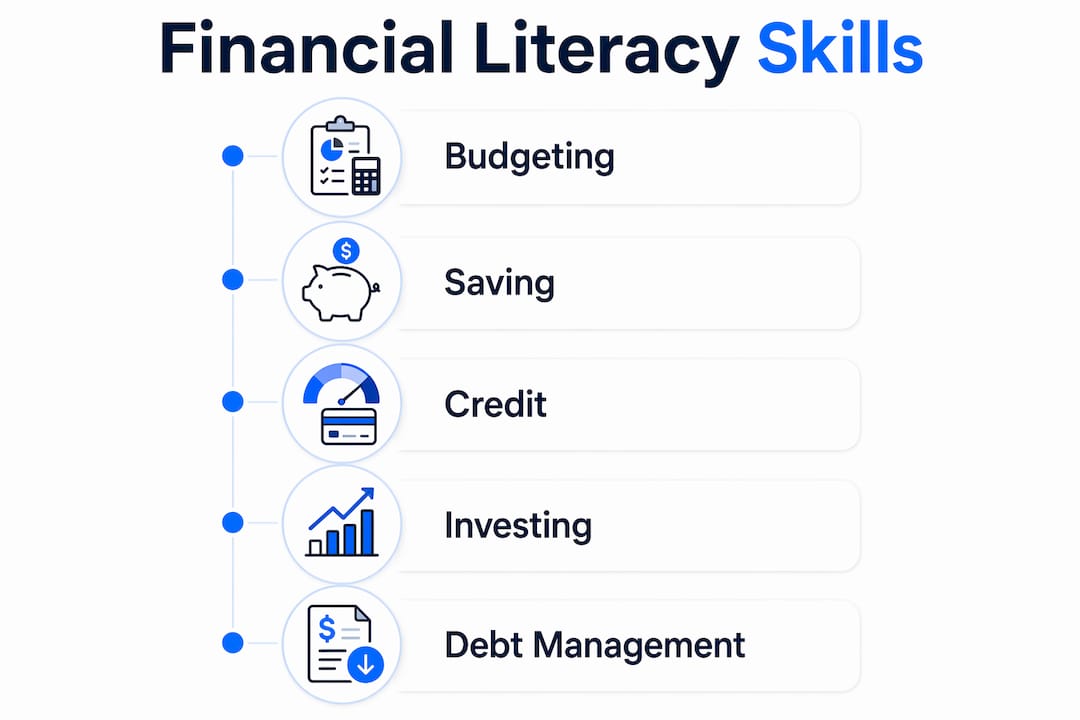
Strong financial literacy rests on five foundational areas. Each one builds on the others.
| Skill | What it means for students |
|---|---|
| Budgeting | Tracking income and expenses monthly to avoid overspending |
| Emergency savings | Setting aside funds to cover 1–3 months of basic expenses |
| Debt management | Understanding interest rates and prioritizing high-cost debt first |
| Credit score basics | Knowing how payment history and utilization affect borrowing costs |
| Basic investing | Understanding compound interest and low-cost index funds |
Each of these skills connects directly to student life. Budgeting covers tuition payments and grocery runs. Emergency savings prevent a single bad month from becoming a financial crisis. Debt management is critical for anyone carrying student loans. Credit score knowledge protects students from costly borrowing mistakes for years after graduation. Basic investing, even at a small scale, teaches the principle that money grows over time when left alone.
Students who want a structured starting point can use Finblog’s guide for beginners to work through these five areas in order. The guide is built for readers with no prior financial background.
- Budgeting tools like spreadsheets or free apps make tracking spending visible and concrete.
- Savings goals work best when automated. Set up a recurring transfer on payday so saving happens before spending.
- Debt prioritization using the avalanche method (highest interest rate first) saves the most money over time.
- Credit monitoring through free services lets students catch errors and track progress without paying fees.
- Investment basics start with understanding that a 7% average annual return doubles money roughly every 10 years.
How can students actually improve their financial literacy?
Knowing financial literacy matters is not enough. Students need specific steps to build these skills.
-
Start with free government programs. The FDIC’s Money Smart program offers free, unbiased financial education covering budgeting, credit, and savings. Parents often provide biased financial advice, shaped by their own financial experiences and mistakes. Official programs like Money Smart give students a neutral, research-backed foundation instead.
-
Take one free online course. Platforms like Khan Academy and Coursera offer personal finance courses at no cost. Completing even one course builds vocabulary and confidence that makes every financial decision easier.
-
Simulate real decisions before making them. Before signing a lease or taking out a loan, run the numbers on paper first. Calculate the total cost including interest, fees, and opportunity cost. This habit prevents the most common student financial mistakes.
-
Track spending for 30 days. Most students underestimate how much they spend on food, subscriptions, and small purchases. A single month of tracking reveals patterns that are impossible to see otherwise.
-
Build lasting financial habits early. Financial literacy is cumulative. The habits formed at 18 or 19 compound over decades. Starting early is the single biggest advantage a student has.
Pro Tip: Use the 50/30/20 rule as a starting framework: 50% of income to needs, 30% to wants, and 20% to savings and debt repayment. Adjust the percentages as your situation changes, but keep the structure.
Avoiding common pitfalls matters as much as building good habits. Credit card minimum payments, buy-now-pay-later schemes, and payday loans all carry costs that are easy to miss at first glance. Students who understand interest calculations can spot these traps before they become problems.
Key Takeaways
Financial literacy is the single most transferable skill students can build, because it directly determines their ability to manage debt, build savings, and avoid the financial stress that derails academic and personal goals.
| Point | Details |
|---|---|
| Start with the basics | Master budgeting, saving, and credit before tackling investing or complex debt. |
| Literacy gaps are measurable | Only 49% of U.S. adults answer financial literacy questions correctly, showing the scale of the problem. |
| Poor literacy has real costs | Low financial literacy quintuples the risk of insufficient savings and doubles debt-constraint likelihood. |
| Use trusted free resources | FDIC Money Smart and similar government programs provide unbiased, research-backed financial education. |
| Early habits compound | Financial skills built in your late teens and early twenties shape your financial health for decades. |
Financial education is not a luxury for students
I have watched students graduate with strong GPAs and almost no understanding of how interest works. They sign loan agreements without reading the terms, carry credit card balances because they do not realize the cost, and hit their mid-twenties with debt loads that take years to unwind. The problem is not intelligence. It is exposure.
What strikes me most is how preventable this is. A single semester of financial education, even an informal one, changes the decisions students make for the rest of their lives. The student who learns to calculate compound interest at 19 does not carry a revolving credit card balance at 25. The student who builds an emergency fund in college does not panic when the car breaks down at 27.
The path to financial independence is not complicated. It requires consistent habits, basic knowledge, and the confidence to make decisions based on facts rather than fear. Schools and universities that integrate financial education into their programs give students a genuine advantage, not just academically but in every dimension of adult life. Students who seek this knowledge out, even when it is not required, are making one of the best investments available to them.
— Povilas
Build your financial foundation with Finblog
Finblog publishes practical, research-backed guides designed for readers who are serious about building financial skills from the ground up. Whether you are working through your first budget, trying to understand student loan debt, or ready to move into investing, the resources at Finblog cover each stage clearly. The guides are written for real people managing real money, not for finance professionals. If you are ready to move from knowing financial literacy matters to actually practicing it, Finblog’s full resource library is a direct and practical place to start.
FAQ
Why is financial literacy important for students specifically?
Students face major financial decisions, including student loans, credit cards, and housing costs, before they have experience managing money. Financial literacy gives them the skills to make those decisions without costly mistakes.
What are the biggest risks of low financial literacy?
Low financial literacy doubles debt-constraint risk and quintuples the likelihood of insufficient savings. Students without these skills are far more vulnerable to financial shocks and long-term debt.
What is the best free resource for student financial education?
The FDIC’s Money Smart program is one of the most trusted free resources available. It covers budgeting, credit, savings, and debt management with unbiased, government-backed content.
How does financial stress affect students academically?
Financial worries are the top stressor for nearly 70% of Americans. For students, that stress reduces concentration, increases absenteeism, and can push people to drop out entirely.
When should students start learning about personal finance?
The earlier, the better. Financial literacy is cumulative, meaning early knowledge of credit and interest prevents mistakes that affect credit scores for years. Starting in high school gives students the longest runway to build good habits.