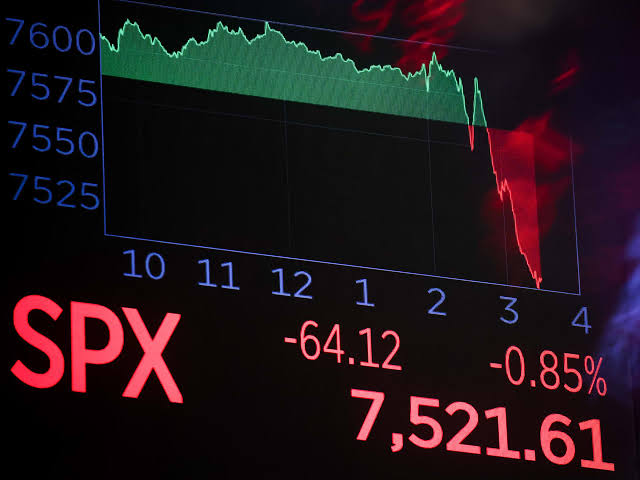

Q1 2026 began with record highs, but quickly turned into a difficult period for Big Tech as war, oil, and shifting expectations hit valuations.
The so-called “Magnificent Seven” stocks, long seen as the backbone of the market rally, have now all fallen sharply from their recent highs. What was once the strongest trade on Wall Street is now under pressure, and investors are hesitating to step in, even as prices look more attractive.
From Market Leaders to Correction Territory
Every Mag 7 stock is now down double digits from its peak.
- Microsoft has dropped around 32% from its highs
- Meta is down roughly 25%
- Alphabet has fallen about 15%
- Nvidia and Amazon are also negative this year
A broader index tracking the group has officially entered correction territory, falling more than 10% from its record levels.
This marks a sharp reversal from previous years, when the same group delivered massive gains:
- +107% in 2023
- +67% in 2024
- +25% in 2025
Now, the momentum has clearly shifted.
What Changed So Fast?
Several forces hit Big Tech at the same time, but the biggest catalyst has been the Iran war.
The conflict triggered a surge in oil prices, which has:
- Reignited inflation fears
- Changed expectations for interest rates
- Reduced the appeal of growth stocks
Markets are now pricing in a higher chance of rate hikes instead of cuts, removing one of the key supports for tech valuations.
At the same time, investor sentiment around AI has also cooled. Instead of being excited about massive AI spending, markets are now questioning it. Big Tech companies are expected to spend more than $650 billion on AI infrastructure in 2026, a huge increase from last year.
That level of spending is now being seen as a risk to margins, not just a growth opportunity.
Money Is Moving Elsewhere
Institutional investors are not just sitting still, they are rotating capital.
Money is flowing out of: Big Tech, Growth stocks
And moving into: Energy, Industrials, Domestic manufacturing
This shift reflects a broader change in market priorities, from growth to stability and real assets, especially in a world shaped by geopolitical risk.
So Why Aren’t Investors Buying the Dip?
On paper, valuations are starting to look more reasonable. Some investors argue that:
- Big Tech earnings remain strong
- Balance sheets are still solid
- Valuations are now closer to historical norms
But the hesitation comes down to one thing: uncertainty. The Iran war has introduced risks that are difficult to model:
- Oil supply disruptions
- Escalation scenarios
- Global economic slowdown
Even traditional valuation frameworks struggle to account for these variables.
More Than Just War: Additional Pressure Builds
The Mag 7 are also dealing with company-specific challenges:
- Microsoft’s AI products facing criticism
- Meta losing a major social media lawsuit
- Ongoing uncertainty around AI partnerships and strategy
These issues add to the broader pressure coming from macroeconomic conditions.
Still a Bull Case?
Despite the selloff, not everyone is turning bearish. Some strategists believe:
- The AI boom is still intact
- Earnings growth will continue
- US tech could outperform globally later this year
There is also a view that current levels could eventually present long-term buying opportunities, especially if the geopolitical situation stabilizes. The Mag 7 are no longer the unstoppable force they were over the past few years. They are now caught between:
- Rising oil and inflation
- Shifting Fed policy
- Questions around AI spending
- And growing geopolitical risk
For now, investors are watching rather than buying. The dip may be there, but confidence is not
Related: What Went Wrong and Right for Stocks Q1 2026?
Disclosure: This article does not represent investment advice. The content and materials featured on this page are for educational purposes only.