
Balancing a busy career while making smart investment choices can be challenging, especially when the options seem endlessly complex. Choosing between Exchange-Traded Funds and Mutual Funds is a common crossroads for those looking to build a diversified, professionally managed portfolio with long-term stability. Understanding the distinct differences in how these funds operate, trade, and impact your taxes gives you the clarity and control needed for effective financial planning.
Table of Contents
- ETF And Mutual Fund Fundamentals Explained
- Types And Management Styles Of Each Fund
- Trading, Liquidity, And Investment Flexibility
- Expenses, Tax Impacts, And Hidden Costs
- Risks, Misconceptions, And Common Mistakes
Key Takeaways
| Point | Details |
|---|---|
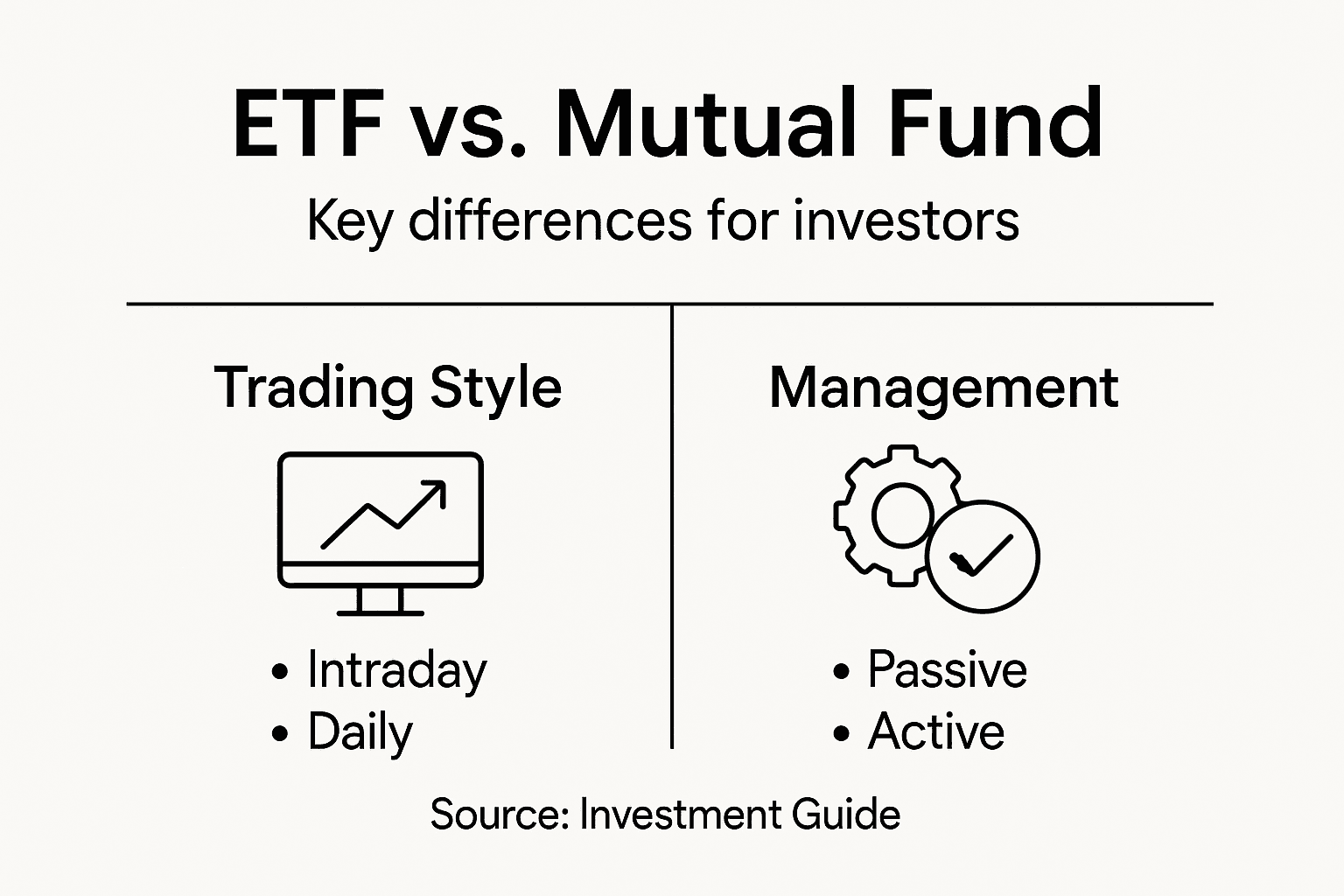
| ETFs vs. Mutual Funds | ETFs offer intraday trading flexibility and often lower fees, while mutual funds are typically actively managed and priced once daily. |
| Investment Control | ETFs provide investors with dynamic portfolio management through real-time trades, compared to the limited trading flexibility of mutual funds. |
| Cost Considerations | Consider both visible and hidden costs, including expense ratios and potential tax implications, when choosing between ETFs and mutual funds. |
| Risk Awareness | Understand that both investment types involve inherent risks; avoid emotional decision-making and focus on long-term strategies. |
ETF and mutual fund fundamentals explained
Investors seeking diversified investment strategies have two powerful tools at their disposal: Exchange-Traded Funds (ETFs) and Mutual Funds. These investment vehicles allow individuals to pool money together and invest in a broad range of assets, providing professional management and risk distribution.
At their core, both ETFs and mutual funds are pooled investment structures that enable investors to purchase shares representing fractional ownership in a diversified portfolio. However, they differ significantly in their trading mechanisms, tax implications, and operational structures:
-
Mutual Funds:
- Priced once daily after market close
- Shares bought/redeemed directly through fund companies
- Professional fund managers actively select investments
- Typically have higher management expenses
- Capital gains distributed automatically to shareholders
-
ETFs:
- Trade like stocks throughout market hours
- Prices fluctuate in real-time
- Often passively track market indexes
- Generally lower expense ratios
- More tax-efficient due to creation/redemption process
The key distinction lies in their trading and management approach. Mutual funds are actively managed, with fund managers attempting to outperform market benchmarks. ETFs, by contrast, usually track specific market indexes, providing more predictable performance aligned with broader market trends.
Here is a summary of how ETFs and mutual funds differ in key operational areas:
| Category | ETFs | Mutual Funds |
|---|---|---|
| Pricing & Trading | Real-time, intraday trading | Priced once after market close |
| Tax Efficiency | Generally more tax efficient | More frequent capital gains |
| Fee Structure | Lower expense ratios, fewer fees | Higher expenses, possible loads |
| Management Style | Mostly passive index tracking | Frequently active management |
| Liquidity | Highly liquid, instant trades | Less liquid, daily liquidity |
Investment Control and Flexibility
ETFs offer investors greater trading flexibility. You can buy and sell shares instantly during market hours, set limit orders, and even short sell – options not typically available with traditional mutual funds. This real-time tradability makes ETFs particularly attractive for investors who want more dynamic portfolio management.

Cost and Performance Considerations
Cost structures vary between these investment types. Mutual funds often carry higher expense ratios due to active management, while ETFs tend to have lower fees because they typically track existing indexes.
Risk and Diversification
Both investment vehicles provide diversification, spreading risk across multiple securities. However, the specific risk profile depends on the underlying assets and investment strategy. Some ETFs and mutual funds focus on specific sectors, while others provide broad market exposure.
Pro tip: Before investing, carefully analyze the expense ratios, trading costs, and underlying assets of both ETFs and mutual funds to align with your specific financial goals and risk tolerance.
Types and management styles of each fund
Investors navigating the world of investment funds encounter two primary structures: Exchange-Traded Funds (ETFs) and Mutual Funds, each offering unique management styles and investment approaches. ETF and mutual fund categories reveal a complex landscape of investment strategies designed to meet diverse financial objectives.
Fund types can be broadly categorized into two primary management approaches:
-
Passive Management:
- Tracks market indexes
- Minimal trading activity
- Lower expense ratios
- Aims to match market performance
-
Active Management:
- Professional managers select investments
- Attempts to outperform market benchmarks
- Higher management fees
- More frequent trading and portfolio adjustments
Passive Investment Strategies
Passive funds, particularly ETFs, have gained significant popularity due to their cost-effectiveness and transparency. These funds typically mirror established market indexes like the S&P 500, providing investors with broad market exposure without the complexity of individual stock selection.
Active Management Dynamics
Mutual funds traditionally dominate the actively managed space. Fund managers conduct extensive research, analyze market trends, and make strategic investment decisions aimed at generating returns that exceed standard market performance. This approach requires more intensive management and typically results in higher operational costs.
Investment Vehicle Characteristics
Both ETFs and mutual funds offer multiple investment categories, including:
- Equity funds
- Fixed-income funds
- Sector-specific funds
- International market funds
- Commodity-based funds
The evolution of investment vehicles continues to blur traditional management boundaries, with increasingly sophisticated strategies emerging in both ETF and mutual fund structures.
Structural Differences
The fundamental difference lies in how these funds are traded and managed. ETFs provide intraday trading flexibility and often have lower expense ratios, while mutual funds are priced once daily and may offer more complex active management strategies.
Pro tip: Carefully assess your investment goals, risk tolerance, and desired level of management involvement when choosing between passive ETFs and actively managed mutual funds.
Trading, liquidity, and investment flexibility
Investors seeking dynamic investment strategies must understand the critical differences in trading mechanisms between Exchange-Traded Funds (ETFs) and Mutual Funds. Trading flexibility varies significantly between these investment vehicles, impacting an investor’s ability to manage their portfolio strategically.
Trading Characteristics Comparison:
-
ETF Trading Features:
- Trade like stocks during market hours
- Real-time price fluctuations
- Ability to use advanced trading orders
- Instant buy/sell capabilities
-
Mutual Fund Trading Features:
- Priced once daily after market close
- Transactions processed at end-of-day Net Asset Value (NAV)
- Limited trading flexibility
- No intraday trading options
Liquidity Dynamics
Liquidity represents an investor’s ability to convert investments into cash quickly. ETFs offer superior liquidity, allowing investors to execute trades instantly throughout the trading day. Mutual funds, by contrast, require investors to wait until the market closes to complete transactions at the day’s final pricing.
Investment Flexibility Nuances
The trading differences create substantial flexibility advantages for ETF investors. With ETFs, you can:
- Execute limit orders
- Place stop-loss orders
- Short sell
- Make immediate portfolio adjustments
ETFs provide investors unprecedented control over their investment timing and strategy, transforming traditional investment approaches.
Order Type Capabilities
ETF investors enjoy more sophisticated trading options comparable to individual stock trading. This means implementing complex investment strategies becomes more accessible, allowing for more responsive portfolio management.
Cost and Transaction Considerations
While ETFs offer more trading flexibility, investors should remain aware of potential brokerage commissions and bid-ask spreads that can impact overall transaction costs. Mutual funds typically have different fee structures, often charging redemption fees for early withdrawals.
Pro tip: Evaluate your personal investment strategy and trading frequency to determine whether the intraday flexibility of ETFs outweighs the potential transaction costs compared to traditional mutual funds.
Expenses, tax impacts, and hidden costs
Navigating the complex landscape of investment expenses requires a nuanced understanding of how Exchange-Traded Funds (ETFs) and Mutual Funds differ in their cost structures. Tax implications play a crucial role in determining the true cost of investment vehicles beyond their apparent expense ratios.
Expense Ratio Breakdown:
-
ETF Cost Components:
- Lower management fees
- Minimal transaction costs
- Often commission-free trading
- Typically lower overall expenses
-
Mutual Fund Cost Components:
- Higher management expenses
- Potential sales loads
- Redemption fees
- More complex fee structures
Tax Efficiency Dynamics
ETFs demonstrate superior tax efficiency through innovative redemption mechanisms. By utilizing in-kind transactions, ETFs can minimize capital gains distributions, effectively reducing investors’ tax liabilities. Mutual funds, conversely, often trigger taxable events through more frequent portfolio rebalancing and cash redemptions.
Hidden Cost Considerations
Beyond visible expense ratios, investors must evaluate several less apparent costs:
- Bid-ask spreads
- Brokerage commissions
- Transaction fees
- Potential tax implications
The true cost of an investment extends far beyond its published expense ratio, requiring careful analysis of multiple financial factors.
Comparative Cost Analysis
While ETFs generally offer lower expenses, investors should not automatically assume they are always the most cost-effective option. Some mutual funds, particularly index-based versions, can compete favorably in terms of overall expenses.
Strategic Cost Management
Sophisticated investors recognize that minimizing costs involves more than comparing simple percentage points. It requires a holistic view of potential tax consequences, trading flexibility, and long-term investment performance.
Pro tip: Calculate the total cost of ownership by considering expense ratios, potential tax impacts, and transaction costs rather than focusing solely on published fees.
Risks, misconceptions, and common mistakes
Investors navigating Exchange-Traded Funds (ETFs) and Mutual Funds must understand the nuanced landscape of potential risks and prevalent misconceptions. Investment risks extend beyond simple performance metrics, requiring a comprehensive approach to financial strategy.
Common Investment Misconceptions:
-
Risk Perception Errors:
- Believing funds are risk-free
- Overlooking underlying market volatility
- Assuming past performance guarantees future returns
- Ignoring potential loss scenarios
-
Performance Misunderstandings:
- Overemphasizing short-term gains
- Neglecting risk-adjusted returns
- Misinterpreting benchmark comparisons
- Underestimating fee impacts
Market Risk Fundamentals
Both ETFs and mutual funds are subject to market fluctuations. Investors often mistakenly view these investment vehicles as guaranteed instruments, forgetting they are not FDIC-insured and can experience significant value changes based on market conditions.
Performance Evaluation Pitfalls
Many investors fall into common analytical traps when evaluating investment performance:
- Focusing exclusively on raw returns
- Neglecting risk-adjusted metrics
- Failing to account for expense ratios
- Overlooking tax efficiency implications
The most dangerous investment mistake is believing you can predict market movements with absolute certainty.
Strategic Risk Management
Effective risk management requires a holistic approach that goes beyond surface-level performance indicators. Sophisticated investors analyze multiple factors, including fund structure, management strategy, and potential tax consequences.
Psychological Investment Traps
Emotional decision-making often leads investors astray. The tendency to chase performance, panic during market downturns, or make impulsive investment choices can significantly undermine long-term financial goals.
This table highlights common investor mistakes and ways to avoid them:
| Mistake Type | Example Error | Proactive Solution |
|---|---|---|
| Misjudging Risk | Treating funds as risk-free | Assess portfolio volatility |
| Ignoring Fees | Overlooking expense ratios | Review all fee disclosures |
| Focusing on Short-Term | Reacting to recent performance spikes | Monitor long-term trends |
| Emotional Investing | Making impulsive buy/sell decisions | Set clear, objective strategies |
Pro tip: Develop a disciplined investment strategy that prioritizes comprehensive risk assessment over short-term performance fluctuations.
Take Control of Your Portfolio with Expert Guidance on ETFs and Mutual Funds
Understanding the difference between ETFs and Mutual Funds is essential to build a diversified investment portfolio that aligns with your financial goals and risk tolerance. This article highlights key challenges such as managing cost structures, trading flexibility, and tax efficiency that can impact your investment success. If you have ever felt overwhelmed by choices around fund types, management styles, or worried about hidden fees and tax impacts this is your opportunity to gain clarity.
Explore tailored solutions designed to help you navigate these complexities with confidence. Whether you seek professional advice on active versus passive management or want to optimize your trading strategy for better liquidity and lower costs our secure and user-friendly platform at finblog.com is here to support you. Discover how to avoid common investor mistakes and develop a disciplined approach by leveraging expert insights available at finblog.com. Take the next step and unlock personalized financial consultations by visiting finblog.com now. Making informed choices about ETFs and Mutual Funds starts here.
Frequently Asked Questions
What are the main differences between ETFs and mutual funds?
ETFs trade like stocks throughout the day, with real-time price fluctuations, while mutual funds are priced once daily after the market closes. Additionally, ETFs often have lower expense ratios and are more tax-efficient compared to mutual funds, which typically involve higher management fees.
How do the expense ratios of ETFs compare to those of mutual funds?
ETFs generally have lower expense ratios because they often passively track market indexes with minimal trading activity. In contrast, mutual funds usually have higher expenses due to active management strategies that require more intensive oversight and frequent trading.
What are the tax implications of investing in ETFs versus mutual funds?
ETFs tend to be more tax-efficient, as they use an in-kind redemption process that minimizes capital gains distributions. Mutual funds, however, may trigger taxable events more frequently due to their strategy of rebalancing and cash redemptions, which can result in higher capital gains taxes for investors.
Can I trade ETFs and mutual funds at any time during the day?
ETFs can be bought and sold throughout the market day at varying prices, giving investors real-time trading flexibility. Mutual funds, on the other hand, can only be bought or sold at the end of the trading day at the calculated net asset value (NAV).