Navigating the world of charitable giving is more complex than a simple donation of funds to your favorite nonprofit. For many affluent professionals, aligning philanthropy with investment strategies means unlocking greater social impact while optimizing for tax efficiency. By understanding the voluntary two-sided process of giving and recognizing common myths about charities, you can maximize both your financial benefits and the effectiveness of your support.
Table of Contents
- Charitable Giving Defined And Common Myths
- Major Types Of Charitable Contributions
- Tax Advantages And Financial Planning Strategies
- Integrating Philanthropy With Investment Goals
- Legal Rules, Compliance, And Risk Avoidance
Key Takeaways
| Point | Details |
|---|---|
| Understand the Reciprocity in Giving | Charitable giving is a two-sided process where both donors and organizations make mutual decisions about contributions. Recognizing this can enhance strategic giving. |
| Dispel Common Charity Myths | Misconceptions about charities can prevent affluent donors from supporting deserving organizations. Understand the realities of nonprofit operations for informed contributions. |
| Leverage Tax Strategies for Giving | Utilizing donor-advised funds and structured giving can optimize your tax situation while amplifying your philanthropic impact. Consult a tax advisor for tailored strategies. |
| Ensure Legal Compliance | Donors must verify nonprofit status and document gifts properly to secure tax deductions and avoid complications. Consult legal experts when needed to mitigate risks. |
Charitable Giving Defined and Common Myths
Charitable giving operates as a voluntary two-sided process where you decide to donate and organizations choose whether to accept your contribution. This mutual decision-making is more nuanced than most donors realize. Your giving isn’t simply a one-way transaction where money moves from your account to a nonprofit’s bank account. The organization evaluates whether your donation aligns with their mission, funding capacity, and operational needs. This reciprocal nature matters because it affects everything from how your contribution gets deployed to the recognition and gratification you receive in return.
What complicates this straightforward definition is how framing and information shape your behavior as a donor. Research on donor decision-making and voluntariness reveals that the way organizations present giving options significantly influences both your choice to donate and the amount you give. Default settings, suggested donation levels, and the timing of asks all push your decision in particular directions, sometimes without you realizing it. This isn’t manipulation in the traditional sense, but it does challenge the common misconception that donations always stem from fully informed, completely autonomous choices. When you encounter a pre-filled donation amount or a suggested giving tier, that’s not neutral presentation. It’s designed to guide your decision.
Misunderstandings about how charities operate create unnecessary skepticism among affluent donors like yourself. ICAEW guidance on charity myths addresses widespread misconceptions that distort your perception of nonprofit effectiveness. Common myths include beliefs that charities operate entirely with volunteer labor, that overhead spending represents waste, that executive compensation is inappropriate, or that organizations are perpetually vulnerable to fraud. These myths aren’t just incorrect. They actively prevent capable donors from supporting organizations that deserve funding. The reality is that well-managed charities employ professional staff because effective programs require expertise, infrastructure costs are necessary for operations, and reasonable executive compensation attracts qualified leadership. Organizations also implement rigorous fraud prevention measures that professional donors often underestimate. Understanding the actual mechanics of charitable operations helps you allocate your giving strategically rather than emotionally.
Pro tip: Request detailed breakdowns of any organization’s operating budget and fundraising expenses before making large gifts. Transparent organizations willingly provide this information and it directly shows you how donations translate into program impact rather than administrative overhead.
Major Types of Charitable Contributions
Charitable contributions take multiple forms, and understanding each type helps you choose the approach that aligns with your financial situation and giving objectives. The most straightforward option is direct monetary donations, where you transfer cash, checks, or electronic funds to an organization. But money represents just one piece of a much larger giving toolkit. You can also contribute in-kind gifts such as equipment, inventory, real estate, or professional services. A marketing executive might donate strategic consulting hours. A real estate investor might transfer a commercial property. Someone with an art collection can donate pieces to a museum. These non-monetary contributions often provide significant value to organizations while potentially offering you unique tax advantages that pure cash donations cannot match.
Volunteering your time constitutes another meaningful contribution category, though it operates differently from financial giving in terms of tax treatment. When you donate 200 hours annually to serve on a nonprofit board or mentor emerging entrepreneurs through a charitable program, you’re providing value that would cost organizations thousands of dollars to replace with hired staff. Beyond individual contributions, structured giving through foundations and intermediaries allows you to leverage institutional frameworks for larger-scale impact. Donor-advised funds function as personal charitable accounts where you receive an immediate tax deduction, then recommend grants over time. Private foundations offer control over your giving strategy and can span multiple generations. Charitable trusts let you combine income needs with charitable objectives. These structured vehicles appeal to affluent professionals because they provide flexibility, tax efficiency, and alignment with long-term wealth strategies.
Charitable giving extends across diverse sectors and causes, from religious organizations and education to healthcare, human services, and international affairs. The distribution of your giving depends entirely on your values and priorities. Some donors concentrate contributions in a single area like medical research or education. Others spread gifts across multiple causes. The key distinction for your giving strategy is recognizing that different contribution types serve different purposes. Cash gifts fund immediate operations. In-kind contributions address specific resource gaps. Time commitments build organizational capacity. Structured vehicles create lasting legacies. Your most impactful giving often combines multiple contribution types over time.
Pro tip: Evaluate your unique assets before deciding on contribution types. If you own appreciated securities, donating them directly avoids capital gains taxes while providing organizations cash. If you have professional expertise, offering services might address genuine organizational needs more effectively than cash.
Here’s a comparison of major types of charitable contributions and their strategic benefits:
| Contribution Type | Key Benefit | Typical Example | Unique Consideration |
|---|---|---|---|
| Direct Monetary Gifts | Immediate operational support | Cash or check donation | Simple and quick to process |
| In-Kind Gifts | Fills specific resource gaps | Donating equipment or artwork | May require appraisal for taxes |
| Volunteer Service | Builds organizational capacity | Board membership or mentoring | No tax deduction, but high impact |
| Structured Vehicle | Sustains multi-year giving | Donor-advised fund, foundation | Offers control and flexibility |
Tax Advantages and Financial Planning Strategies
The tax incentives associated with charitable giving represent one of the most compelling reasons affluent professionals strategically integrate philanthropy into their broader wealth management approach. When you contribute to qualified organizations, you unlock immediate tax deductions that reduce your taxable income in the year of the gift. For someone in a higher tax bracket, this translates into real dollars saved. If you donate $50,000 to a registered charity and fall into a 37 percent federal tax bracket, that gift effectively costs you $31,500 because of the tax deduction. But the financial advantages extend far beyond this straightforward deduction mechanism. The strategic use of planned giving and foundation structures allows you to multiply your philanthropic impact while optimizing your personal tax situation across multiple years or even decades.

Donor-advised funds represent perhaps the most powerful planning tool available to affluent donors today. You contribute appreciated assets to a donor-advised fund, receive an immediate tax deduction for the full contribution amount, then recommend grants to charities over time. This structure offers extraordinary flexibility because you separate the timing of your tax benefit from the timing of your actual charitable distribution. A particularly clever strategy involves donating appreciated securities directly rather than selling them first. If you own stock that has appreciated 300 percent since you purchased it, selling creates capital gains tax liability. Donating the stock directly to your donor-advised fund eliminates capital gains tax entirely while securing a deduction based on the current market value. You receive a double tax benefit that pure cash donations cannot provide.
Charitable trusts and bequests allow you to embed philanthropy into your long-term estate and financial planning across generations. A charitable remainder trust can provide you with income during your lifetime while designating a portion of the remainder for charitable causes after your death. This approach satisfies both personal financial goals and philanthropic objectives simultaneously. Bequests offer another avenue where you designate charitable gifts in your will, potentially reducing estate taxes while directing significant resources to causes you care about. The 2023 Bank of America Study of Philanthropy reveals that wealthy donors increasingly integrate these sophisticated planning strategies into their overall wealth management framework, treating philanthropy not as an afterthought but as a core wealth management component that aligns with both tax efficiency and social impact goals.
Pro tip: Work with a tax advisor before year-end to coordinate your charitable giving with your overall income and investment strategy; bunching gifts into a single year using a donor-advised fund often produces greater tax benefits than spreading donations across multiple years, especially if you’re nearing a lower income year.
Integrating Philanthropy With Investment Goals
The most sophisticated approach to charitable giving treats philanthropy not as separate from your investment strategy but as an integral component of it. Your charitable contributions and investment portfolio share a common objective: building long-term wealth and impact aligned with your values. When you view giving through this lens, you can leverage tools and strategies that simultaneously serve both goals. Impact investing allows you to allocate capital to companies or funds that generate measurable social or environmental returns alongside financial returns. You might invest in renewable energy companies, sustainable agriculture funds, or enterprises serving underserved communities. These investments can produce competitive financial performance while advancing causes you care about. The distinction matters because you’re not choosing between financial returns and social impact. You’re orchestrating them together.
Donor-advised funds exemplify this integrated approach by allowing you to combine investment strategy with charitable distribution timing. When you contribute appreciated assets to a donor-advised fund, those assets continue growing through investment within the fund. You maintain control over the allocation strategy, directing the fund toward growth investments, dividend-focused positions, or whatever aligns with your risk tolerance. Meanwhile, you’ve already captured the tax deduction and can recommend grants whenever your philanthropic priorities dictate. This separation of tax benefit timing from distribution timing creates extraordinary flexibility. You might experience a windfall year from stock options or a business sale, funnel appreciated securities into a donor-advised fund, and then distribute grants strategically over the following five or ten years. Economic perspectives on giving reveal that donors increasingly balance personal financial constraints with philanthropic objectives, treating charitable giving as an investment in social welfare rather than pure consumption.
Understanding tax efficient investing becomes particularly relevant when you coordinate charitable giving with your broader portfolio management. If your investment strategy involves rebalancing holdings or harvesting capital losses, charitable giving can amplify these tax benefits. When you donate appreciated securities, you avoid capital gains tax while creating deductions. When you donate depreciated assets, you capture losses that offset other gains. The 2023 Bank of America Study reveals that affluent donors increasingly use social impact investing alongside traditional charitable vehicles to achieve long-term philanthropic effectiveness while managing financial risk. This triple alignment of tax optimization, investment performance, and social impact represents the gold standard for wealthy professionals managing their financial legacies.
Pro tip: Before making major charitable contributions, review your capital gains position and investment rebalancing needs; donating appreciated securities you planned to sell anyway maximizes tax benefits while funding your philanthropic goals without disrupting your overall portfolio strategy.
Legal Rules, Compliance, and Risk Avoidance
Charitable giving operates within a defined legal framework, and understanding the rules protects both you as a donor and the organizations receiving your gifts. The primary legal requirement is ensuring that you donate only to qualified charitable organizations recognized by the Internal Revenue Service. This matters because only gifts to eligible entities generate tax deductions. A donation to your neighbor’s personal fund, regardless of the charitable purpose, provides no tax benefit and creates unnecessary complexity. Verify charitable status before making significant contributions by checking the IRS Tax Exempt Organization Search or using resources provided by GuideStar. This simple verification step takes minutes but prevents costly mistakes. Beyond donor verification, organizations themselves must maintain strict compliance with reporting requirements, governance standards, and transparency obligations. Charity governance and transparency standards protect donor confidence while reducing fraud risk and ensuring that your contributions reach intended beneficiaries.
When making substantial gifts, particularly of non-cash assets like real estate or artwork, documentation becomes critical for substantiation. The IRS requires detailed appraisals for gifts exceeding specified thresholds, and inadequate documentation can trigger audit risk or loss of deductions. If you donate a commercial property worth 500,000 dollars, you must obtain a qualified independent appraisal completed within 60 days of the contribution. The organization must also acknowledge the gift in writing with specific details about what was received and any goods or services provided in return. For appreciated securities, your broker provides cost basis information essential for substantiation. Many donors underestimate how thoroughly the IRS scrutinizes large charitable deductions. Professional documentation protects your position if questions arise. Additionally, understanding donor-advised fund compliance requirements matters if you use these structures. While you control grant recommendations, the fund administrator ensures compliance with legal restrictions on grant recipients and maintains detailed records of all transactions.
Risk avoidance also involves understanding what types of gifts create complications. Gifts of real estate with environmental liens or title issues, intellectual property with disputed ownership, or closely held business interests can trigger legal complications requiring specialized expertise. Before donating anything beyond cash or publicly traded securities, consult with a tax attorney or CPA experienced in charitable giving. The cost of professional guidance is negligible compared to potential complications. Legal compliance frameworks for philanthropic planning emphasize that affluent donors must navigate regulatory requirements across multiple jurisdictions, particularly if supporting international causes or maintaining charitable structures across different countries. This complexity is manageable with proper planning but becomes problematic when ignored.
Pro tip: Before donating any asset worth over 5,000 dollars, request from the receiving organization their IRS Form 990-N filing status and their most recent audited financial statements; legitimate charities provide this information readily, and reviewing it takes 30 minutes but reveals governance quality and financial health.
The table below summarizes key legal and compliance steps for risk-free charitable giving:
| Action Step | Why It Matters | Common Tools Used | Risks If Ignored |
|---|---|---|---|
| Verify nonprofit status | Ensures tax deduction eligibility | IRS search, GuideStar | No deduction, possible penalties |
| Document non-cash gifts | Protects against IRS audit | Appraisals, written acknowledgment | Loss of deduction, audit exposure |
| Review compliance reports | Confirms proper governance | IRS Form 990-N, audited financials | Donation may be misused or at risk |
| Consult legal/tax experts | Prevents complex legal issues | CPA, tax attorney | Costly mistakes, donor liability |
Maximize Your Charitable Giving Impact with Expert Financial Guidance
Navigating the complexities of charitable contributions involves understanding tax advantages, selecting the right giving strategies, and aligning philanthropy with your financial goals. This article highlights key challenges many donors face, such as managing in-kind gifts, utilizing donor-advised funds, and leveraging tax-efficient donation methods like donating appreciated securities. These critical concepts directly affect the effectiveness and financial benefits of your generosity.
Are you ready to transform your charitable giving into a powerful component of your overall wealth strategy? Visit FinBlog to access professional insights designed for serious investors and affluent professionals seeking to optimize philanthropic impact and financial returns. Discover how structured giving vehicles and strategic planning can protect your assets while enhancing social impact. Take control of your financial legacy today by exploring expert advice on planned giving and wealth strategies and learn how to coordinate your charitable contributions with your investment portfolio. Empower your philanthropy with informed decisions and actionable expertise now.
Frequently Asked Questions
What are the primary benefits of charitable giving?
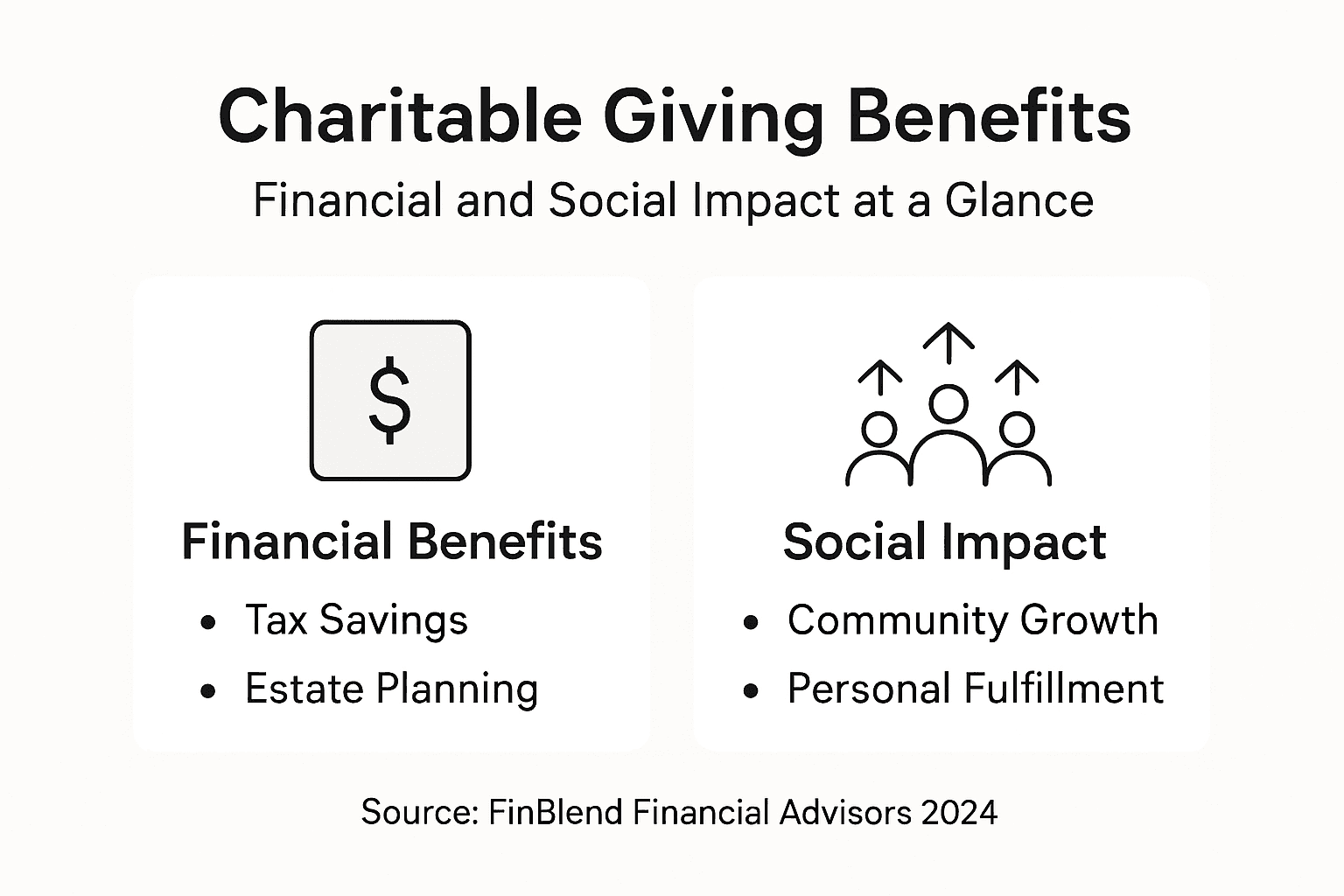
Charitable giving not only provides immediate support to organizations but also offers tax benefits, enhances personal fulfillment, and allows donors to make a significant social impact aligned with their values.
How do tax deductions work for charitable donations?
When you donate to qualified charities, you may receive a tax deduction that reduces your taxable income for the year. This means that your donation can effectively cost less than the amount you gave after accounting for the tax benefits.
Can I donate non-monetary items, and what are the benefits?
Yes, you can donate in-kind gifts such as equipment, real estate, or professional services. These donations can provide significant value to charities and may offer unique tax advantages compared to cash donations.
How can I ensure the charity I’m donating to is trustworthy?
To verify a charity’s legitimacy, check its tax-exempt status using the IRS Tax Exempt Organization Search, review its IRS Form 990-N filings, and examine its financial statements for transparency and governance quality.