



Choosing where to place your hard-earned savings can feel complicated with so many asset types, sectors, and global markets in play. For mid-career professionals and individual investors, understanding portfolio diversification matters because financial markets are unpredictable and simple choices may not be enough. By exploring balanced strategies that go beyond just owning more stocks, you can reduce risk and build a more resilient investment approach that adapts to changing global conditions.
Table of Contents
- Portfolio Diversification Defined and Debunked
- Major Asset Classes for Diversification
- How Diversification Reduces Risk and Volatility
- Global, Sector, and Currency Diversification Strategies
- Common Missteps and How to Avoid Them
Key Takeaways
| Point | Details |
|---|---|
| Importance of Diversification | Diversifying across multiple asset classes reduces financial risk and enhances investment stability. |
| Asset Class Considerations | Investors should include at least three distinct asset classes to build a resilient portfolio that can weather market fluctuations. |
| Regular Portfolio Review | Maintaining an optimal allocation requires periodic rebalancing to align with financial objectives and changing market dynamics. |
| Common Mistakes to Avoid | Investors should avoid over-diversification and under-diversification, ensuring a balanced and manageable investment strategy. |
Portfolio Diversification Defined and Debunked
Portfolio diversification is a strategic investment approach designed to reduce financial risk by spreading investments across different asset classes, sectors, and geographic regions. At its core, this method aims to optimize returns while minimizing potential losses through a balanced investment mix.
Research reveals that portfolio diversification goes far beyond simply buying multiple stocks. Strategic asset allocation methods demonstrate that effective diversification involves carefully selecting investments with low correlation, meaning they do not move identically under similar market conditions. This approach helps protect investors from significant losses when one particular asset or sector experiences a downturn.
Contrary to common misconceptions, diversification is not about randomly selecting investments. Modern portfolio theory suggests that intelligent diversification requires understanding complex relationships between different asset types. Sustainable investment strategies have shown that traditional correlation measurements fail to capture the full complexity of portfolio performance. Investors must consider factors like price return distribution, risk-return trade-offs, and individual asset characteristics.
Pro Tip: Always allocate investments across at least three distinct asset classes to create a robust diversification strategy that can withstand market volatility.
Major Asset Classes for Diversification
Portfolio diversification requires a strategic approach to selecting different asset classes that can help manage risk and potentially enhance investment returns. Global investment landscapes typically include several core asset categories that investors can leverage to build a robust investment strategy.
The primary asset classes for effective diversification include domestic and international stocks, bonds, commodities, real estate, and alternative investments. Domestic stocks represent ownership in US-based companies, while international stocks provide exposure to global markets. Bonds offer more stable, fixed-income opportunities, with government and corporate bonds presenting different risk-return profiles. Commodities like gold, oil, and agricultural products can serve as hedge investments that often move independently of traditional stock and bond markets.
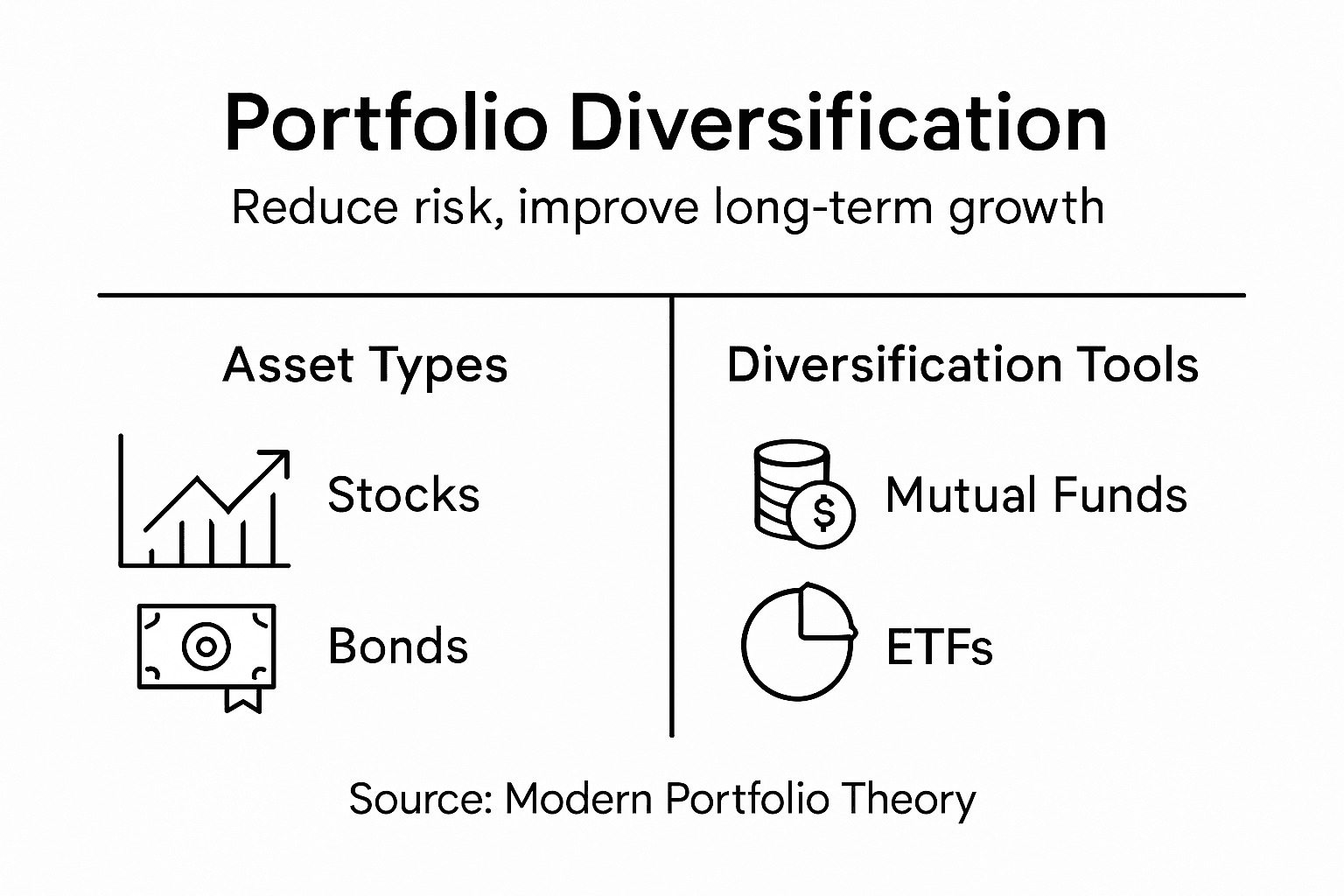
Asset allocation strategies recommend mixing these classes to create a balanced portfolio. Investors should consider their risk tolerance, investment horizon, and financial goals when determining the right mix. For instance, younger investors might allocate a higher percentage to stocks, while those closer to retirement might shift towards more conservative bond-heavy portfolios. Alternative investments like private equity, hedge funds, and cryptocurrency can provide additional diversification, though they typically require more sophisticated investment knowledge.
Pro Tip: Aim to maintain a diversified portfolio with at least 3-5 different asset classes, rebalancing annually to maintain your desired risk profile.
The table below highlights the main asset classes and how each contributes to portfolio diversification:
| Asset Class | Risk Profile | Typical Role in Portfolio | Example Investment Type |
|---|---|---|---|
| Domestic Stocks | Moderate to High | Growth potential | Large-cap US stocks |
| International Stocks | Moderate to High | Global market exposure | Emerging market ETFs |
| Bonds | Low to Moderate | Income and stability | US Treasuries, corporate bonds |
| Commodities | Varies | Inflation hedge, diversification | Gold, oil, agricultural futures |
| Real Estate | Moderate | Income, value appreciation | REITs, rental properties |
| Alternatives | High | Non-traditional diversification | Hedge funds, private equity |
How Diversification Reduces Risk and Volatility
Diversification serves as a powerful risk management strategy that helps investors protect their portfolios from dramatic market fluctuations. Long-term investment research demonstrates that strategically combining different assets can significantly reduce overall portfolio volatility by minimizing the impact of individual investment performance.
The core mechanism of risk reduction involves selecting assets with low or negative correlations. This means choosing investments that do not move in lockstep with each other, so when one asset class experiences a downturn, others may remain stable or even appreciate. For example, stocks and bonds often behave differently during economic cycles, with bonds typically providing stability when stock markets become turbulent. Commodities like gold can further enhance this effect by acting as a hedge against market uncertainty.

Cross-asset investment strategies reveal that while no strategy guarantees complete protection, a well-constructed portfolio can substantially mitigate risk. Investors should understand that correlation dynamics can shift during market crises, potentially reducing diversification benefits temporarily. However, maintaining a balanced approach across multiple asset classes consistently provides more predictable and smoother investment returns compared to concentrated portfolios.
Pro Tip: Regularly review and rebalance your portfolio at least annually to maintain optimal asset allocation and risk management.
Global, Sector, and Currency Diversification Strategies
Global diversification represents a sophisticated approach to reducing investment risk by spreading capital across different international markets and economic regions. International investment research demonstrates that strategically allocating investments across multiple countries can help mitigate region-specific economic vulnerabilities and market volatilities.
Sector diversification involves distributing investments across different industry segments to reduce concentrated risk. Technology, healthcare, financial services, energy, and consumer goods sectors often respond differently to economic conditions. By carefully selecting stocks or funds representing various industries, investors can create a more resilient portfolio that can withstand sector-specific downturns. This approach helps balance potential losses in one sector with potential gains in another, smoothing overall investment performance.
Diversification landscape strategies emphasize the critical role of currency diversification in managing international investment risks. Different currencies fluctuate based on local economic conditions, interest rates, and geopolitical events. By holding investments denominated in multiple currencies, investors can protect against exchange rate volatility and potentially benefit from favorable currency movements. This strategy is particularly important for those seeking to minimize the impact of single-country economic challenges.
Pro Tip: Consider using internationally focused exchange-traded funds (ETFs) to simplify your global and sector diversification strategy without managing individual international stocks.
Common Missteps and How to Avoid Them
Investors frequently encounter several critical pitfalls when attempting to diversify their investment portfolios. Portfolio management research reveals that the most common mistakes stem from misunderstanding the fundamental principles of strategic asset allocation.
One significant misstep is over-diversification, where investors spread their investments too thinly across multiple assets, ultimately diluting potential returns and increasing unnecessary complexity. Conversely, under-diversification represents an equally dangerous approach, leaving portfolios vulnerable to concentrated risk. Investors must strike a careful balance, selecting a strategic mix of investments that provides meaningful diversification without sacrificing potential growth.
Another critical error involves neglecting regular portfolio rebalancing. Financial markets continuously evolve, and asset performance can shift dramatically over time. Investors who fail to periodically reassess and readjust their investment mix risk becoming misaligned with their original financial objectives. This requires consistently monitoring individual asset performance, understanding changing market dynamics, and making informed decisions about maintaining an optimal portfolio composition.
Below is a summary of common diversification mistakes and how to avoid them:
| Common Mistake | Impact on Portfolio | Solution |
|---|---|---|
| Over-diversification | Diluted investment returns | Select meaningful positions |
| Under-diversification | High concentrated risk | Include different asset types |
| Ignoring rebalancing | Misaligned objectives | Schedule regular reviews |
Pro Tip: Conduct a comprehensive portfolio review every six months, reassessing your asset allocation and ensuring it remains aligned with your current financial goals and risk tolerance.
Take Control of Your Investment Future with Smart Diversification
The challenge of reducing risk while pursuing better growth is clear in the article’s focus on portfolio diversification. You understand the pain points of avoiding over-diversification and managing asset allocation effectively across global markets, sectors, and currencies. With concepts like strategic asset allocation and regular portfolio rebalancing, it is essential to craft a balanced mix that protects your investments without sacrificing returns.
Explore how our expert advice can help you avoid common missteps like under-diversification or ignoring rebalancing. At Finblog, we provide clear, actionable insights tailored for serious investors aiming to build resilient portfolios. Start by learning more about strategic asset allocation and discover proven methods for managing risk across multiple asset classes. Don’t wait for market volatility to catch you off guard—take the first step toward smarter investing today with trusted guidance from Finblog.
Frequently Asked Questions
What is portfolio diversification?
Portfolio diversification is an investment strategy that reduces financial risk by spreading investments across various asset classes, sectors, and geographic regions to optimize returns while minimizing potential losses.
How does diversification help in reducing risk?
Diversification reduces risk by selecting assets with low or negative correlations, meaning they do not move in the same direction. This strategy helps protect the overall portfolio from significant losses when one particular sector or asset experiences a downturn.
What are the main asset classes for effective diversification?
The primary asset classes for effective diversification include domestic and international stocks, bonds, commodities, real estate, and alternative investments like hedge funds or private equity. Mixing these classes helps create a balanced portfolio.
How often should I rebalance my diversified portfolio?
It’s recommended to review and rebalance your portfolio at least annually to maintain your desired asset allocation and risk management strategy, ensuring it aligns with your financial goals.