

More than 80 percent of American investors report that inflation has eroded their portfolio returns in recent years. When prices accelerate, traditional investment strategies lose their edge and volatility spikes across global markets. Identifying opportunities to safeguard your portfolio during periods of rising costs means evaluating inflation exposure, shifting allocations, and closely tracking critical economic signals. This guide offers seasoned tactics to help protect and grow wealth with every turn of the economic cycle.
Table of Contents
- Step 1: Assess Current Portfolio For Inflation Exposure
- Step 2: Evaluate Inflation-Resistant Asset Classes
- Step 3: Diversify With Strategic Allocations
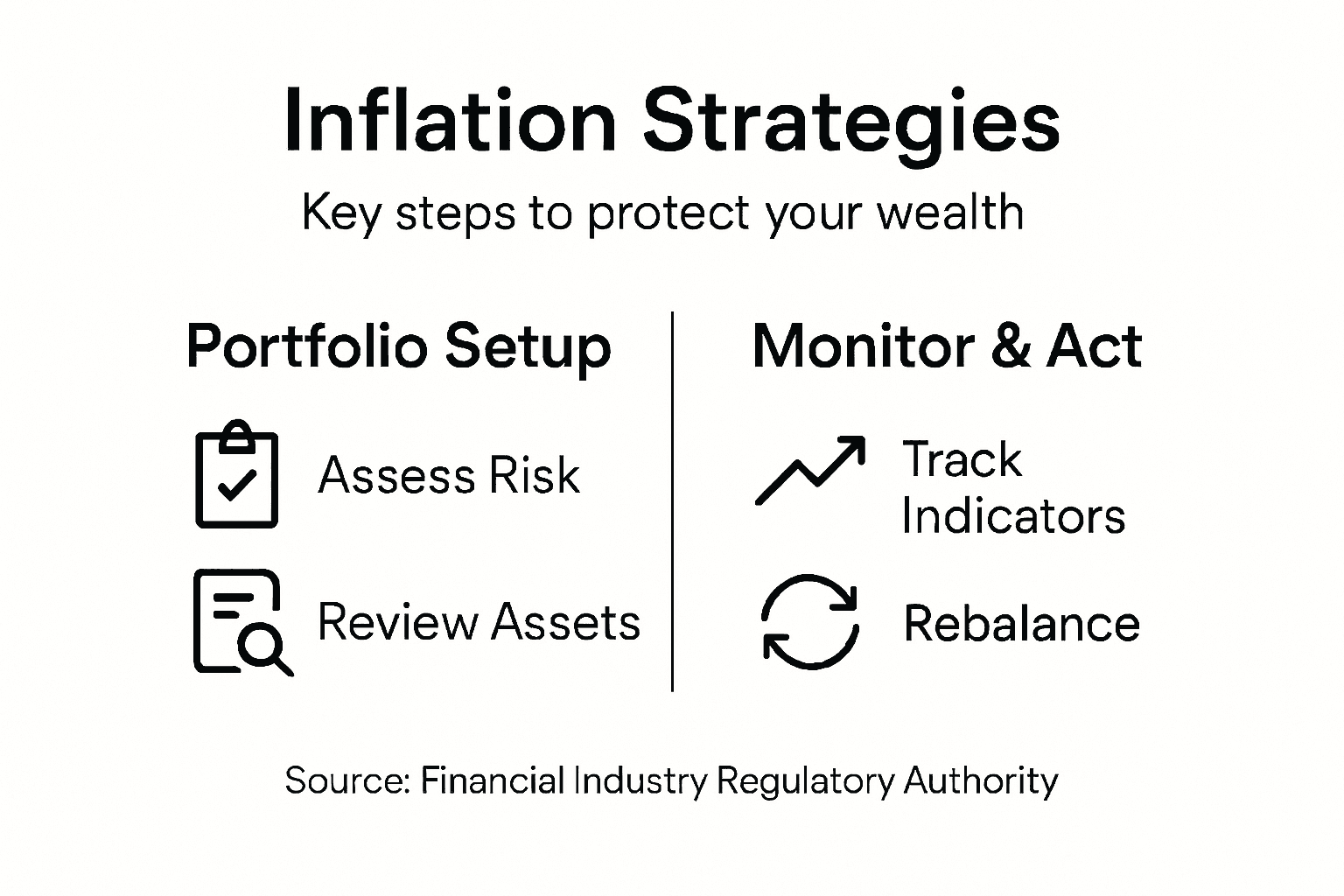
- Step 4: Monitor Economic Indicators And Adjust Holdings
- Step 5: Verify Performance And Rebalance As Needed
Quick Summary
| Essential Insight | Explanation |
|---|---|
| 1. Assess Portfolio for Inflation Risk | Categorize each investment by its sensitivity to inflation to understand potential vulnerabilities and adjust allocations accordingly. |
| 2. Focus on Inflation-Resistant Assets | Prioritize investments in sectors like energy, real estate, and commodities that historically provide better protection against inflation. |
| 3. Diversify Allocations Intentionally | Develop a balanced mix of asset classes to minimize risk and enhance returns during inflationary periods. |
| 4. Monitor Economic Indicators Regularly | Track key indicators such as the Consumer Price Index and wage growth to inform timely investment adjustments. |
| 5. Rebalance Portfolio Periodically | Regularly evaluate portfolio performance against benchmarks and realign asset allocations to meet changing market conditions. |
Step 1: Assess current portfolio for inflation exposure
Understanding your investment portfolio’s vulnerability to inflation requires a strategic and thorough examination of your current asset allocation. The goal is to identify which investments might lose value or underperform when prices rise rapidly.
Start by categorizing each investment according to its inflation sensitivity. Fixed income assets like traditional bonds are typically most at risk, as their fixed payment streams become less valuable during inflationary periods. Inflation risk metrics from the Federal Reserve Bank of Cleveland can help you systematically evaluate each asset’s potential performance. Look closely at the real return potential by subtracting the current inflation rate from your expected investment returns.
Stock portfolios often provide better inflation protection, particularly sectors like energy, healthcare, and consumer staples that can pass increased costs to customers. Examine your equity holdings to determine their pricing power and ability to maintain margins during economic shifts. Real estate investments, commodities, and Treasury Inflation Protected Securities (TIPS) can also serve as natural hedges against rising prices.
Here’s how common asset classes typically respond to inflationary periods:
| Asset Class | Typical Inflation Response | Why It Performs This Way |
|---|---|---|
| Traditional Bonds | Tends to underperform | Fixed payments lose real value |
| Stocks (Energy) | Often outperforms | Passes increased costs to consumers |
| Real Estate | Often outperforms | Property values and rents can rise |
| Commodities | Performs well | Prices usually rise with inflation |
| TIPS | Performs well | Value adjusts with inflation rate |
Insider Tip: Create a spreadsheet tracking each investment’s historical performance during past inflationary periods to predict potential future resilience.
Step 2: Evaluate inflation-resistant asset classes
To build a resilient investment strategy during inflationary periods, you need a systematic approach to identifying asset classes that can maintain or grow value when prices rise. Not all investments perform equally during economic shifts, making careful selection crucial for protecting your wealth.

Research on asset performance from the National Bureau of Economic Research reveals that certain asset types demonstrate stronger resistance to inflation. Real assets typically outperform traditional fixed income securities. Focus on sectors like energy, real estate, commodities, and stocks with strong pricing power. Infrastructure investments and natural resource funds can also provide robust protection against rising prices.
When evaluating potential investments, consider their historical performance during previous inflationary periods. Stocks in essential sectors such as healthcare, consumer staples, and utilities often maintain value better than speculative or luxury market segments. Look for companies with demonstrated ability to pass increased costs to consumers without significantly reducing demand.
Pro Tip: Diversify your inflation-resistant assets across multiple sectors to minimize risk and create a more stable investment portfolio.
Step 3: Diversify with strategic allocations
Building a resilient investment portfolio requires more than simply spreading money across different assets. Strategic allocation means intentionally selecting investments that work together to minimize risk and maximize potential returns during inflationary periods.
Asset allocation strategies recommended by the Financial Industry Regulatory Authority emphasize creating a balanced mix that protects against market volatility. Consider allocating investments across multiple sectors such as stocks, bonds, real estate, commodities, and treasury inflation protected securities. Aim for a portfolio composition that includes 40 to 60 percent stocks from diverse sectors like technology, healthcare, consumer staples, and energy.
Understand your personal risk tolerance and investment timeline when developing your allocation strategy. Younger investors might lean toward more aggressive growth investments, while those closer to retirement should prioritize stable income generating assets. Regularly rebalance your portfolio to maintain your target allocation percentages and adjust for changing economic conditions.
Pro Tip: Create a quarterly review schedule to reassess your portfolio allocations and ensure they remain aligned with your financial goals and current market conditions.
Step 4: Monitor economic indicators and adjust holdings
Successfully navigating inflationary periods requires continuous monitoring of key economic indicators that signal potential shifts in market conditions. This ongoing vigilance allows you to make informed decisions about protecting and repositioning your investment portfolio.
Economic tracking tools from the Federal Reserve Bank of Atlanta provide real-time insights into inflation trends and underlying economic pressures. Focus on critical indicators such as the Consumer Price Index, Producer Price Index, wage growth rates, and unemployment figures. Pay special attention to the Federal Reserve’s statements about monetary policy, as interest rate changes can significantly impact investment performance across different asset classes.
Develop a systematic approach to reviewing economic data by establishing a consistent monthly or quarterly evaluation schedule. Compare current economic indicators against historical trends and your initial investment strategy. Be prepared to make tactical adjustments to your portfolio allocations when fundamental economic conditions show meaningful changes. This might involve shifting between sectors, rebalancing asset weightings, or introducing additional inflation protective investments like Treasury Inflation Protected Securities or commodities.
This summary outlines key indicators to track for inflation management:
| Indicator | What It Measures | Why It Matters for Investors |
|---|---|---|
| Consumer Price Index (CPI) | General price inflation | Gauges overall cost-of-living trends |
| Producer Price Index (PPI) | Wholesale price changes | Signals upstream inflation pressure |
| Wage Growth | Rate of salary increases | Higher wages can drive inflation |
| Unemployment Rate | Labor market health | Low rates can boost wage inflation |
| Fed Policy Statements | Central bank stance on rates | Interest rate changes affect assets |
Pro Tip: Set up automated alerts from reputable financial news sources to receive immediate updates on significant economic indicator changes that could impact your investment strategy.
Step 5: Verify performance and rebalance as needed
Regular performance verification is a critical strategy for protecting your investments during inflationary periods. You want to ensure your portfolio remains aligned with your financial goals and adapts to changing economic conditions.
Portfolio rebalancing research from the National Bureau of Economic Research highlights the importance of systematic performance evaluation. Calculate your portfolio’s actual returns against benchmarks every quarter, comparing performance across different asset classes. Identify investments that have drifted significantly from their target allocations and consider strategic realignments.
Implement a disciplined approach to rebalancing by setting specific triggers for action. These might include portfolio segments that have moved more than 5 percent from their original allocation or assets that no longer match your risk tolerance. When rebalancing, be mindful of transaction costs and potential tax implications. Consider using low-cost index funds or exchange traded funds to minimize expenses while maintaining diversification.
Pro Tip: Automate your performance tracking through digital portfolio management tools that provide real-time allocation insights and can alert you when rebalancing becomes necessary.
Protect Your Wealth Against Inflation Starting Today
Navigating the challenges of inflation requires more than just knowledge. You need a tailored approach that addresses portfolio inflation exposure, strategic asset allocation, and continuous economic monitoring. If you feel uncertain about how to assess your investments or implement proven inflation-resistant strategies, you are not alone. Many investors struggle with balancing risk, rebalancing portfolios, and reacting swiftly to economic indicators that impact their wealth.
At finblog.com, we specialize in guiding you through these complex financial decisions with expert insights and personalized support. Explore our trusted resources to gain confidence in selecting inflation-proof assets and maintaining an effective portfolio balance. Act now to safeguard your financial future by visiting finblog.com and taking the first step toward smarter investing in inflationary times. Don’t wait for inflation to erode your returns—start protecting your wealth today.
Frequently Asked Questions
How can I assess my current portfolio for inflation exposure?
To assess your portfolio for inflation exposure, categorize each investment by its inflation sensitivity. Focus on fixed income assets, as they are most vulnerable to inflation, and use metrics to evaluate their potential performance against inflation rates.
What types of asset classes are resistant to inflation?
Inflation-resistant asset classes include real estate, commodities, and stocks in essential sectors like energy and healthcare. Allocate a portion of your portfolio to these asset types to enhance resilience against rising prices.
How should I diversify my investments during inflationary periods?
Diversify your investments by strategically allocating funds across various asset classes, including stocks, bonds, and real estate. Aim for a balanced mix, such as 40 to 60 percent in stocks across different sectors to minimize risk and enhance potential returns.
What economic indicators should I monitor to manage inflation risks?
Key economic indicators to track include the Consumer Price Index, Producer Price Index, and wage growth rates. Regularly review these metrics to make informed adjustments to your investment portfolio based on emerging inflation trends.
How often should I rebalance my portfolio during inflationary times?
Regularly rebalance your portfolio at least quarterly to ensure it aligns with your financial goals and adapts to changing economic conditions. Set specific triggers for rebalancing, such as a 5 percent deviation from your target allocations, to maintain your desired risk exposure.
Recommended
- Inflation Hedging Investments: Complete Expert Guide – Finblog
- Inflation Forecast 2025: Impacts on Global Investments – Finblog
- 7 Safe Investment Options for Your Financial Future – Finblog
- Complete Guide to Wealth Preservation Strategies – Finblog
- Top 5 Gold Companies 2025 | Best Gold IRA Companies