

Working in a fast-paced city, the dream of leaving behind financial stress can feel distant when every paycheck seems to disappear. For many urban professionals, increasing living costs and rising retirement fears only add to the pressure. Achieving financial independence is not about sudden wealth but creating stability that allows freedom of choice and peace of mind. This guide breaks down what financial independence truly means, uncovers persistent myths, and spotlights practical strategies for building real security.
Table of Contents
- Defining Financial Independence and Key Myths
- Levels of Financial Independence Explained
- Core Prerequisites and How It Works
- Strategic Approaches for Urban Professionals
- Common Pitfalls and Long-Term Impacts
Key Takeaways
| Point | Details |
|---|---|
| Financial Independence Defined | Achieving financial independence involves creating sustainable financial freedom through disciplined saving and strategic investment. It’s not just about wealth accumulation but managing your finances for greater personal choice. |
| Levels of Financial Independence | Financial independence consists of four levels: Basic Survival, Financial Stability, Financial Security, and Complete Financial Freedom, each offering different degrees of financial flexibility and focus. |
| Core Prerequisites | Key components for financial independence include robust financial knowledge, disciplined behavior, and developing multiple income streams to create a resilient financial ecosystem. |
| Common Pitfalls | Avoid chronic underfunding of savings, high-interest debt, and lifestyle inflation to prevent long-term financial stress and maintain financial flexibility. |
Defining Financial Independence and Key Myths
Financial independence represents a transformative state where individuals gain complete control over their financial destiny. At its core, financial independence means accumulating sufficient resources to cover living expenses without relying on traditional employment income. This powerful concept goes beyond mere wealth accumulation – it’s about creating sustainable financial freedom that enables personal choice and reduces economic stress.
Contrary to popular misconceptions, financial independence is not about becoming instantly wealthy or completely stopping work. Instead, it involves strategically building personal financial knowledge that allows flexibility in career and lifestyle choices. Many people mistakenly believe financial independence requires massive wealth, but it actually demands smart financial planning, disciplined saving, and strategic investment.
The fundamental elements of financial independence include developing multiple income streams, minimizing unnecessary expenses, and creating robust investment portfolios that generate passive revenue. This approach requires understanding key financial principles: reducing debt, increasing savings rates, investing consistently, and continuously educating yourself about personal finance strategies. Critically, financial independence is not a destination but an ongoing journey of financial literacy and strategic decision making.
Pro tip: Start tracking your monthly expenses meticulously and identify three areas where you can consistently reduce spending to accelerate your path toward financial independence.
Levels of Financial Independence Explained
Financial independence is not a binary state but a nuanced journey with multiple progression stages. Understanding these financial well-being levels helps individuals map their financial growth and set realistic goals for economic autonomy.

Typically, financial independence can be categorized into four primary levels. The first level, Basic Survival, represents meeting essential living expenses through minimal income sources. At this stage, individuals cover basic needs but have little financial flexibility. The second level, Financial Stability, involves generating consistent income that covers living expenses with a small buffer for emergencies. Here, individuals start building modest savings and reducing financial vulnerability.
The third and fourth levels represent more advanced stages of financial independence. Financial Security occurs when passive income streams and investments consistently exceed monthly expenses, providing significant work optionality. The pinnacle level, Complete Financial Freedom, represents a state where wealth generation is so robust that individuals can pursue passion projects, travel extensively, or choose work entirely based on personal fulfillment rather than financial necessity. This level requires sophisticated investment strategies, multiple income streams, and disciplined long-term financial planning.
Here is a summary of four key levels of financial independence and their main characteristics:
| Level | Main Income Source | Flexibility | Typical Focus |
|---|---|---|---|
| Basic Survival | Minimal employment | Very limited | Covering essentials |
| Financial Stability | Consistent earned income | Moderate | Emergencies, savings |
| Financial Security | Reliable passive income streams | High | Work optionality |
| Complete Financial Freedom | Abundant passive/portfolio income | Maximum | Pursue passions |
Pro tip: Create a detailed spreadsheet tracking your current income, expenses, and potential passive income sources to understand which financial independence level you currently occupy and develop a strategic roadmap for progression.
Core Prerequisites and How It Works
Achieving financial independence requires a strategic combination of knowledge, skills, and deliberate financial behaviors. Financial capability fundamentals form the critical foundation for anyone seeking economic autonomy. This involves developing comprehensive financial literacy that goes beyond basic money management and encompasses a holistic understanding of personal finance principles.
The core prerequisites for financial independence include several key components. First, robust Financial Knowledge is essential, encompassing understanding investment strategies, tax optimization, and complex financial instruments. Second, Disciplined Behavior becomes crucial, involving consistent budgeting, strategic saving, and intentional spending habits. Developing multiple income streams, reducing unnecessary expenses, and creating a diversified investment portfolio are fundamental strategies that transform financial potential into tangible independence.
The mechanism of financial independence operates through a cyclical process of continuous learning and strategic implementation. Individuals must consistently evaluate their financial health, adjust their strategies, and build resilient financial systems that can withstand economic fluctuations. This involves creating passive income sources, managing risk through diversification, and maintaining a long-term perspective that prioritizes financial growth over short-term consumption. The ultimate goal is building a financial ecosystem that generates sustainable wealth and provides genuine economic freedom.
Pro tip: Conduct a comprehensive financial audit every six months, tracking income sources, expense patterns, and investment performance to systematically refine your financial independence strategy.
Strategic Approaches for Urban Professionals
Urban professionals face unique financial challenges that demand sophisticated and adaptive strategies for achieving financial independence. Financial capability strategies must be tailored to address the complex economic landscape of metropolitan environments, where living costs and competitive pressures create distinct financial dynamics.
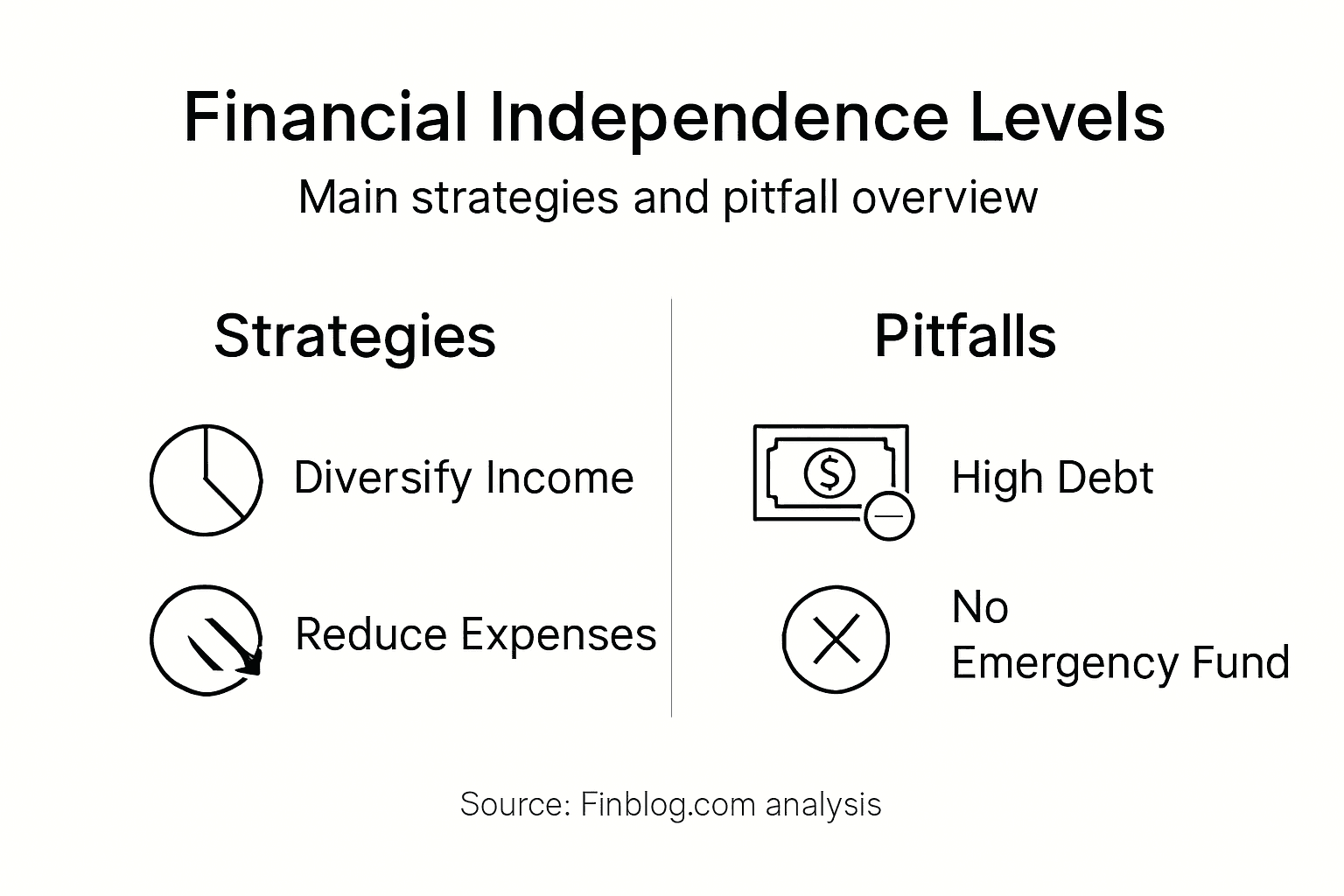
The primary strategic approaches for urban professionals revolve around three critical pillars. First, Income Diversification becomes paramount, moving beyond traditional employment to create multiple revenue streams. This might include freelance work, digital side hustles, strategic investments, and passive income opportunities that leverage urban economic ecosystems. Second, Aggressive Cost Management is essential, requiring disciplined approaches to reducing urban living expenses through smart housing choices, optimized transportation strategies, and intentional lifestyle design that prioritizes financial efficiency over consumption.
The third strategic pillar focuses on building Resilient Financial Systems. Urban professionals must develop sophisticated investment portfolios that can withstand economic volatility, create robust emergency funds specifically designed for metropolitan risk scenarios, and continuously upgrade their skill sets to remain competitive in rapidly changing job markets. Navigating urban financial independence requires a holistic approach that combines personal financial management with strategic career development, always maintaining flexibility and adaptability as core principles.
Pro tip: Develop a quarterly financial review process that reassesses your income streams, living expenses, and investment allocation, specifically calibrated to the unique economic dynamics of your urban environment.
Common Pitfalls and Long-Term Impacts
Navigating the path to financial independence is fraught with potential obstacles that can dramatically undermine long-term economic stability. Financial well-being survey data reveals critical patterns of financial vulnerability that can derail even the most well-intentioned financial strategies. Understanding these common pitfalls becomes crucial for individuals committed to maintaining their financial trajectory.
The most significant pitfalls include Chronic Underfunding of emergency reserves, persistent high-interest debt, and systematic lifestyle inflation. Many professionals unknowingly trap themselves in cycles of financial dependency by failing to create robust savings buffers, continuously accumulating consumer debt, and increasing expenses proportionally with income increases. These behaviors create compound negative effects that progressively erode financial flexibility, making true independence increasingly difficult to achieve. Strategic interventions require disciplined spending, aggressive debt reduction, and consistent investment in income-generating assets.
Long-term impacts of these financial missteps extend far beyond immediate monetary constraints. Persistent financial stress can lead to decreased mental health, reduced career mobility, and compromised personal relationships. Individuals who fail to address fundamental financial behaviors often experience a cascading effect where limited financial options generate increasingly restrictive life choices. The key is recognizing these patterns early, implementing systematic financial education, and developing resilient economic strategies that prioritize long-term wealth accumulation over short-term consumption.
Compare the most common pitfalls on the path to financial independence and their long-term impacts:
| Pitfall | Short-Term Effect | Long-Term Impact |
|---|---|---|
| Underfunded savings | Vulnerability to emergencies | Chronic financial stress |
| High-interest debt | Lower monthly cash flow | Reduced wealth accumulation |
| Lifestyle inflation | Temporary satisfaction | Ongoing financial dependency |
Pro tip: Implement a personal financial diagnostic every six months that comprehensively evaluates your debt-to-income ratio, emergency fund status, and investment portfolio performance to proactively identify and mitigate potential financial vulnerabilities.
Take Control of Your Financial Future Today
Understanding what financial independence really means and recognizing the common pitfalls can be overwhelming. You might be facing challenges like managing high-interest debt, combating lifestyle inflation, or building reliable passive income streams. These obstacles can create financial stress and limit your freedom to live life on your terms. That is why adopting clear strategies and gaining expert guidance is essential to confidently progress through the levels of financial independence outlined in the article.
At finblog.com, we offer tailored insights and proven financial consulting services designed to help you minimize expenses, diversify income, and build a resilient investment portfolio. Don’t wait until financial vulnerabilities hold you back. Use our comprehensive tools to track your progress and refine your plan as you work toward complete financial freedom. Explore how you can transform knowledge into effective action by visiting finblog.com now. Start your journey with our customized support and take decisive steps toward a secure and flexible financial future.
Frequently Asked Questions
What does financial independence mean?
Financial independence means having enough resources to cover living expenses without relying on traditional employment income, allowing for personal choice and reduced economic stress.
What are the different levels of financial independence?
Financial independence can be categorized into four levels: Basic Survival, Financial Stability, Financial Security, and Complete Financial Freedom, each reflecting varying degrees of financial control and flexibility.
How can I achieve financial independence?
To achieve financial independence, develop financial knowledge, practice disciplined budgeting and spending, create multiple income streams, and build a diversified investment portfolio to generate passive income.
What common pitfalls should I avoid on the path to financial independence?
Common pitfalls include chronic underfunding of emergency savings, accumulating high-interest debt, and lifestyle inflation, all of which can erode financial flexibility and hinder long-term wealth accumulation.
Recommended
- What is a Financial Plan? Understanding Its Importance – Finblog
- Achieve Financial Independence Retire Early: Step-by-Step Guide – Finblog
- Financial Freedom Roadmap: Achieve Independence Step-by-Step – Finblog
- Master Financial Planning for Freelancers in 2025 – Finblog
- Understanding Why Set Priorities for Success – Optio Station: Best Project Management App for Prioritization