
Global leaders at the World Economic Forum made one message clear this week: AI’s future depends on power, grids, and infrastructure. After a record year of data-center construction and soaring electricity demand, executives and policymakers say 2026 will look much the same, only bigger and more expensive.
President Donald Trump used his Davos speech to stress that the US must rapidly expand domestic power generation to support AI growth.
“We needed more than double the energy currently in the country just to take care of the AI plants,” Trump said, adding that the US is now opening energy facilities instead of shutting them down.
Energy demand surging fast
According to Goldman Sachs, global data-center power use is set to jump from 55 gigawatts to 84 gigawatts in just two years. But the supply side is struggling to keep up.
Heavy machinery makers face multi-year backlogs for gas turbines. Connecting new plants to the US power grid can take more than a decade. Nearly half of US transmission equipment is near the end of its useful life, Bank of America estimates.
Schneider Electric CEO Olivier Blum summed up the challenge:
“AI is the digital engine of growth, but it is also a massive consumer of energy.”
Industrials surge on infrastructure boom
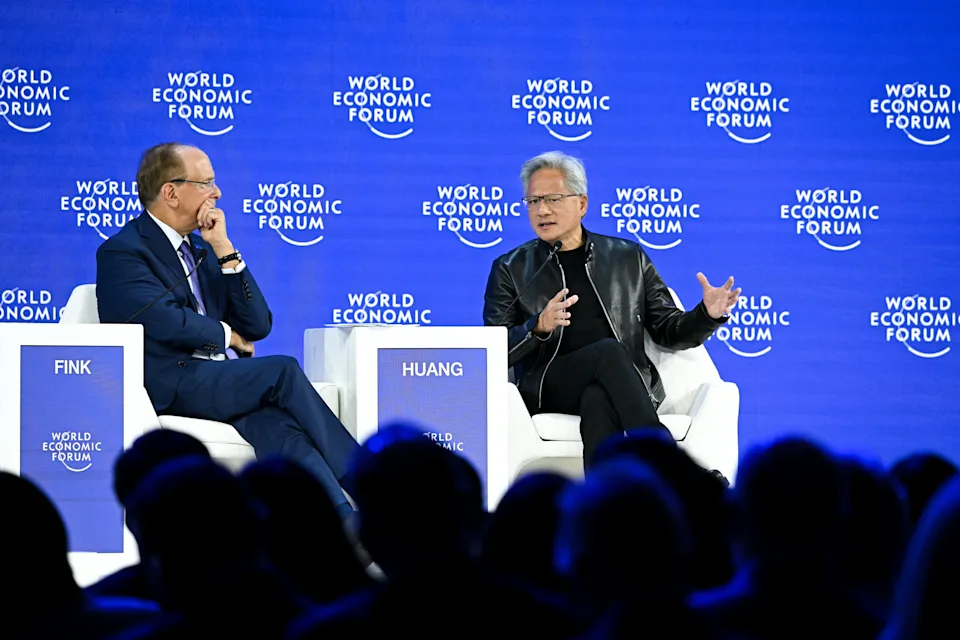
Investors are already positioning for what Nvidia CEO Jensen Huang called “the largest infrastructure build-out in history.”
- The Industrials sector is up 17.5% over the past year
- Caterpillar has jumped 58%
- Jensen Huang says AI will require trillions of dollars in new spending
BlackRock added that power availability and grid reliability are now “the key constraint” for AI growth.
Nuclear makes a comeback
One of the biggest themes at Davos was what many called a “nuclear renaissance.”
Trump said the US plans to add 300 gigawatts of new nuclear capacity by 2030, calling modern nuclear technology safe and affordable.
“We’re going heavy into nuclear… the progress they’ve made is unbelievable,” Trump said.
Bank of America now expects nuclear to become a $10 trillion industry, with 18 gigawatts of new capacity added annually through 2040.
Who wins the AI race
Microsoft CEO Satya Nadella framed the competition bluntly:
“Are you a cheap producer of energy? Can you build data centers? That will decide who wins.”
Big Tech firms including Amazon, Microsoft, Google, and Meta are preparing to lift AI spending again in upcoming earnings. But HSBC warns that capacity constraints will persist through 2026 due to long construction timelines.
AI demand is not slowing. But power shortages, aging grids, and slow infrastructure rollouts now threaten to cap growth.
As Davos made clear, the next AI winners may not be the best chip designers, but the countries and companies that can build power plants and grids the fastest.
Disclosure: This article does not represent investment advice. The content and materials featured on this page are for educational purposes only.