
Enable multi-factor authentication on your bank and email accounts, and never pay an unsolicited request with gift cards, crypto, or a wire transfer. Add one more habit: verify any request by calling the organization’s official number yourself, not the one the message gives you. These three moves shut down the levers scammers rely on most: stolen credentials, irreversible payment, and manufactured trust.
- Turn on MFA for email, banking, and your password manager. Email recovery unlocks nearly everything else, so secure it first.
- Refuse gift cards, crypto, and wire transfers for any unsolicited payment demand. Legitimate businesses and government agencies do not ask for these.
- Hang up and call back using a number you find independently, never one texted or emailed to you.
Pro Tip: The Consumer Financial Protection Bureau and CISA both flag multi-factor authentication as the single most effective step against account takeover, because it stops access even after a password leaks.
TL;DR:
- Activate multi-factor authentication on email and banking accounts to prevent unauthorized access even if passwords are leaked.
- Never send money via gift cards, cryptocurrency, or wire transfers in response to unsolicited requests, as these payments are nearly impossible to recover.
- Always verify any suspicious contact by calling the organization’s official phone number, independently sourced from their website or official statements.
- Quickly stop all communication and report to authorities if you suspect you’ve been targeted or have sent money to scammers.
- Regularly review account activity weekly, set transaction alerts, and store sensitive documents securely to reduce long-term scam risks.
Table of Contents
- How to Recognize the Warning Signs of a Financial Scam
- Common Financial Scams and Their Red Flags
- Setting Up Your Defenses: Prevention Steps to Apply Today
- What to Do If You’ve Already Been Targeted or Sent Money
- Building Habits That Keep You Protected Long-Term
- Povilas’s Practical Priorities and Non-Obvious Defenses
- Staying Current on New Scam Tactics
- Understanding the Psychology Behind the Scam
- Safer Ways to Send and Receive Money
- Protecting Your Financial Information Offline
- Key Takeaways
- Sources
How to Recognize the Warning Signs of a Financial Scam
Scammers work fast because slowing down kills their pitch. Pressure is the tell: “act in the next hour,” “don’t tell your spouse,” “stay on the phone while you go to the bank.” Any message demanding secrecy or urgency deserves suspicion by default, not benefit of the doubt.
Watch for these patterns together, because they rarely appear alone:
- Unusual payment instructions, especially a sudden switch to gift cards, crypto, or a new bank account for a “vendor” you’ve paid before.
- Requests for remote access to your computer or phone, often framed as tech support or fraud prevention.
- Claims of authority from the IRS, Social Security Administration, your bank, or a well-known company, paired with a threat.
- Contact you didn’t initiate, especially when it arrives by text or email and asks you to click a link or call a number.
Spoofing makes a lot of this convincing. Caller ID can display your bank’s real name. A scam email can copy a company’s logo pixel for pixel. A text can appear in the same thread as legitimate messages from your carrier. None of that proves authenticity, because phishing and impostor scams are built specifically to defeat the visual cues you trust.
Pro Tip: When in doubt, call, not reply or click. Look up the number yourself from a statement, the back of your card, or the official website.
Common Financial Scams and Their Red Flags
Most scams fall into a handful of categories, and once you can name the type, the right response becomes obvious.
- Phishing and impostor scams. A message claims to be your bank, the IRS, or Amazon. Red flag: it asks you to confirm account details by clicking a link. Stop and log in directly through the official app instead.
- Romance scams. A new online partner professes love quickly, then needs money for an emergency. Red flag: you’ve never met in person and they push for funds urgently.
- Investment and crypto scams. Promises of guaranteed high returns with little risk. Red flag: pressure to move fast before a “limited window” closes.
- Money-mule recruitment. A stranger or new online contact asks you to receive and forward money or packages. This is often a sign you’re being recruited into a mule scheme, and you should stop involvement immediately.
- Charity scams. Especially common after news events. Red flag: no verifiable registration or pressure to donate via gift card.
- Fake job or advance-fee scams. An employer asks you to pay for training or equipment before you start. Red flag: any job that requires you to send money first.
- Check fraud. You deposit a check and are asked to wire back a portion. Red flag: any request to return funds from a check that hasn’t fully cleared.
Notice the recurring thread: gift cards, wire transfers, and crypto show up across nearly every category, because they’re hard to trace and nearly impossible to reverse.
Setting Up Your Defenses: Prevention Steps to Apply Today
Start with the accounts that unlock everything else. Email comes first, because most account recovery flows run through it; a compromised inbox gives a scammer a path into your bank, your cloud storage, and your social media in one move. After email, secure your password manager, then your primary bank account. CISA recommends multi-factor authentication as a baseline for exactly this reason: it blocks access even when a password has already leaked.
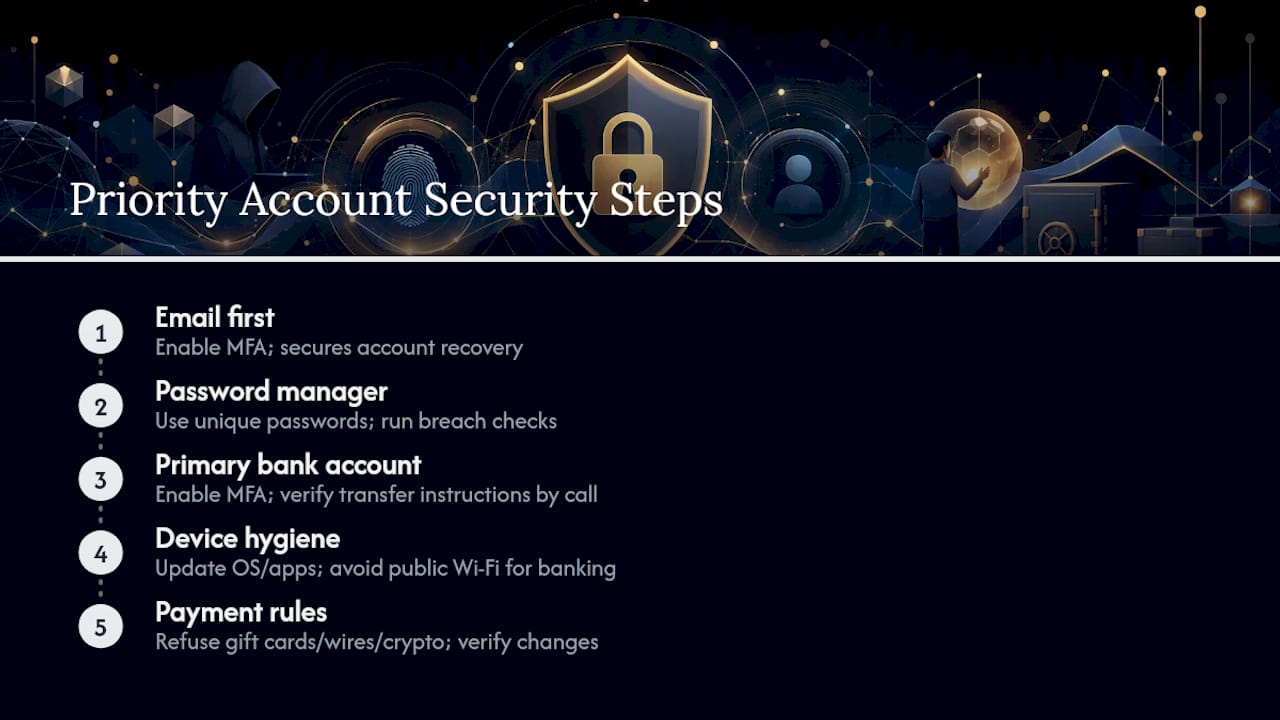
Password hygiene matters more than most people admit. A password manager generates and stores unique passwords for every account, so one breach doesn’t cascade into ten. If you’re still reusing passwords across sites, that’s the first habit to break, and most managers include a built-in breach checker that flags exposed credentials automatically.
Device hygiene closes the remaining gaps. Keep your phone and computer updated, since many exploits target known, patched vulnerabilities that people simply haven’t installed yet. Avoid logging into banking apps on public Wi-Fi. Before clicking any link, hover over it to preview the destination, or better, skip the link entirely and type the address you already know into your browser.
Finally, set a hard rule for payments: refuse any request for gift cards, wire transfers, or cryptocurrency, no exceptions, no matter who’s asking. If someone provides new transfer instructions for a payment you regularly make, verify them by calling a known contact directly rather than replying to the message. A combination of MFA, monitoring, and firm payment rules delivers the largest overall reduction in risk available to an individual account holder.

What to Do If You’ve Already Been Targeted or Sent Money
Speed matters here more than almost anywhere else in personal finance.
- Stop all contact immediately. Don’t respond to further messages, and don’t comply with any additional requests, even ones that sound like they’re trying to “fix” the situation.
- Preserve evidence. Screenshot messages, save emails, and note phone numbers before you block anyone.
- Call your bank or card issuer right away to report unauthorized transfers and ask about holds, reversals, or a new account number.
- File reports with ReportFraud.ftc.gov, the Internet Crime Complaint Center (IC3) for anything online, and your local police department. Consider a credit freeze or fraud alert with the three credit bureaus if personal information was exposed.
- If you shared credentials or gave remote access, change your passwords from a different, secure device, enable MFA everywhere you haven’t already, and notify any affected institutions directly.
If a fraudulent check is involved, stop any transfers you’ve already made in response and document every communication. Banks can sometimes recover funds, but the window closes fast.
Building Habits That Keep You Protected Long-Term
Weekly checks catch problems that monthly statements miss. Set up transaction alerts for any charge above a threshold you choose, and glance at your accounts once a week rather than waiting for the statement to arrive. Routine, small checks like this catch fraud earlier and meaningfully improve recovery odds.
- Turn on account alerts for large or foreign transactions.
- Use a credit freeze if you suspect identity theft or exposure of your Social Security number; it’s free and reversible, and monthly credit monitoring works as a lighter-touch alternative when risk feels lower.
- Keep a short list of official phone numbers for your bank, card issuer, and utilities, and require a second person’s confirmation before any large transfer leaves your household.
Povilas’s Practical Priorities and Non-Obvious Defenses
Secure your email and password manager before anything else. Most account takeovers start with a password reset routed through a compromised inbox, so that’s where your first hour of effort should go, not your bank login screen.
Context is what makes modern scams convincing. A text referencing a toll you actually owe, or a delivery you’re actually expecting, works precisely because it lines up with something real happening in your life right now. Treat any message that references recent activity with more suspicion, not less.
Pro Tip: Read Finblog’s guide to investment scams next if you’ve been approached about a “guaranteed return” opportunity.
— Povilas
Staying Current on New Scam Tactics
Scam techniques shift constantly, which means a defense built entirely around last year’s tricks eventually goes stale. Fraud rings adapt their scripts to whatever’s dominating the news cycle: tax season, natural disasters, a popular delivery service running behind schedule, even AI-generated voice cloning that mimics a family member’s voice in a distress call.
The OECD’s analysis of consumer-protection frameworks across 69 jurisdictions found that systematically tracking scam typologies helps regulators respond faster and allocate enforcement resources more effectively. The same logic applies at the individual level. Reading a fraud alert from your bank or a consumer-protection agency once a month costs a few minutes and keeps your mental model of “what a scam looks like” up to date.
Subscribing to alerts from your state attorney general’s office or the FTC’s consumer alerts page is a low-effort way to stay current. Many banks also publish fraud bulletins specific to tactics targeting their own customers, since scammers often tailor pitches to a particular institution’s branding and terminology.
The goal isn’t memorizing every scam variant. It’s recognizing the underlying pattern fast enough to pause before you act, because pausing is almost always enough to break the scam’s momentum.
Understanding the Psychology Behind the Scam
Every effective scam manipulates the same handful of emotional triggers, and recognizing them by name makes them far easier to resist in the moment. Urgency short-circuits careful thinking: “your account will be suspended in 24 hours” is designed to make you act before you verify. Authority borrows trust: a scammer posing as the IRS or your bank exploits the instinct to comply with officials. Fear does similar work, especially in impostor scams where a caller claims a family member is in legal trouble.
Isolation shows up constantly in romance and investment scams. Scammers actively discourage you from discussing the situation with a spouse, friend, or financial advisor, because outside perspective is the fastest way to break the spell. If someone you’re dealing with financially asks you to keep the relationship or the transaction secret, treat that request itself as a red flag.
Reciprocity and sunk-cost thinking keep victims engaged even after doubt sets in. Once someone has sent money, a psychological pull to “see it through” and recover the loss makes it easier for a scammer to ask for more. That’s precisely why the first response to any suspected scam should be to stop, not to try to fix it by sending additional funds.
Recognizing these tactics doesn’t make you immune. It gives you a script: pause, name the emotion being triggered, and verify independently before doing anything else.
Safer Ways to Send and Receive Money
Cybersecurity habits protect your devices and accounts, but the payment method itself matters just as much. Bank transfers through your bank’s verified app or website, credit cards, and established payment platforms with buyer protections all offer some path to dispute or reverse a transaction. Gift cards, wire transfers, and cryptocurrency generally do not, which is exactly why scammers push so hard for those three.
Before sending money to a new recipient, verify the account details through a second channel; a quick phone call to a known contact number beats trusting whatever appears in an email or text. For recurring payments like a mortgage or a contractor invoice, confirm any change in bank details directly with the person or company using a number you already have on file, never one included in the message announcing the change.
Credit cards carry stronger fraud protections than debit cards for most purchases, since a debit card draws directly from your checking account and can be harder to reverse once funds clear. When a platform offers purchase protection or an escrow-style holding period for larger transactions, use it, especially for anything bought from an individual seller rather than an established business.
Keep transaction records for anything above a threshold you set for yourself. A simple log of who you paid, when, and through which method gives you a paper trail if a dispute ever arises, and it takes a fraction of the time it takes to unwind fraud after the fact.
Protecting Your Financial Information Offline
Digital defenses get most of the attention, but plenty of fraud still starts in your mailbox. Check-washing, where a stolen check is chemically altered and rewritten for a different amount or payee, remains a documented tactic, and mailed statements or pre-approved credit offers give identity thieves raw material to work with. Shredding financial mail before disposal and using secure mail practices cuts that risk significantly.
If you’re mailing a check, consider dropping it at a post office rather than an outdoor collection box, since collection boxes are a known target for mail theft. A locking mailbox at home adds another layer of protection if package and mail theft is common in your area.
Store sensitive documents, Social Security cards, passports, old tax returns, in a locked file or safe rather than a desk drawer. When you dispose of financial documents, shred them completely rather than tossing them in the trash intact. Old prescription bottles, bank statements, and utility bills all carry personal details that identity thieves can piece together.
Be careful with what you share verbally, too. A caller posing as a survey taker or a prize notification service might ask seemingly harmless questions, your birthday, your mother’s maiden name, your pet’s name, that turn out to be answers to your account security questions elsewhere.
A Quick Word From the Author
Most people who’ve had a financial scare weren’t careless. They were busy, and the scammer counted on that. Try one change this week: turn on MFA everywhere you haven’t, or set a transaction alert on your main account.
Where to Go for Deeper Guidance
Finblog exists to help you go beyond the basics once the immediate defenses are in place. Beyond this article, Finblog’s guide to common financial scams breaks down each scam type in more detail, and readers who want ongoing alerts on emerging fraud tactics, market analysis, and financial planning guidance can sign up through Finblog’s newsletter and consultation forms. If you’re ready for a broader look at protecting your assets over time, the wealth protection strategies guide is a natural next stop. Visit Finblog to subscribe or request a consultation with a financial advisory contact.
Key Takeaways
The fastest way to stop most financial scams is to enable multi-factor authentication, refuse gift card or crypto payment requests, and verify every unsolicited contact through an independently found phone number.
| Point | Details |
|---|---|
| Secure email first | Email recovery unlocks most other accounts, so enable MFA there before your bank or social media. |
| Never use untraceable payment | Refuse gift cards, wire transfers, and crypto for any unsolicited request, since these are nearly impossible to reverse. |
| Verify independently | Call the organization using a number you find yourself, never one given in the suspicious message. |
| Act fast if targeted | Stop contact, call your bank immediately, and report to ReportFraud.ftc.gov and IC3.gov within hours, not days. |
| Build weekly habits | Check account activity weekly and set transaction alerts rather than waiting for monthly statements. |
| Go deeper with Finblog | Finblog’s guides and advisory signups at Finblog offer continued education on scam prevention and financial security. |
This article is general information, not a substitute for advice from a qualified financial advisor. Consult a qualified financial professional about your own circumstances before acting on anything here.
Sources
- How To Avoid a Scam | Consumer Advice (FTC)
- Protecting consumers from financial scams and frauds (OECD) — Full report