

TL;DR:
- Beginners should focus on buy-and-hold investing, holding stocks for at least three to five years to reduce risk. They should understand order types like market, limit, and stop-loss orders, and always set stop-loss levels for protection. Starting with fractional shares and practicing through paper trading accounts helps build confidence and informed decision-making.
Stock trading is defined as the buying and selling of company shares on exchanges like the NYSE and Nasdaq, with the goal of building wealth over time. For new investors, mastering stock trading basics means understanding not just how trades work, but which strategies actually protect your money. The SEC regulates U.S. markets to keep trading fair and transparent, which gives individual investors a reliable foundation to build on. This guide covers the core concepts you need: trading styles, order types, portfolio diversification, and risk management, all explained without the jargon that usually gets in the way.
What are the main types of stock trading strategies?
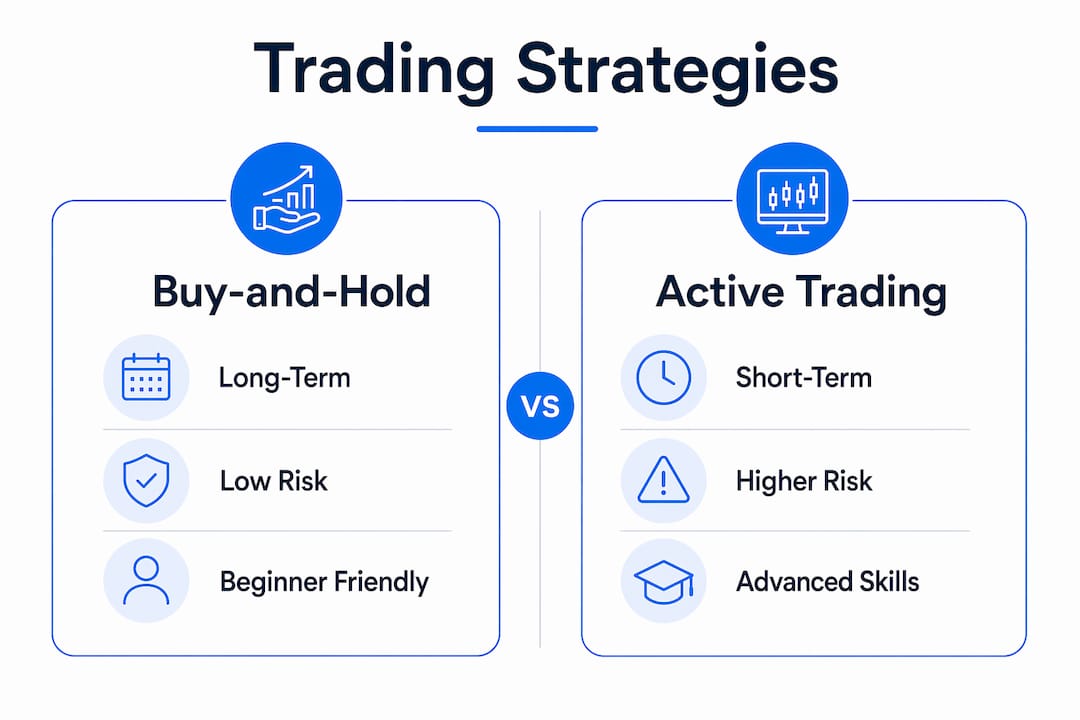
Active trading involves frequent buy and sell transactions timed to capture short-term price moves, while long-term investing means buying and holding shares for years to capture compound growth. The distinction matters because your strategy determines your risk level, your tax bill, and how much time you spend watching the market.

Buy-and-hold investing
Buy-and-hold is the recommended starting point for beginners. Financial experts advise holding positions for at least 3 to 5 years to ride out short-term market swings without panic selling. That time horizon lets compound growth do the heavy lifting, and it keeps transaction costs low. Warren Buffett built his reputation on this exact principle.
Active trading styles
Day trading involves buying and selling within a single session to profit from intraday price swings. Day trading carries high risk and is widely considered unsuitable for new investors. Swing trading holds positions for days or weeks, targeting medium-term price moves. Position trading holds for months, sitting between swing trading and full buy-and-hold in terms of commitment.
Value investing, made famous by Benjamin Graham, focuses on buying shares priced below their intrinsic worth. It requires reading financial statements and understanding valuation ratios like price-to-earnings, which takes time to learn but rewards patience.
| Trading style | Typical holding period | Risk level | Suitable for beginners? |
|---|---|---|---|
| Buy-and-hold | 3+ years | Low to moderate | Yes |
| Position trading | Months | Moderate | With guidance |
| Swing trading | Days to weeks | Moderate to high | Cautiously |
| Day trading | Hours or less | Very high | No |
| Value investing | Years | Moderate | Yes, with study |
Pro Tip: Start with a paper trading account before risking real money. Most brokerage platforms offer simulated trading that mirrors live markets, giving you real experience at zero cost.
How do stock trading orders work?
Understanding order types is one of the most practical parts of learning the stock market for beginners. The order type you choose controls when your trade executes and at what price. Getting this wrong can cost you more than you expect.
Market orders execute immediately at the best available price. They are fast but give you no price control, which matters when a stock is moving quickly. Limit orders execute only at your specified price or better. They give you control but may not fill if the market never reaches your target.
Stop-loss orders automatically sell your shares once the price drops to a level you set. They are one of the most effective tools for protecting capital without watching the market all day. Stop-limit orders combine both: they trigger at a stop price but only execute at your limit price or better.
Order duration matters too. A day order expires at market close if unfilled. A good-till-cancelled order stays active until you cancel it or it fills, sometimes weeks later.
- Choose market orders when speed matters more than price, such as buying a stable blue-chip stock.
- Use limit orders when you have a specific entry price in mind and can wait for the market to reach it.
- Set stop-loss orders on every position to cap your downside before you open the trade, not after.
- Check order duration so you do not accidentally leave open orders sitting in your account overnight or for weeks.
Pro Tip: Always set a stop-loss order when you open a new position. Deciding your exit point before emotions get involved is the single habit that separates disciplined investors from impulsive ones.
How should beginners get started with stock trading?
The first step in any stock trading tutorial for beginners is opening a brokerage account. You have two main options: a taxable brokerage account for general investing, or a tax-advantaged account like a Roth IRA or traditional IRA for retirement savings. The right choice depends on your goals and timeline.
Fractional shares let you invest with as little as $1 to $5 through modern brokerage platforms. That means you can own a slice of a high-priced stock like Amazon or Google without buying a full share. This development has genuinely opened stock market access to people who previously could not afford a single share of many companies.
Follow this sequence to start responsibly:
- Set a budget you can afford to lose entirely without affecting your rent, groceries, or emergency fund.
- Open a brokerage account suited to your goal, retirement or general wealth building.
- Start with fractional shares or low-cost index ETFs to build exposure without concentrating risk.
- Practice with a paper trading account before committing real capital, as practice accounts reduce early mistakes significantly.
- Increase your investment gradually as your confidence and knowledge grow, not before.
Familiarizing yourself with key market terminology early saves confusion later. Terms like market capitalization, dividend yield, and earnings per share appear constantly in financial news and analyst reports.
Why does portfolio diversification matter for new investors?
Diversification is defined as spreading your investments across different assets, sectors, or geographies to reduce the impact of any single loss. A diversified portfolio across sectors reduces the risk of permanent loss and smooths out volatility over time. That smoothing effect is what lets investors stay calm during market downturns instead of selling at the worst moment.
New investors often make two opposite mistakes. The first is concentrating too heavily in one stock or sector, which amplifies losses when that area struggles. The second is over-diversifying into so many positions that gains in one area barely move the overall portfolio.
Practical ways to diversify as a beginner:
- Buy index ETFs that track the S&P 500 or total market, giving you instant exposure to hundreds of companies.
- Mix stock types: common stock carries voting rights and dividend potential, while preferred stock offers fixed dividends with less volatility.
- Spread across sectors such as technology, healthcare, consumer goods, and financials so a downturn in one does not sink your whole portfolio.
- Consider geographic diversification by adding international ETFs alongside domestic holdings.
Understanding diversification strategies across different asset classes, including currencies and international markets, adds another layer of protection that most beginners overlook entirely.
Pro Tip: A simple three-fund portfolio, one U.S. total market ETF, one international ETF, and one bond ETF, gives most beginners all the diversification they need without the complexity of picking individual stocks.
What risk management strategies protect beginner investors?
Risk management is the practice of limiting how much you can lose on any single trade or across your whole portfolio. Stock prices fluctuate constantly based on company results, economic data, and public sentiment. Reacting to every price move is one of the fastest ways to destroy returns.
The most common risk management mistakes beginners make:
- Chasing hot tips from social media or news headlines without doing independent research.
- Skipping stop-loss orders, leaving positions open with no defined exit point.
- Overtrading, which racks up transaction fees and triggers short-term capital gains taxes.
- Ignoring records, making tax season painful and hiding patterns in your own trading behavior.
- Putting too much in one position, which turns a single bad call into a major setback.
Consistent buy-and-hold investing typically outperforms frequent trading because it avoids transaction costs and captures compound growth over decades. That is not a theory. It is the documented outcome of most long-term market data. Keeping a trading journal, even a simple spreadsheet, forces you to review decisions and spot emotional patterns before they become expensive habits. For a deeper look at protecting your capital, Finblog’s guide on stock trading risk management covers position sizing and loss limits in practical detail.
Key Takeaways
Mastering stock trading basics requires choosing the right strategy, understanding order types, diversifying your portfolio, and managing risk before chasing returns.
| Point | Details |
|---|---|
| Start with buy-and-hold | Hold positions for at least 3 to 5 years to reduce risk from short-term volatility. |
| Learn order types first | Use limit and stop-loss orders to control price and protect capital on every trade. |
| Diversify from day one | Spread investments across sectors and asset types using low-cost index ETFs. |
| Start small, grow gradually | Fractional shares let you begin with as little as $1 while you build knowledge. |
| Manage risk before returns | Set stop-loss levels and keep a trading journal to catch emotional decisions early. |
What I have learned after years of watching new investors start out
New investors almost always focus on the wrong thing at the start. They want to know which stock to buy. The better question is what process to follow before buying anything.
The most durable insight I have picked up is this: the investors who do best over a decade are rarely the ones who made the cleverest trades. They are the ones who did not panic in february 2020, did not sell everything in october 2022, and did not pile into meme stocks in january 2021. Discipline beats cleverness in this game, and it is not close.
Buy-and-hold investing gets dismissed as boring, but boring is exactly what protects you when markets drop 30% in three months. Active trading feels exciting, but the data consistently shows that most active traders underperform a simple S&P 500 index fund after fees and taxes. That is a hard truth, but new investors deserve to hear it plainly.
My honest advice: spend your first six months learning, not trading. Read financial statements. Practice with a paper account. Build your understanding of investing basics before you risk a dollar. The market will still be there when you are ready, and you will be far better positioned to profit from it.
— Povilas
Finblog’s resources for new stock market investors
Finblog publishes practical, jargon-free guides built specifically for investors who are learning the stock market for the first time. Whether you need a clear introduction to the stock market or want to go deeper on specific strategies, the site covers the full range of beginner topics in plain language. The educational content spans trading styles, order mechanics, diversification, and risk management, giving you a structured path from zero knowledge to confident participation. New investors who read widely before trading tend to make fewer costly mistakes. Finblog is built to support exactly that kind of informed, patient approach to building wealth through the stock market.
FAQ
What is the best trading strategy for beginners?
Buy-and-hold investing is the best starting strategy for beginners. Financial experts recommend holding positions for at least 3 to 5 years to reduce exposure to short-term market volatility.
How much money do I need to start stock trading?
Fractional shares let you start investing with as little as $1 to $5 through modern brokerage platforms. There is no minimum required to open many brokerage accounts today.
What is a stop-loss order and why does it matter?
A stop-loss order automatically sells your shares when the price drops to a level you set in advance. It is one of the most effective tools for limiting losses without monitoring the market constantly.
What is the difference between a market order and a limit order?
A market order executes immediately at the best available price, while a limit order only executes at your specified price or better. Limit orders give you price control; market orders give you speed.
Is day trading suitable for beginners?
Day trading is not suitable for beginners. It carries very high risk, requires significant market knowledge, and most new traders lose money before they develop the skills needed to trade profitably.