
Global finance leaders know that even subtle price shifts can reshape investment plans overnight. Inflation, with its persistent rise in costs and erosion of purchasing power, directly challenges both short-term gains and long-term strategies. Understanding the complex core drivers of inflation, from energy prices to central bank policies, is essential for professionals looking to adapt portfolios and navigate economic uncertainty with confidence.
Table of Contents
- Defining Inflation And Its Core Drivers
- Types Of Inflation And Their Impact On Assets
- How Inflation Influences Investment Returns
- Comparing Asset Classes During Inflationary Periods
- Risks, Mistakes, And Hedging Strategies For Investors
Key Takeaways
| Point | Details |
|---|---|
| Understanding Inflation Drivers | Key factors influencing inflation include energy prices, wage growth, monetary policy, and geopolitical events. Monitoring these can inform better investment strategies. |
| Impact of Inflation on Asset Classes | Different asset classes react uniquely to inflation; commodities and real estate typically perform well, while fixed-income securities often suffer. Diversifying across asset classes can mitigate risks. |
| Investor Mistakes | Common mistakes include overconcentration in fixed income and lack of diversification. Learning from these errors and adapting strategies can enhance portfolio resilience. |
| Hedging Against Inflation | Regularly adjust investment portfolios to include inflation-resistant assets, maintaining a dynamic allocation strategy that reacts to economic conditions. |
Defining Inflation And Its Core Drivers
Inflation represents a complex economic phenomenon characterized by a widespread increase in prices across goods and services, systematically eroding purchasing power. At its core, inflation measures how quickly money loses value over time, impacting everything from personal savings to global investment strategies. Economists define inflation as a sustained upward movement in price levels within an economy.
The core drivers of inflation are multifaceted and interconnected, including several critical macroeconomic factors:
- Energy prices and global commodity markets
- Labor market dynamics and wage growth
- Monetary policy decisions by central banks
- Supply chain disruptions and production costs
- Geopolitical events and international trade tensions
Understanding these drivers becomes crucial when examining how inflation impacts global economic conditions. Central banks worldwide typically aim to maintain inflation around 2%, viewing this level as conducive to economic stability. When inflation deviates significantly from this target, it can create substantial economic challenges for businesses and individual investors.
Recent global trends demonstrate that inflation is not a static concept but a dynamic economic indicator influenced by complex interactions between domestic and international economic systems. The Harmonised Indicator for Consumer Prices (HICP) provides a standardized method for tracking these intricate price movements across different economic sectors.
Pro tip: Monitor multiple economic indicators beyond headline inflation rates to gain a comprehensive understanding of potential investment risks and opportunities.
Types Of Inflation And Their Impact On Assets
Inflation is not a monolithic economic phenomenon but a complex system with multiple distinct types that uniquely impact investment portfolios and asset performance. Investors must understand these variations to develop robust wealth protection strategies that can withstand different economic scenarios.
The primary types of inflation include:
- Demand-Pull Inflation: Occurs when aggregate demand outpaces economic supply
- Cost-Push Inflation: Results from increasing production costs being passed to consumers
- Built-In Inflation: Driven by rising wages and expectations of future price increases
- Creeping Inflation: Gradual price increases typically below 3% annually
- Hyperinflation: Extreme scenario with rapid, uncontrolled price escalations
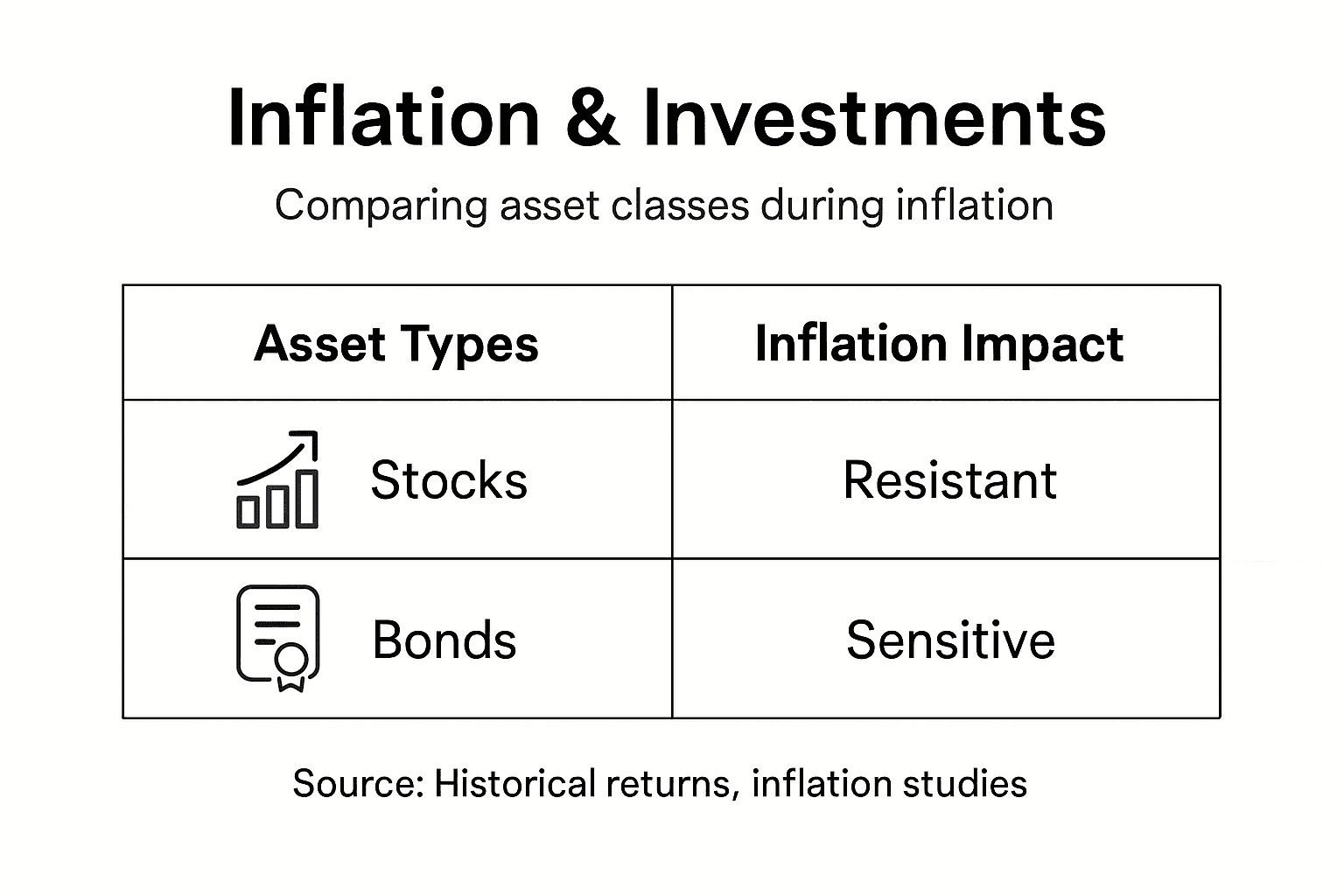
Unexpected inflation dramatically affects real returns across different asset classes. Commodities and inflation-linked bonds typically generate positive real returns during inflationary periods, while traditional sovereign bonds and stock market indices often experience negative real returns. This variation underscores the importance of strategic asset allocation during inflationary environments.
Investors must recognize that each inflation type presents unique challenges and opportunities. For instance, demand-pull inflation might benefit certain sectors like technology and consumer goods, while cost-push inflation could disproportionately impact manufacturing and transportation industries. Understanding these nuanced impacts allows for more sophisticated investment decision-making.
Pro tip: Diversify your investment portfolio across multiple asset classes to mitigate inflation-related risks and maintain consistent wealth preservation.
How Inflation Influences Investment Returns
Inflation represents a complex economic force that fundamentally transforms investment performance across different asset classes. Investors must understand how inflation creates nuanced impacts on returns, eroding purchasing power and reshaping investment strategies in real-time economic landscapes.
Key mechanisms through which inflation influences investment returns include:
- Reduced real returns by diminishing purchasing power
- Increased volatility in financial markets
- Differential impacts across various asset classes
- Changes in investor risk perception and behavior
- Potential for asset value reallocation
High inflation episodes dramatically affect asset pricing through distinct channels of ‘good’ and ‘bad’ inflation. Demand-driven inflationary shocks can generate different investment outcomes compared to supply-side inflationary pressures, creating complex risk dynamics for portfolio management.
Nominal investments suffer most during inflationary periods, with fixed-income securities experiencing significant value erosion. Bonds and cash holdings become particularly vulnerable, as their fixed returns cannot keep pace with rising price levels. Conversely, real assets like commodities, real estate, and inflation-protected securities often demonstrate superior performance during high-inflation environments.

Pro tip: Regularly rebalance your investment portfolio to include inflation-resistant assets that can maintain purchasing power during economic uncertainty.
Comparing Asset Classes During Inflationary Periods
Navigating investment strategies during inflationary periods requires a nuanced understanding of how different asset classes perform under varying economic conditions. Investors must recognize that not all investments respond identically to rising price levels, making strategic allocation critical for wealth preservation.
Key performance characteristics of major asset classes during inflation include:
- Commodities: Typically generate positive real returns
- Real Estate: Often provides natural inflation hedge
- Stocks: Performance varies by sector and company fundamentals
- Bonds: Generally most vulnerable to inflationary erosion
- Inflation-Protected Securities: Designed to maintain purchasing power
Conventional real assets demonstrate complex hedging properties against different inflation components. While stocks, currencies, and real estate might effectively hedge against energy-driven inflation, they often struggle to protect against more persistent core inflation mechanisms.
Sophisticated investors should focus on diversification and strategic allocation. Energy sectors, commodities, and real estate tend to outperform during inflationary periods, while traditional sovereign bonds and broad stock indices frequently experience negative real returns. Understanding these dynamics allows for more resilient portfolio construction that can withstand economic uncertainty.
Here’s a comparative look at how main asset classes tend to perform during inflationary periods:
| Asset Class | Typical Inflation Impact | Main Risk | Inflation-Hedging Strength |
|---|---|---|---|
| Commodities | Positive real returns | High price volatility | Strong for most inflation shocks |
| Real Estate | Outpaces consumer inflation | Sensitive to local market cycles | Moderate to strong |
| Stocks | Varies by sector | Earnings uncertainty | Weak overall but sector-dependent |
| Bonds | Value eroded by inflation | Fixed coupon risk | Very weak |
| Inflation-Protected Sec. | Maintains purchasing power | Lower yield in low inflation | Strong |
Pro tip: Implement a dynamic asset allocation strategy that periodically rebalances towards inflation-resistant investments during high-inflation environments.
Risks, Mistakes, And Hedging Strategies For Investors
Navigating inflation’s complex landscape requires investors to develop sophisticated strategies that protect wealth against purchasing power erosion. Understanding potential risks and implementing strategic hedging techniques becomes crucial for maintaining long-term financial stability in volatile economic environments.
Common investment mistakes during inflationary periods include:
- Overconcentrating in fixed-income securities
- Neglecting portfolio diversification
- Failing to adjust investment allocations
- Ignoring inflation-resistant asset classes
- Panicking and making reactive investment decisions
Investment portfolios face significant challenges hedging inflation risks with traditional financial instruments. Inflation-linked bonds provide limited protection, and both nominal debt and stocks demonstrate comparable challenges in maintaining real value during economic uncertainties.
Sophisticated investors should focus on strategic asset allocation across multiple inflation-resistant categories. Real assets like commodities, real estate, and infrastructure offer robust diversification mechanisms that can help mitigate inflation’s erosive effects. By maintaining a dynamic, adaptive investment approach, investors can build resilient portfolios capable of withstanding unexpected economic shifts.
Below is a quick-reference table of key investor mistakes and smarter alternatives for managing inflation risk:
| Common Mistake | Smarter Alternative |
|---|---|
| Overconcentrate in fixed income | Allocate more to real assets |
| Ignore inflation signals | Monitor diverse economic indicators |
| Fail to diversify | Invest across asset classes |
| Panic during volatility | Stick to a dynamic allocation |
Pro tip: Regularly review and rebalance your investment portfolio, allocating at least 15-20% towards real assets that historically demonstrate strong inflation-hedging capabilities.
Protect Your Wealth From Inflation Challenges Today
Navigating how inflation affects your investments can be overwhelming. Rising prices and unpredictable market shifts threaten your portfolio’s real returns and purchasing power. This article highlights key pain points like erosion of fixed-income value, volatility in stocks, and the need for smart diversification. If you want to gain control over inflation risks and safeguard your wealth, it is time to explore expert guidance tailored to these challenges.
Discover actionable strategies and personalized advice that align with the inflation landscape discussed here. Visit finblog.com to access professional financial insights and consultation services designed for investors serious about securing their future. Don’t wait for inflation to erode your hard-earned assets—take decisive steps now by visiting finblog.com to protect your investment portfolio with proven hedging techniques and dynamic asset allocation solutions.
Frequently Asked Questions
How does inflation impact investment returns?
Inflation reduces real returns by eroding purchasing power, affecting asset classes differently. Fixed-income securities and cash typically suffer the most, whereas real assets like commodities and real estate may perform better during inflationary periods.
What types of inflation are most relevant for investors?
The primary types of inflation include demand-pull, cost-push, built-in, creeping, and hyperinflation. Each type influences investment performance differently, making it essential for investors to understand these variations for effective asset allocation.
How can investors hedge against inflation?
Investors can hedge against inflation by diversifying their portfolios with inflation-resistant assets, such as commodities, real estate, and inflation-protected securities. Regularly rebalancing towards these assets can help maintain purchasing power during economic uncertainty.
What are common investment mistakes during inflationary periods?
Common mistakes include overconcentrating in fixed-income securities, neglecting diversification, failing to adjust allocations based on inflation signals, and panicking during market volatility. Avoiding these mistakes can help maintain portfolio stability.