

Most American professionals discover that keeping financial goals on track feels tougher with every new responsibility. Over 60% of global investors admit they struggle to measure and improve their financial health as life gets more complex. Clarity about where your money truly stands is the first step to breaking out of uncertainty. This guide offers practical ways to assess, organize, and set achievable targets so you can build real momentum on your financial independence journey.
Table of Contents
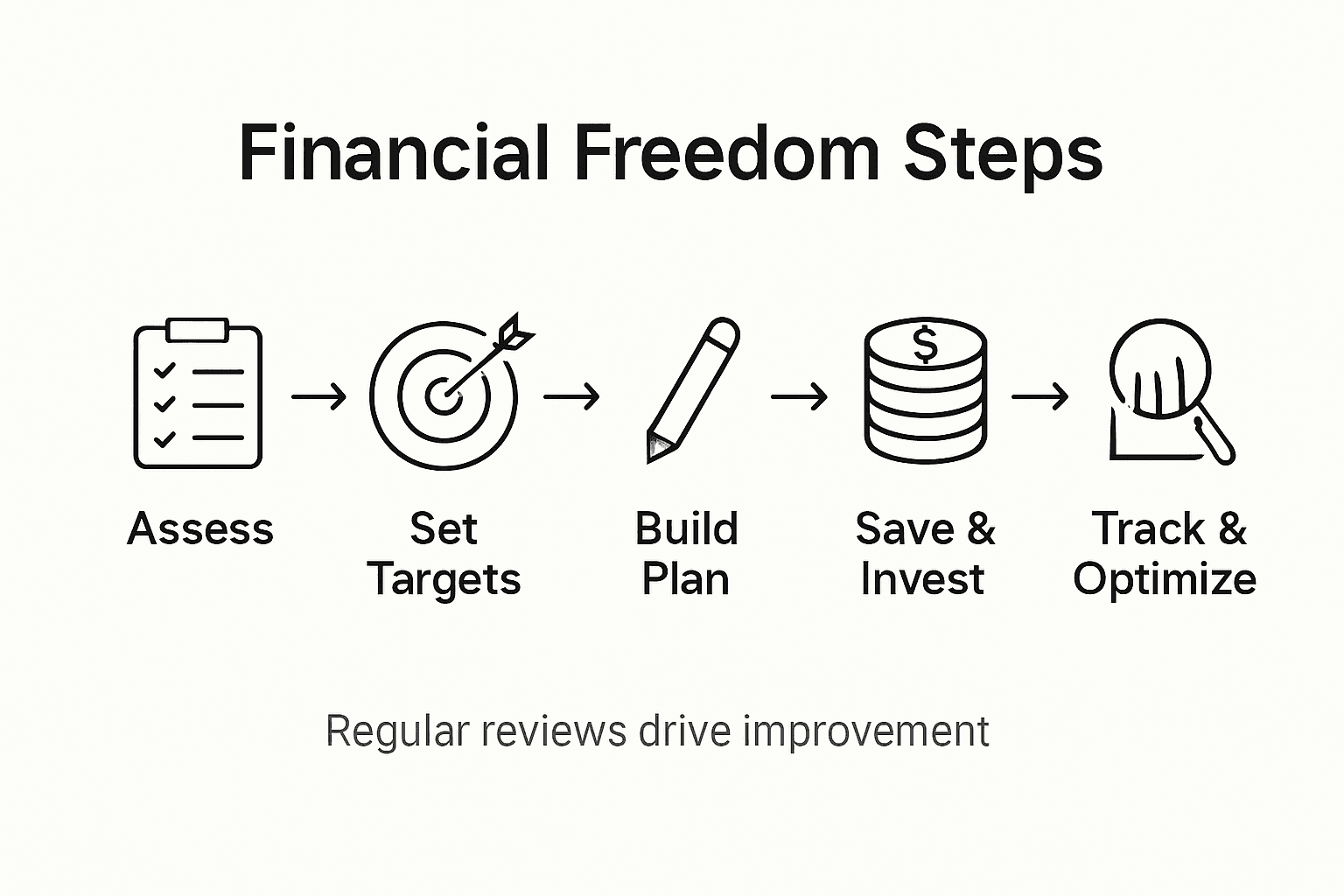
- Step 1: Assess Current Financial Status
- Step 2: Set Clear Investment And Savings Targets
- Step 3: Create A Personalized Wealth-Building Strategy
- Step 4: Implement Disciplined Saving And Investing Habits
- Step 5: Track Progress And Optimize Your Plan
Quick Summary
| Key Point | Explanation |
|---|---|
| 1. Assess your financial status | Gather documentation to review total assets, liabilities, income, and expenses for strategic planning. |
| 2. Set specific savings goals | Identify financial milestones and calculate contributions to meet goals within desired timeframes. |
| 3. Automate savings and investments | Establish direct deposits into designated accounts to ensure consistent wealth growth without emotional distractions. |
| 4. Regularly review financial progress | Conduct quarterly assessments to adjust your strategies based on performance and changing circumstances. |
| 5. Diversify investment strategies | Allocate investments across various asset classes matching personal risk tolerance and goals to optimize growth. |
Step 1: Assess current financial status
Mastering your financial freedom journey begins with a clear snapshot of where you currently stand. Understanding your financial landscape allows you to craft realistic strategies and identify precise areas for improvement.
Start by gathering comprehensive documentation that reveals your complete financial picture. This includes recent bank statements, investment account summaries, retirement fund records, credit card statements, loan documents, and tax returns. Global financial stability insights from comprehensive market reports emphasize the importance of detailed personal financial assessment as a foundation for strategic planning.
Break down your financial status into key components: total assets, total liabilities, monthly income, monthly expenses, debt ratios, and net worth. Calculate your net worth by subtracting total liabilities from total assets. This single number provides a powerful indicator of your current financial health. Analyze your income streams and categorize expenses into fixed costs (mortgage, utilities) and discretionary spending (entertainment, dining out). Look for potential areas where you can reduce unnecessary expenditures.
Track your cash flow meticulously for at least three months to understand spending patterns. Create a spreadsheet or use financial tracking apps to categorize every expense. This granular approach reveals spending habits and helps identify potential savings opportunities.
Here’s a quick summary of essential financial health indicators and what they measure:
| Indicator | What It Measures | Why It Matters |
|---|---|---|
| Net Worth | Total assets minus total liabilities | Shows overall financial health |
| Debt Ratio | Debt divided by total assets | Assesses leverage and risk |
| Cash Flow | Income minus expenses | Reveals savings ability |
| Expense Breakdown | Fixed vs. discretionary spending | Uncovers savings opportunities |
Pro tip: Consider scheduling a quarterly financial review to continuously monitor and adjust your financial strategies based on changing life circumstances and economic conditions.
Step 2: Set clear investment and savings targets
Defining precise investment and savings targets transforms your financial aspirations from abstract dreams into actionable plans. Your goals will serve as a strategic roadmap that guides every financial decision you make.
Investment goal setting strategies from expert resources emphasize creating specific, measurable targets aligned with your life timeline. Begin by identifying your key financial milestones such as retirement, home purchase, children’s education, or starting a business. For each goal, determine the exact amount needed and the target timeframe. Calculate required monthly or annual contributions by breaking down the total amount into manageable increments.
Classify your goals into short term (1-3 years), medium term (3-7 years), and long term (7+ years) categories. This categorization helps you select appropriate investment vehicles and risk levels. Short term goals might use high yield savings accounts or certificates of deposit, while long term goals could involve stock market investments or retirement accounts. Align your investment strategy with each goal’s time horizon and your personal risk tolerance.
Establish automatic savings mechanisms to ensure consistent progress. Set up direct deposit transfers to dedicated accounts for each financial goal, creating a systematic approach to wealth building. Regularly review and adjust your targets as your income, expenses, and life circumstances evolve.
Compare common investment vehicles by term and risk:
| Investment Type | Best For | Typical Time Horizon | Risk Level |
|---|---|---|---|
| Savings Account | Emergency Fund | Under 3 years | Very Low |
| Certificates of Deposit | Short-term Goals | 1 to 3 years | Low |
| Index Funds | Retirement | Over 7 years | Moderate |
| Stocks | Wealth Growth | Over 5 years | High |
Pro tip: Use the 50/30/20 budgeting rule as a baseline for allocating your income toward savings and investment goals, ensuring consistent financial progress.
Step 3: Create a personalized wealth-building strategy
Developing a personalized wealth-building strategy transforms your financial aspirations into a structured roadmap for sustainable growth. Your unique approach will reflect your individual financial situation, goals, and risk tolerance.

Comprehensive wealth-building strategies from financial research highlight the importance of crafting a tailored plan that adapts to your specific circumstances. Begin by conducting a thorough assessment of your current financial landscape including income sources, existing assets, debt levels, and potential investment opportunities. Consider your career trajectory, family responsibilities, and long term financial objectives when designing your strategy.
Segment your wealth-building approach into multiple strategic components. Prioritize debt reduction, emergency fund establishment, retirement savings, and targeted investment portfolios. Diversify your investment approach across different asset classes such as stocks, bonds, real estate, and potentially alternative investments like index funds or exchange traded funds. Match your investment selections with specific financial goals and corresponding time horizons while maintaining a balanced risk profile.
Implement a systematic approach to wealth accumulation by establishing automatic investment mechanisms. Set up recurring transfers to investment accounts, retirement plans, and targeted savings vehicles. Regularly review and rebalance your portfolio at least annually, adjusting your strategy in response to changing personal circumstances, market conditions, and progress toward your financial milestones.
Pro tip: Develop a financial dashboard or spreadsheet to track your wealth-building progress, allowing you to visualize your financial growth and maintain consistent motivation.
Step 4: Implement disciplined saving and investing habits
Building consistent financial habits transforms your wealth creation potential from wishful thinking into measurable progress. Developing a systematic approach to saving and investing requires commitment and strategic planning.
Psychological research on saving behavior reveals that personalized strategies significantly improve financial discipline. Start by automating your savings through direct deposit allocations that immediately route a predetermined percentage of your income into investment and savings accounts. This approach removes emotional decision making and ensures consistent wealth accumulation regardless of monthly fluctuations.
Design a structured saving framework that prioritizes multiple financial objectives simultaneously. Implement the 50/30/20 budgeting rule as a foundational strategy allocating 50% to essential expenses, 30% to discretionary spending, and 20% to savings and investments. Break down your savings into specific buckets emergency funds, retirement accounts, short term goals, and long term investment portfolios. Each bucket should have clear contribution targets and predetermined investment vehicles matching its specific time horizon and risk profile.
Track your progress meticulously by establishing monthly financial review sessions. During these reviews, analyze your saving rates, investment performance, and adjust your strategy based on changing personal circumstances. Cultivate a mindset of continuous financial learning, staying informed about market trends and investment opportunities without becoming emotionally reactive to short term market fluctuations.
Pro tip: Implement a quarterly financial self audit to maintain accountability and ensure your saving and investing habits remain aligned with your evolving financial goals.
Step 5: Track progress and optimize your plan
Successful financial independence requires consistent monitoring and strategic adaptation of your wealth-building approach. Your financial plan is a living document that must evolve with your changing life circumstances and economic conditions.
Comprehensive financial tracking strategies recommend establishing a systematic approach to evaluating your financial progress. Create a comprehensive dashboard that captures key performance indicators including savings rate, investment returns, debt reduction progress, and alignment with your original financial goals. Use digital tools or spreadsheets to maintain visual representations of your financial trajectory, allowing you to quickly identify areas of success and potential improvement.
Implement quarterly review sessions designed to assess your financial strategy holistically. During these reviews, compare your actual performance against predefined benchmarks and original objectives. Analyze your investment portfolio diversification, rebalance assets as needed, and adjust contribution levels to match your evolving financial capacity. Look for opportunities to optimize tax efficiency, reduce unnecessary expenses, and reallocate resources toward higher performing investment vehicles.
Cultivate a proactive mindset of continuous learning and financial adaptability. Stay informed about market trends, economic shifts, and potential investment opportunities without becoming emotionally reactive. Develop a network of trusted financial advisors or peer groups who can provide objective insights and help you maintain perspective during your financial independence journey.
Pro tip: Maintain a separate journal documenting your financial decisions, tracking the reasoning behind each strategy to help you learn from both successes and setbacks.
Take Control of Your Financial Freedom Journey Today
Achieving true financial independence requires more than just understanding your current financial status or setting investment targets. The key is to develop a disciplined, personalized strategy that evolves with your goals and lifestyle. The challenges of tracking expenses, managing cash flow, and maintaining consistent saving and investing habits can be overwhelming. That is where expert guidance and tailored support become invaluable.
At finblog.com, we provide practical tools and financial advisory services designed to help you master every step outlined in the Financial Freedom Roadmap. From creating detailed wealth-building strategies to implementing disciplined saving routines, our secure and user-friendly platform helps you stay on track. Visit our landing page and explore how you can benefit from personalized financial consultations and resources that turn your ambitions into measurable progress. Don’t wait until tomorrow—start optimizing your path to financial independence now and build the confidence to conquer your financial future.
Frequently Asked Questions
How do I assess my current financial status?
Begin by gathering all relevant financial documents like bank statements, investment summaries, and tax returns. Break down your financial status into key components, including total assets, total liabilities, and cash flow. Track your expenses for at least three months to reveal spending habits and identify potential savings opportunities.
What are effective ways to set investment and savings targets?
Define clear investment and savings targets by identifying your key financial milestones and the amounts needed for each. Break down these targets into short-term, medium-term, and long-term categories to select suitable investment vehicles. Consider setting up automatic transfers to dedicated accounts to consistently work toward your goals.
How can I create a personalized wealth-building strategy?
Start by assessing your financial landscape, including income sources and existing assets. Segment your strategy into components like debt reduction and emergency funds, diversifying your investments based on your specific goals and risk tolerance. Implement automatic investment mechanisms to streamline your wealth accumulation process.
What disciplined saving and investing habits should I adopt?
Automate your savings by routing a set percentage of your income into investment and savings accounts. Use the 50/30/20 budgeting rule to allocate your income effectively and track your progress through monthly financial reviews. Cultivating these habits will promote consistent growth toward your financial goals.
How do I track my financial progress and optimize my plan?
Establish a systematic approach by creating a financial dashboard that captures key performance indicators like savings rate and investment returns. Conduct quarterly review sessions to assess your strategy and make adjustments as needed. Continuously educate yourself on market trends to stay adaptable and informed.
Why is it important to have a financial dashboard?
A financial dashboard allows you to visualize your financial growth and track progress toward your goals. By regularly reviewing key performance indicators, you can identify areas of success and opportunities for improvement. Maintain your dashboard and update it at least quarterly to ensure your financial strategy remains aligned with your objectives.
Recommended
- Achieve Financial Independence Retire Early: Step-by-Step Guide – Finblog
- Master Financial Planning for Freelancers in 2025 – Finblog
- What is a Financial Plan? Understanding Its Importance – Finblog
- How to Budget Effectively: Master Your Finances in 2025 – Finblog
- Financial Planning for Teens: Step-by-Step for Smart Choices | ReVroom
- Master Self Employment: Build Your Side Business in 2025 | siift
- From Marriage to Retirement: Key Life Events That Require Estate Plan Updates – Law Office of Eric Ridley