President Donald Trump says the US Navy could escort oil tankers through the Strait of Hormuz to restore global energy flows. But shipping companies, analysts, and energy experts warn the plan may be far harder to execute than the White House suggests as the war with Iran intensifies.
The narrow waterway between Iran and Oman has effectively shut down after Iran threatened to attack vessels crossing the strait following US and Israeli strikes on Iranian targets. The closure has already disrupted global shipping and pushed oil prices sharply higher, raising fears of a broader energy crisis if the conflict drags on.
Meanwhile, the war itself is expanding rapidly. US Defense Secretary Pete Hegseth said Washington will not stop until Iran is “totally and decisively defeated,” and the war will end on the US timeline. At the same time, President Trump has sent mixed signals about how long the conflict could last, saying at one point the war was “very complete,” but later warning that the US still needs to achieve “ultimate victory.”
Trump has also intensified warnings to Iran, saying the US would strike “TWENTY TIMES HARDER” if Tehran attempts to disrupt global oil supplies.
A Critical Chokepoint for Global Oil
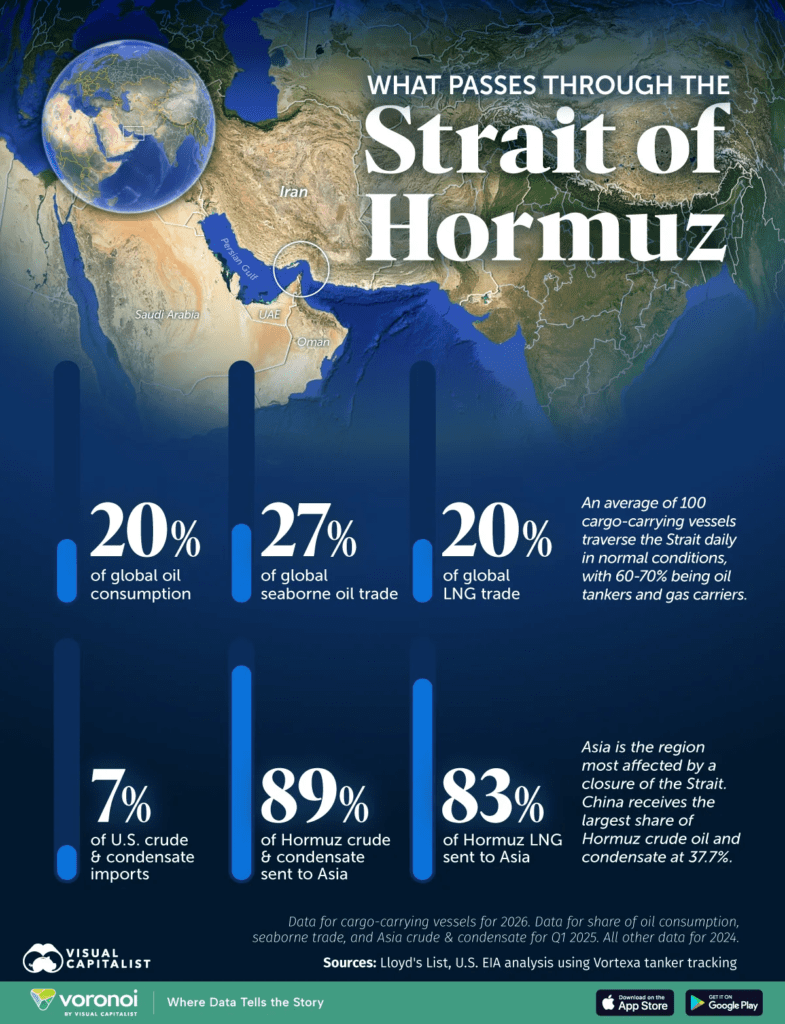
The Strait of Hormuz is one of the most important energy routes in the world. Around 20% of global oil supply normally passes through the channel, connecting Gulf producers to international markets.
According to energy data firm Kpler, more than 14 million barrels of oil per day moved through the strait in 2025, roughly a third of all oil transported by sea worldwide. Under normal conditions, about 100 tankers and cargo ships cross the strait each day.
Now, however, the channel has nearly come to a halt. Hundreds of ships are reportedly stuck inside the Persian Gulf, while others refuse to enter the area due to security risks.

Trump’s Proposal: Naval Escorts for Oil Tankers
In response to the crisis, Trump has proposed that the US Navy escort commercial oil tankers through the Strait of Hormuz to guarantee safe passage and restore energy exports.
The administration has also suggested government-backed insurance for shipping companies, hoping the measure would encourage vessels to resume operations despite the war.
Energy Secretary Chris Wright said naval escorts would begin “as soon as we can”, once military resources can shift toward protecting commercial shipping lanes. But industry experts warn the plan faces major logistical and security challenges.
Shipping Companies Are Reluctant to Take the Risk
Even with military escorts, many shipping companies say they are unwilling to send crews through the strait while attacks continue.
Commercial seafarers have already experienced missile strikes in nearby waters. One tanker crew member told CNN that rockets and drones targeting merchant ships make the route extremely dangerous.
“As long as they keep firing rockets or drones at merchant vessels, this unsafe feeling will remain,” the sailor said. (CNN)
Major shipping companies including Maersk and Hapag-Lloyd have already halted most cargo shipments destined for Persian Gulf countries. At the same time, maritime insurers have withdrawn war-risk coverage, making operations in the region financially risky.
Not Enough Warships to Escort Every Vessel
Another major challenge is scale.
Providing protection for every tanker traveling through the strait could require a massive number of naval vessels, analysts say.
Jakob Larsen, chief safety and security officer for the global shipping association BIMCO, warned that escorting every ship would be unrealistic.
“Providing protection for all tankers operating in areas currently threatened by Iran is unrealistic,” Larsen said, noting that such an operation would require “a very high number of warships and other military assets.” (CNN)
Even if naval escorts were available, hundreds of ships are already waiting in the region, meaning it could take weeks to clear the backlog of tankers trapped in the Gulf.

A Different Situation Than the 1980s
The US Navy has escorted tankers through the Gulf before. During the Iran-Iraq war in the late 1980s, American forces protected commercial shipping after attacks on oil tankers threatened global energy supplies.
But experts say the current situation is very different.
At that time, the United States was not directly fighting Iran, whereas today Washington is deeply involved in the conflict.
“We weren’t the active combatant then,” said Helima Croft, global head of commodity strategy at RBC Capital Markets and a former CIA analyst. “We are the main character in this.” (CNN)
The Risk of a Global Oil Shock
If the Strait of Hormuz remains closed for an extended period, the consequences for global energy markets could be severe.
Analysts warn oil prices could surge well above $100 per barrel if supply disruptions persist. Some forecasts suggest prices could even rise toward $120 per barrel if exports remain blocked.
Energy markets are already nervous. Saudi Aramco CEO Amin Nasser warned the Iran conflict could have “catastrophic consequences for the world’s oil market.”
Energy analysts say prolonged disruptions could trigger “demand destruction,” where high fuel prices force businesses and consumers to reduce energy usage.
Global Supply Chains Could Also Be Hit
The disruption extends far beyond energy markets.
If ships remain trapped outside the Persian Gulf, the crisis could ripple through global supply chains, affecting shipping costs and delivery times worldwide.
Shipping executives warn the situation could resemble the logistical chaos seen during the COVID-19 pandemic, when container shortages and port congestion drove up prices for goods globally.
Ports across Asia are already approaching capacity as ships divert cargo away from the region.
Meanwhile, several Gulf nations depend heavily on imports. Countries such as Saudi Arabia, the United Arab Emirates, and Qatar import roughly 85% of their food, making shipping disruptions particularly concerning.

Which Countries Are Most at Risk
The biggest economic exposure to disruptions in the Strait of Hormuz lies in Asia, which receives the vast majority of energy shipments moving through the corridor.
Roughly 89% of crude oil exports passing through the strait go to Asian markets.
The most exposed countries include:
• China – about 38% of shipments
• India – about 15%
• South Korea – about 12%
• Japan – about 11%
Together these economies account for most of the oil transported through the strait, making them particularly vulnerable to supply disruptions.
By contrast, the United States is far less dependent on the route. Only about 7% of US crude imports pass through the strait, and roughly 2% of US petroleum consumption relies on it.
However, because oil is priced globally, American gasoline prices would still rise sharply if global supply drops..
For now, the world’s most important oil chokepoint remains unstable, leaving markets, governments, and energy companies watching closely to see whether Trump’s strategy can actually reopen the Strait of Hormuz without triggering a global oil crisis.
Disclosure: This article does not represent investment advice. The content and materials featured on this page are for educational purposes only.
Related: Iran War Takes Center Stage for Global Markets
Trump on rising gas prices during Iran operation: ‘If they rise, they rise’