
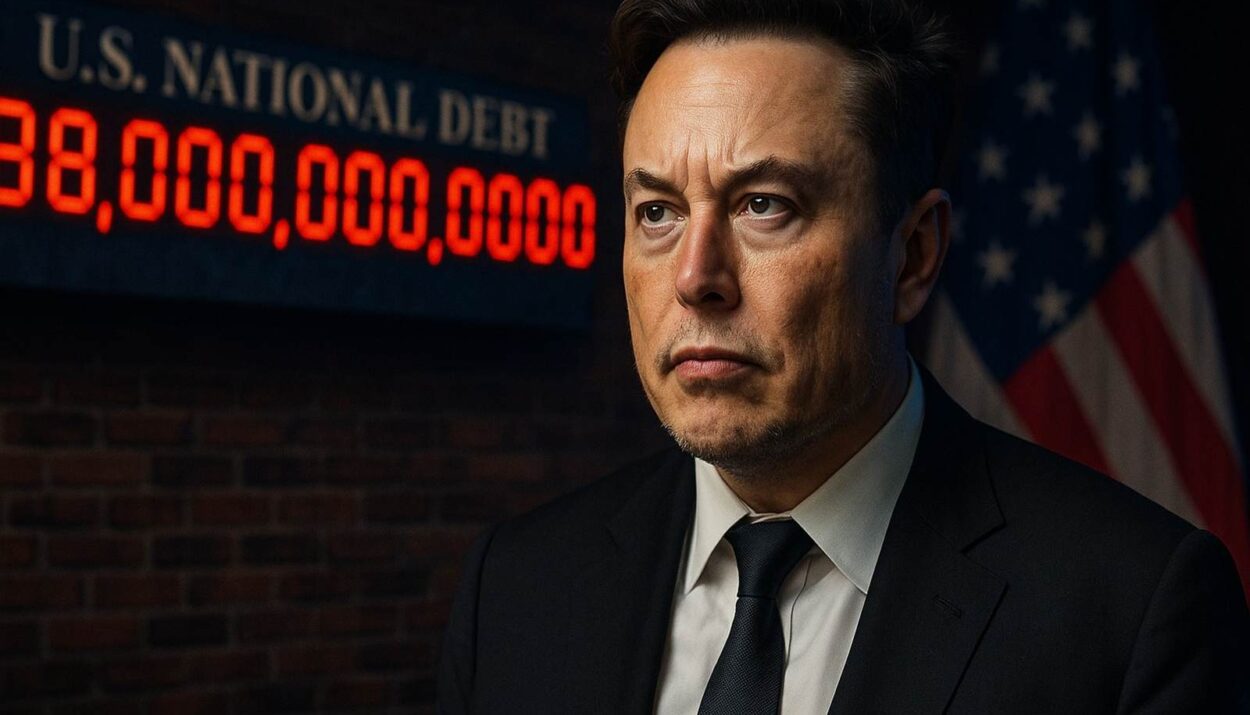

Elon Musk says the US government’s $38 trillion national debt can only be addressed through artificial intelligence and robotics, predicting the technologies will boost output enough to offset the country’s ballooning deficits.
In a podcast interview with Nikhil Kamath, Musk called America’s debt “insanely high” and said interest payments now exceed the entire US military budget. He warned that traditional fiscal and monetary tools will not be enough to fix the problem.
“I think that’s pretty much the only thing that’s going to solve the US debt crisis,” Musk said. “The interest payments alone are greater than defense spending, and they’ll keep growing.”
Musk argued that large-scale deployment of AI and robotics would lead to rapid increases in productivity, potentially creating deflation as goods and services become cheaper and more abundant.
“If you have AI and robotics, and a dramatic increase in the output of goods and services, you’ll likely have deflation,” he said. “You simply won’t be able to expand the money supply as fast as productivity increases.”
The Tesla CEO also predicted that AI-driven efficiency will eventually remake the entire economic system, suggesting that once automation can build chips, machines, and solar panels independently, the economy could “decouple from the monetary system.”
Musk estimated that within three years, AI-driven productivity will surpass the rate of money supply growth, easing inflation and shifting the structure of the global economy.
“In that future, the notion of countries becomes anachronistic,” he said. “This will happen whether I like it or not. As long as civilization keeps advancing, we will have AI and robotics at a very large scale.”
Musk’s remarks come amid growing debate about whether automation will help or hurt fiscal stability, as policymakers weigh the long-term consequences of rapid AI adoption on employment, taxation, and national debt.
Disclosure: This article does not represent investment advice. The content and materials featured on this page are for educational purposes only.