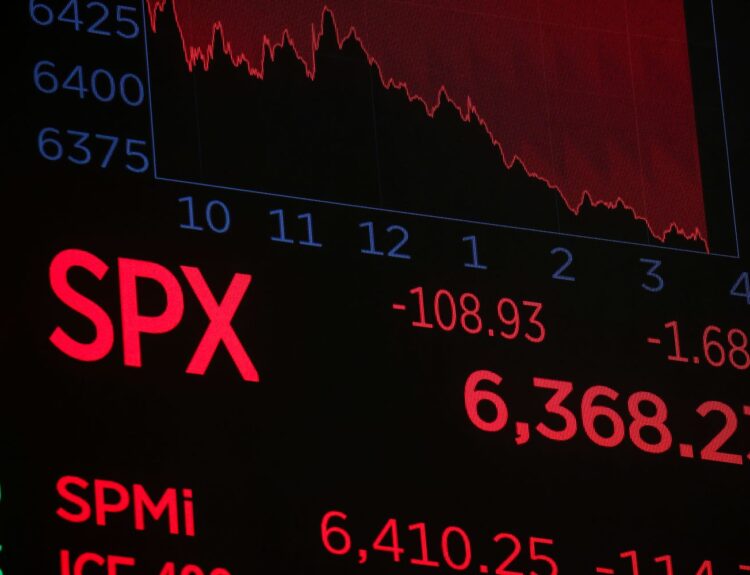

Software stocks have already been sliding on fears that artificial intelligence could make parts of their business models obsolete. That selloff accelerated sharply after the release of new AI coding and productivity tools, reigniting anxiety across global markets. Even Europe’s former most valuable company, Novo Nordisk, was not spared, with shares dropping after disappointing guidance.
After a bruising start to the week, US stock futures now suggest some stabilization. But the bigger question remains unresolved: is this just a painful reset, or the start of something much larger?
The question investors always ask too late
Interest in the phrase “AI bubble” has surged recently, especially after market volatility shook investor confidence. Historically, this question is rarely asked at market tops. It usually appears after prices wobble, not before.
And despite the noise, the AI boom has been massive and persistent. Valuations are stretched, capital spending is enormous, and expectations are sky-high. That combination has prompted some of the most respected voices in finance to weigh in, with sharply different conclusions.
The case for a bubble, according to history’s skeptics
Veteran investor Jeremy Grantham and financial historian Edward Chancellor argue that markets are once again displaying classic bubble characteristics. In a recent essay, they compared today’s AI enthusiasm to more than 300 historical market manias.
Their conclusion is blunt: this looks like one of the great bubbles. However, even they concede that the final signs of a major top may not yet be in place.
Grantham, who openly calls himself a “permabear,” has a long track record of spotting excesses early, sometimes painfully early. That nuance matters, because calling a bubble too soon can be just as costly as missing one entirely.
A calmer view: why this may not be a bubble yet
A very different framework comes from economist and fund manager Owen Lamont, who argues that despite frothy conditions, the AI boom does not yet qualify as a true bubble.
Lamont uses what he calls the four horsemen of bubbles:
- Overvaluation
- Bubble beliefs and hype
- Large inflows from investors
- Equity issuance by insiders
According to him, only three out of four are present today.
Valuations are undeniably high. Investor excitement is everywhere. Retail participation is strong.
But one crucial signal is missing: massive equity issuance.
In past bubbles, corporate insiders rushed to sell shares through IPOs, SPACs, and secondary offerings, effectively handing risk to the public. Today, the opposite is happening. US companies have been buying back nearly $1 trillion in stock, thereby shrinking the public float rather than expanding it.
That behaviour suggests the so-called “smart money” is not yet acting as if prices are unsustainably high.
Big spending does not automatically mean irrationality
Another concern haunting markets is whether the enormous spending on AI infrastructure will ever pay off. Professor Aswath Damodaran takes a pragmatic view.
He argues that many transformative technologies require heavy, uncertain investment upfront. Railroads, oil drilling, and the internet all experienced periods of overbuilding. Some investments failed, but the overall innovation reshaped the economy.
His message is simple: negative returns on some AI projects do not automatically mean the entire sector is a bubble. They may simply reflect the cost of discovering which models and platforms will ultimately win.
Why today still looks different from past crashes
Goldman Sachs strategist Peter Oppenheimer adds another layer of context. Unlike the dotcom era, today’s AI leaders are profitable, cash-rich, and deeply embedded in the global economy. That financial strength gives them far more staying power than many tech firms had in 2000.
That does not guarantee safety. Even cash-rich companies can waste capital. But it reduces the risk of a sudden, system-wide collapse driven by weak balance sheets.
The real warning sign investors should watch
If history is any guide, the moment to worry is not when markets argue about bubbles, but when insiders rush for the exits.
Lamont points to a simple signal: a flood of IPOs from companies eager to sell shares at inflated prices. That phase often brings fraud, speculative listings, and aggressive storytelling aimed at retail investors.
So far, that wave has not fully arrived. But the calendar matters. Reports suggest that 2026 could mark the start of an IPO megacycle, with major private firms preparing to go public. If that happens, the market narrative could shift quickly.
Boom first, bubble later?
For now, the evidence points to an uncomfortable but important conclusion. The AI trade may be overextended in places, volatile, and emotionally charged, but it does not yet display the full anatomy of a historic bubble peak.
That does not mean investors are safe. It means the easy phase of the rally may be over, while the dangerous phase has not yet begun.
In past cycles, the biggest gains often came before the final excess. The biggest losses followed only after everyone agreed there was no risk left at all.
For investors trying to navigate this moment, the real task is not predicting the end, but recognizing the signal when it finally appears.
Related: ‘Get Me Out’: AI Fears Trigger a Software Stock Selloff
Disclosure: This article does not represent investment advice. The content and materials featured on this page are for educational purposes only.