

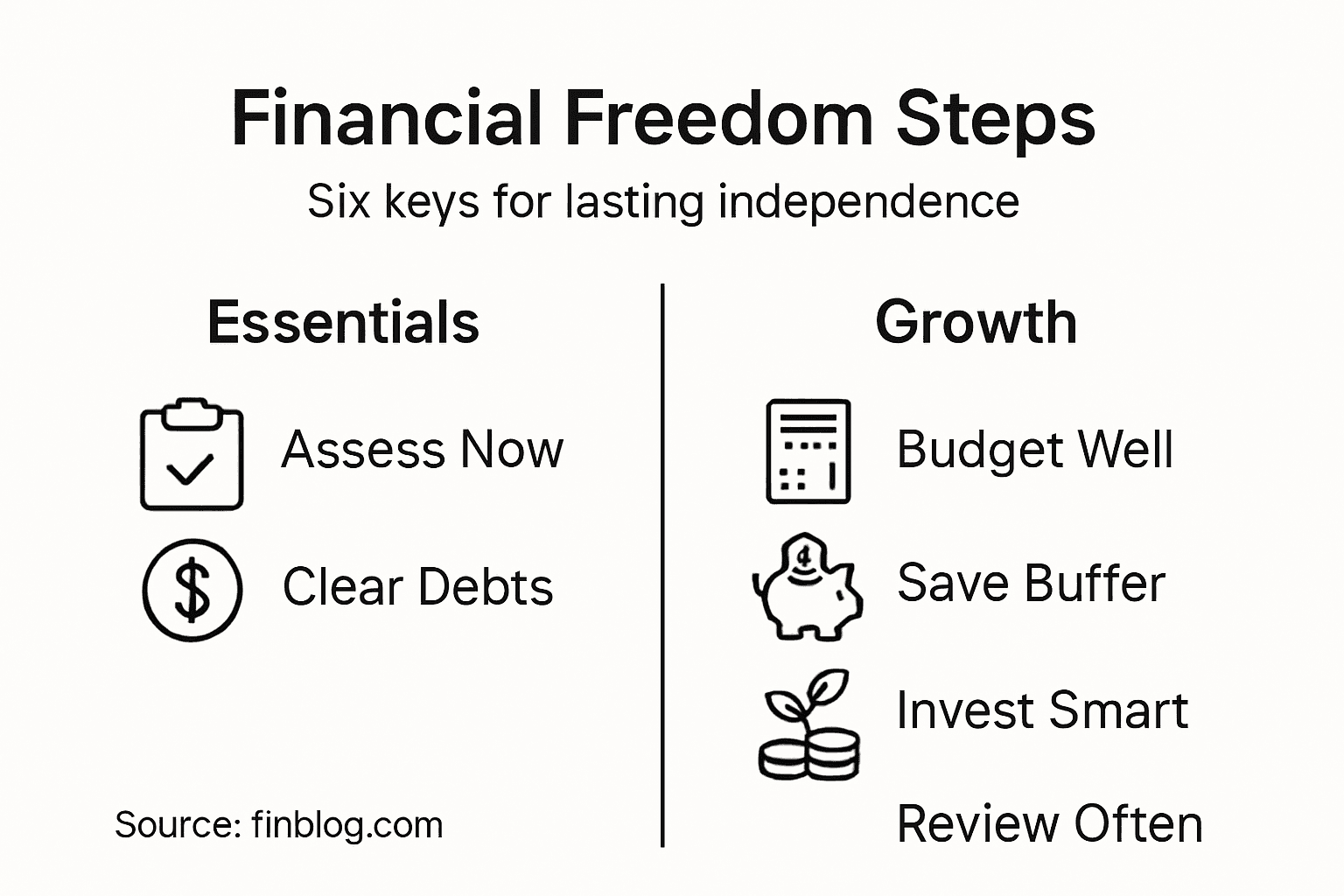
Juggling demanding careers and family commitments often leaves little time to get a handle on finances, yet that stress only builds when debt piles up and clarity slips away. Understanding your unique financial situation is more than just an exercise—it is the foundational step to making measurable changes. Backed by Federal Reserve research, taking a structured look at income, expenses, and outstanding debts offers a powerful starting point for achieving lasting peace of mind and financial independence.
Table of Contents
- Step 1: Assess Your Current Financial Situation
- Step 2: Eliminate High-Interest Debts Swiftly
- Step 3: Establish An Effective Budgeting System
- Step 4: Build Robust Emergency Savings
- Step 5: Invest Strategically For Future Growth
- Step 6: Monitor Progress And Adjust Plans
Quick Summary
| Key Takeaway | Explanation |
|---|---|
| 1. Assess Your Financial Health | A thorough review of income, expenses, debts, and net worth is essential for financial success. Create a detailed overview for actionable insights. |
| 2. Eliminate High-Interest Debt | Focus on paying off debts with the highest interest rates first to save money and reduce financial stress effectively. |
| 3. Establish a Budgeting System | Develop a budgeting framework that tracks income and expenses to align spending with financial goals and enhance decision-making. |
| 4. Build an Emergency Fund | Save three to six months of expenses to protect against unforeseen costs and provide financial stability in uncertain times. |
| 5. Monitor Progress Regularly | Conduct quarterly reviews of your financial plan to ensure it meets changing goals and make necessary adjustments to stay on track. |
Step 1: Assess your current financial situation
Financial freedom starts with a crystal-clear understanding of where you currently stand. This critical first step involves taking a comprehensive snapshot of your financial health that will serve as the foundation for your entire independence strategy.
To begin, gather all your financial documents and conduct a thorough review. This means collecting bank statements, credit card bills, investment accounts, loan documents, and pay stubs. The goal is to create a complete picture of your financial landscape. Federal Reserve research highlights the importance of understanding your economic standing across multiple dimensions.
Break down your assessment into key categories:
- Income sources: Document every stream of revenue
- Monthly expenses: List all recurring and variable costs
- Debt obligations: Total outstanding balances and interest rates
- Savings and investments: Current account balances and performance
- Net worth: Calculate total assets minus total liabilities
To effectively track these elements, consider creating a detailed spreadsheet that allows you to see your financial situation at a glance. Financial behaviors research emphasizes being intentional about managing incoming and outgoing funds.
A clear financial assessment is not about judgment, but about gaining actionable insights into your current economic reality.
Pro tip: Use digital budgeting tools or spreadsheet templates to streamline your financial assessment and make tracking easier.
Step 2: Eliminate high-interest debts swiftly
Defeating high-interest debt requires a strategic and focused approach that transforms your financial landscape. In this crucial step, you will develop a systematic plan to aggressively reduce and ultimately eliminate the most expensive debts that are holding you back from true financial freedom.

Federal Trade Commission guidelines recommend proactively communicating with creditors and prioritizing high-interest debt payments. To start, list all your debts with their corresponding interest rates and minimum payments. This creates a clear view of your debt ecosystem and allows you to target the most costly obligations.
Choose a strategic debt reduction method:
- Debt Avalanche Method: Target highest interest rate debts first
- Debt Snowball Method: Pay off smallest balances to build momentum
- Hybrid Approach: Combine psychological wins with mathematical efficiency
Your debt elimination strategy should include specific tactics:
Here is a comparison of popular debt payoff strategies to help you choose an approach that matches your needs:
| Method | Main Focus | Psychological Benefit |
|---|---|---|
| Debt Avalanche | Highest interest first | Saves most on interest |
| Debt Snowball | Smallest balance first | Fast wins boost motivation |
| Hybrid Approach | Mix of both methods | Balances savings and morale |
- Negotiate lower interest rates with creditors
- Consider balance transfer options for credit card debt
- Explore debt consolidation loans with better terms
- Create a strict budget that maximizes debt repayment
Debt management strategies emphasize adding extra income through side gigs or job changes to accelerate debt elimination.
Eliminating high-interest debt is not just about math – it’s about reclaiming your financial future and reducing stress.
Pro tip: Automate your debt payments to ensure consistency and avoid missed deadlines, which can derail your debt reduction plan.
Step 3: Establish an effective budgeting system
Creating a robust budgeting system is your roadmap to financial clarity and control. This critical step transforms your financial management from reactive guesswork to proactive strategy, giving you precise insights into your money’s movement and potential.
International Monetary Fund principles highlight the importance of disciplined financial planning and resource allocation. Your budgeting system should provide a clear framework for tracking income, managing expenses, and aligning your spending with your long-term financial goals.
Design your budget using these essential components:
- Income Tracking: Document all revenue streams
- Fixed Expenses: List consistent monthly obligations
- Variable Expenses: Monitor flexible spending categories
- Savings Allocations: Designate percentages for different savings goals
- Discretionary Spending: Set realistic limits for personal enjoyment
Implement your budgeting system through practical steps:
Below is an overview of leading budgeting methods and their key strengths:
| Budgeting Method | Core Principle | Best For |
|---|---|---|
| Zero-Based | Assign every dollar a job | Maximum control and awareness |
| 50/30/20 Rule | Split income by percentage | Simplicity and balance |
| Envelope System | Allocate cash per category | Limiting overspending |
- Choose a budgeting method (zero-based, 50/30/20 rule, envelope system)
- Select tracking tools (spreadsheets, budgeting apps, manual ledgers)
- Categorize and tag every expense
- Review and adjust your budget monthly
- Create accountability mechanisms
A well-designed budget is not a constraint, but a powerful tool for financial empowerment and strategic wealth building.
Pro tip: Use digital budgeting apps that automatically categorize expenses and provide real-time financial insights to streamline your tracking process.
Step 4: Build robust emergency savings
Building a solid emergency fund is your financial shield against unexpected life challenges. This critical step transforms uncertainty into security, providing a cushion that protects you from potential financial setbacks and gives you peace of mind.
Mutual savings experts recommend creating a safety net covering three to six months of essential living expenses. The goal is to establish a financial buffer that can absorb unexpected costs without derailing your long-term financial goals.
Strategic approaches to building your emergency fund:
- Start Small: Begin with achievable savings goals
- Automate Contributions: Set up automatic transfers
- Separate Accounts: Keep emergency funds distinct from spending money
- Consistent Growth: Incrementally increase savings over time
- Replenish Quickly: Rebuild fund after using emergency funds
Implement your emergency savings strategy through these steps:
- Calculate your essential monthly expenses
- Open a dedicated high-yield savings account
- Set up automatic monthly transfers
- Use windfalls to boost your emergency fund
- Periodically review and adjust your savings goal
An emergency fund is not just money in the bank – it’s your personal financial safety net that provides confidence and stability.
Pro tip: Choose a high-yield savings account that offers competitive interest rates while maintaining immediate accessibility for true emergencies.
Step 5: Invest strategically for future growth
Strategic investing is your pathway to building long-term wealth and securing financial independence. This critical step transforms your money from a passive resource into a powerful tool for generating sustainable future returns.
World Economic Forum insights highlight the importance of investing in ways that balance economic growth with broader societal and ecological considerations. Your investment strategy should focus on creating value while managing risk across multiple dimensions.
Key principles for strategic investment:
- Diversification: Spread investments across different asset classes
- Long-Term Perspective: Focus on sustained growth over quick gains
- Continuous Learning: Stay informed about market trends
- Risk Management: Balance potential returns with acceptable risk levels
- Regular Rebalancing: Adjust portfolio periodically
Implement your investment strategy through structured steps:
- Assess your current financial situation and risk tolerance
- Research and select appropriate investment vehicles
- Create a balanced investment portfolio
- Set clear investment goals with specific timelines
- Monitor and adjust investments regularly
Successful investing is not about timing the market, but about time in the market and making informed, strategic decisions.
Pro tip: Consider working with a certified financial advisor to develop a personalized investment strategy tailored to your specific financial goals and risk profile.
Step 6: Monitor progress and adjust plans
Financial freedom is a dynamic journey that requires continuous evaluation and strategic course correction. This crucial step transforms your financial plan from a static document into a living, breathing roadmap that adapts to your evolving life circumstances.
Financial planning experts recommend regular reviews to ensure your financial strategy remains aligned with your changing goals and life conditions. Consistent monitoring allows you to catch potential issues early and make proactive adjustments before they become significant challenges.
Key metrics to track in your financial progress:
- Income Tracking: Monitor changes in earnings
- Expense Patterns: Analyze spending trends
- Debt Reduction: Track debt payoff progress
- Savings Growth: Measure savings rate and accumulation
- Investment Performance: Review portfolio returns
Implement a systematic progress monitoring approach:
- Schedule quarterly financial review sessions
- Compare current performance against initial goals3. Identify gaps or areas needing adjustment
- Update your financial plan based on insights
- Celebrate milestones and achievements
Performance tracking techniques help individuals make timely decisions and maintain financial momentum.
Financial progress is not about perfection, but about consistent improvement and adaptability.
Pro tip: Create a digital dashboard or spreadsheet to visually track your financial metrics, making progress monitoring more engaging and less overwhelming.
Take Control of Your Financial Freedom Journey Today
Achieving lasting financial independence requires more than just a plan it demands expert guidance tailored to your unique challenges like tackling high-interest debt, building emergency savings, and investing strategically. If you are ready to move beyond assessment and budgeting and want to accelerate your progress with professional insights explore how finblog.com can empower your journey. Our customized financial consulting services and educational resources are designed to help you eliminate debt faster, create effective budgets, and build wealth confidently.
Don’t let uncertainty hold you back from the future you deserve. Take the next step by visiting finblog.com to access expert advice and tools that align with the top steps you need to financial freedom. Begin today and transform your financial plan into a sustainable reality.
Frequently Asked Questions
What is the first step to achieving financial freedom?
Financial freedom begins with assessing your current financial situation. Gather all your financial documents and create a complete overview to understand your income, expenses, debts, and savings. Start by creating a detailed spreadsheet within the next week to track these elements.
How can I effectively eliminate high-interest debt?
To eliminate high-interest debt, prioritize payments based on interest rates using methods like the Debt Avalanche or Debt Snowball. Make a list of your debts and focus on the highest-interest obligations first; aim to reduce these debts by at least 20% each month to gain momentum.
What budgeting methods are most effective for financial management?
Effective budgeting methods include the Zero-Based Budget, 50/30/20 Rule, and the Envelope System. Choose a method that suits your lifestyle, and implement it by categorizing all your financial activities within the next month to gain clear control over your spending.
How do I build an emergency fund?
Building an emergency fund starts with calculating your essential monthly expenses and aiming to save three to six months’ worth. Open a separate savings account and set up automatic transfers to ensure you consistently grow this fund, ideally reaching your goal within 6-12 months.
What should I consider when investing for future growth?
When investing for future growth, focus on diversification, long-term perspective, and regular portfolio evaluation. Research and select a balanced mix of investment vehicles, then set investments goals and monitor them quarterly to optimize performance.
How often should I review my financial progress?
You should review your financial progress at least quarterly to ensure your strategies remain aligned with your goals. Schedule dedicated review sessions to assess income, expenses, and savings, and make necessary adjustments to keep progressing toward financial freedom.
Recommended
- What Is Financial Independence and Why It Matters – Finblog
- Financial Freedom Roadmap: Achieve Independence Step-by-Step – Finblog
- Achieve Financial Independence Retire Early: Step-by-Step Guide – Finblog
- How to Build Wealth: Proven Steps for Lasting Financial Success – Finblog
- Finanzielle Unabhängigkeit und die FIRE Bewegung: Von der Utopie zur Realität – Smolio