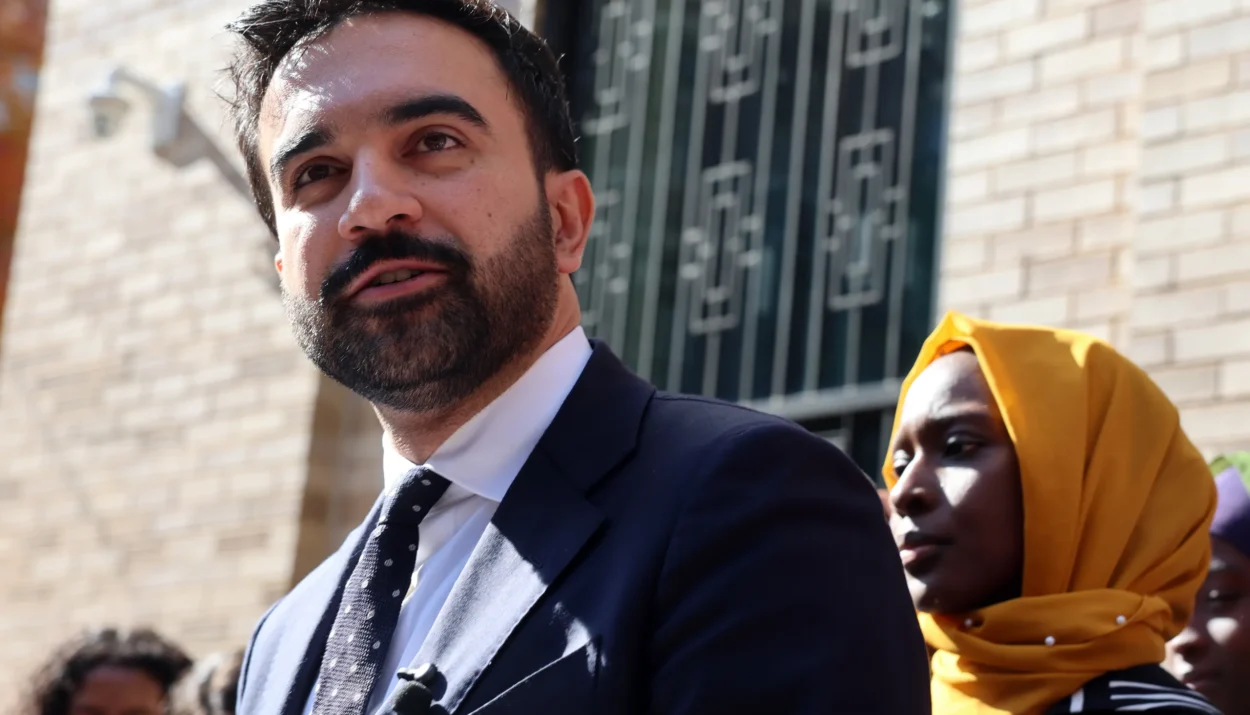

New York City woke up to a new political era on Wednesday as Zohran Mamdani, a 34-year-old democratic socialist and the first Muslim mayor in the city’s history, claimed a decisive victory — defeating former Governor Andrew Cuomo and Republican Curtis Sliwa in one of the most closely watched municipal elections in decades.
His win, part of a Democratic sweep across New York, New Jersey, and Virginia, marks a generational and ideological shift in American politics and sent shockwaves through Wall Street and the crypto market, both wary of his stance on housing, taxation, and corporate power.
A Socialist Shock to Wall Street
Bloomberg called the moment “the end of New York’s hot-commie-summer fears,” referencing Wall Street’s months-long campaign to stop Mamdani. Billionaire hedge fund manager Bill Ackman led an aggressive anti-Mamdani media push, which the new mayor mocked in his victory speech:
“He’s spending more money against me than I would ever tax him.”
But behind the humor lies real anxiety. Mamdani has proposed a 2% income tax on residents earning over $1 million and an 11.5% top corporate tax rate, expected to raise roughly $10 billion annually to fund affordable housing, universal childcare, and public transit.
He also advocates for a rent freeze on stabilized apartments and the creation of city-owned grocery stores and free bus lines — all policies that investors say threaten profit margins across real estate, retail, and transport sectors.
Analysts warn that NYC-based REITs and lenders with exposure to rent-regulated housing could be among the biggest losers. According to a Stocktwits-based analyst note, these four stocks are under particular pressure:
| Ticker | Company | Change Since Election | Notes |
|---|---|---|---|
| ESRT | Empire State Realty Trust | ↓1.2% | Manhattan REIT hit by rent-freeze fears. |
| VNO | Vornado Realty Trust | ↓5.8% | Major office owner; sentiment turned bearish. |
| SLG | SL Green Realty | ↓1.0% | Manhattan’s largest office landlord faces policy risk. |
| FLG | Flagstar Financial | ↓2.4% | Loan exposure to rent-stabilized properties raises concern. |
Mizuho analyst Vikram Malhotra said the “rent-freeze rhetoric could slow rent growth and lower property valuations across the city.”
Wall Street’s Response: From Panic to Pragmatism
While billionaire investors from Goldman Sachs to Citadel voiced caution, others signaled readiness to adapt.
“Markets may overreact to Mamdani’s win in the short term,” said Greg Valliere of AGF Investments. “But long-term, New York’s fundamentals remain strong — Wall Street always adjusts.”
Even Ackman, who previously labeled Mamdani “a threat to capitalism,” urged a “constructive dialogue” after the defeat.
Still, not everyone is optimistic. David Sacks, the White House’s crypto and AI adviser, warned that Mamdani’s rise signals “a communist turn for the Democratic Party,” urging Silicon Valley to align with Trump to avoid “regulatory harassment.”
Several major hedge fund managers told Reuters that the election could accelerate outflows from NYC commercial real estate as firms weigh higher taxes and political uncertainty.
Yet analysts at JPMorgan and GW&K Investment Management argue that Mamdani’s powers are limited by New York’s balanced-budget law and state council oversight, which require legislative approval for major tax changes — tempering fears of abrupt policy shifts.
Crypto Market Reaction: Policy Over Profit
The crypto market wasn’t spared. Bitcoin fell below $100,000 for the first time since June — a 6% drop in 24 hours — while Ether plunged nearly 10%, extending a broader selloff driven by political uncertainty and risk aversion.
Mamdani’s record adds to the concern. As a state lawmaker, he co-sponsored Assembly Bill A7389C, calling for a moratorium on proof-of-work mining using on-site energy due to environmental concerns. He also backed a crypto transaction tax projected to raise $150 million annually for public services.
“When crypto companies collapse, it isn’t the rich who suffer — it’s small investors, often from low-income communities,” Mamdani said in 2023.
Crypto analysts now worry that his progressive taxation and compliance agenda could push blockchain firms to relocate to low-tax states like Texas or Florida, where over 150 companies (worth nearly $1 trillion in combined market cap) have already moved since 2020.
Unlike former Mayor Eric Adams, who embraced Bitcoin and established the Office of Digital Assets, Mamdani has remained cautious. His administration is expected to prioritize consumer protection, environmental compliance, and transparency, possibly expanding NYDFS oversight but also supporting Web3 projects with tangible social utility.
“New York’s regulatory stance often sets the tone nationally,” said Meltem Demirors, chief strategist at CoinShares. “If Mamdani’s policies tighten oversight, other blue states could follow.”
A Political Earthquake with Global Ripples
Mamdani’s win caps off a turbulent 48 hours for markets already rattled by Wall Street CEOs warning of a 10-15% equity correction, Michael Burry’s short positions on Nvidia and Palantir, and the Supreme Court’s pending tariff decision.
Yet amid all the noise, Mamdani struck a unifying tone in his victory speech:
“New York will remain a city built by immigrants, powered by immigrants, and now, led by an immigrant.”
He then turned directly to President Trump:
“Trump, I know you’re watching — turn the volume up.”
Zohran Mamdani’s victory represents more than a local political shift, it’s a symbolic rebuke of corporate dominance and a wake-up call for markets already jittery about valuations, policy risk, and regulation.
For investors, the message is clear: New York’s politics just turned redder, and Wall Street will have to adjust its shade of green.
Related: Market Wrap: Global Selloff Deepens Ahead of Tariff Court Decision